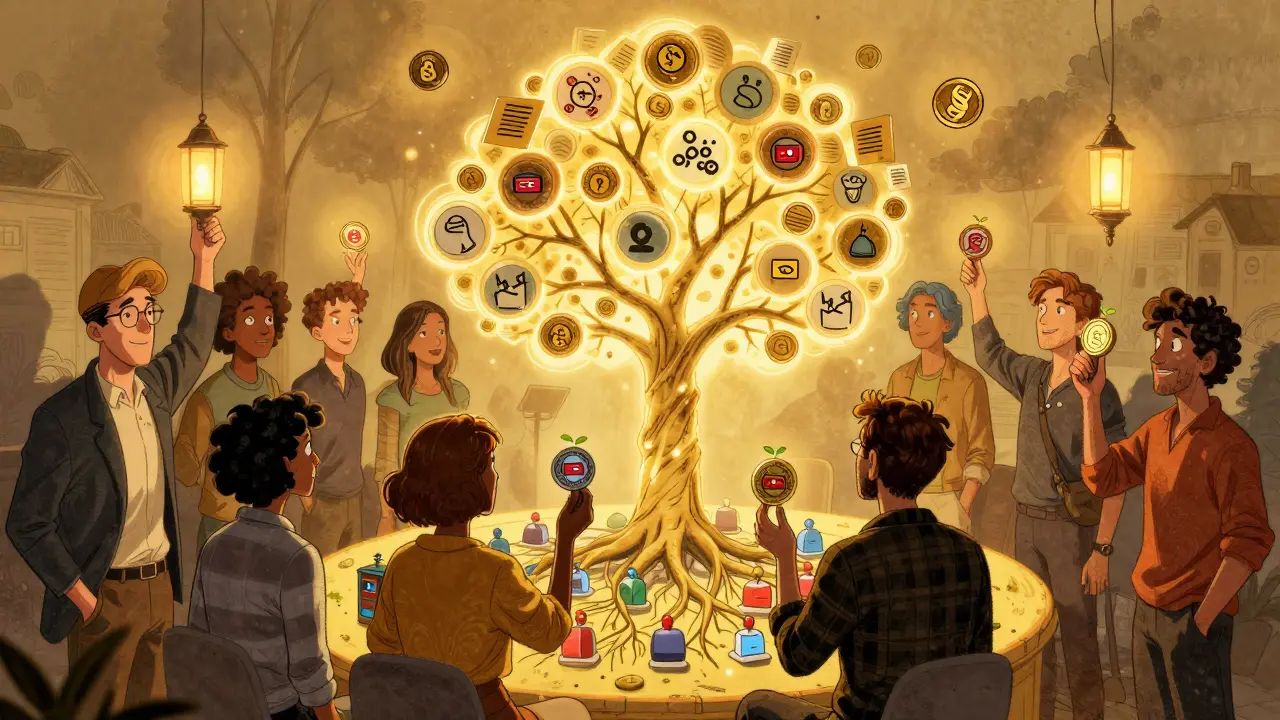
Most online communities today are built on platforms that take more than they give. Facebook, Twitter, Discord, and YouTube profit from your time, your data, and your engagement - but you don’t own any of it. What if the people who build and sustain a community could also share in its value? That’s where social tokens come in.
What Are Social Tokens?
Social tokens are digital assets issued by creators or communities that represent ownership, access, or influence. Unlike Bitcoin or Ethereum, which are general-purpose cryptocurrencies, social tokens are tied directly to a specific group - whether it’s a Discord server of 500 artists, a newsletter with 10,000 subscribers, or a global DAO like Friends With Benefits.
They’re built on blockchains like Ethereum, Polygon, or Solana using smart contracts. These contracts define rules: how many tokens exist, who can earn them, what they unlock, and how they can be traded. The value doesn’t come from speculation alone - it comes from what the token lets you do.
Ownership That Actually Matters
Traditional communities rely on loyalty points or VIP badges. But those are just digital stickers. They don’t have real economic value. Social tokens change that.
When you hold a community’s token, you’re not just a member - you’re a co-owner. If the community grows, your token might rise in value. If the group launches a product, you get a cut. If it hosts an event, you vote on it. This alignment turns passive followers into active participants.
Take Friends With Benefits (FWB), a social club built around NFTs and culture. By late 2021, its treasury held over $10 million - all owned and managed by token holders. Members didn’t just attend parties; they decided where the money went: art grants, meetups, even hiring staff. That’s not a forum. That’s a decentralized company run by its users.
Access That’s Fair and Automated
Imagine being able to join a private Discord channel, attend a live Q&A, or buy limited-edition merch - but only if you hold a certain number of tokens. No more waiting for admin approval. No more fake accounts slipping through.
Smart contracts handle access automatically. If you own 10+ WHALE tokens, you get invited to virtual art galleries. If you hold 100+, you receive a physical sculpture. This tiered system rewards deeper involvement without requiring manual oversight.
A professional association used token-gated Zoom calls to replace paid memberships. Unauthorized access dropped to zero. Paid sign-ups jumped 40% in three months. Why? Because holding the token proved you were invested - not just curious.
Governance That Actually Gets Votes
Most online communities have leaders who make decisions alone. Even in “democratic” groups, voter turnout is often below 10%. Social tokens fix that.
With token-based voting, your influence scales with your stake. At Index Coop, members holding over 1,000 INDEX tokens could propose changes. In 2021, they passed 27 proposals with 78% voter turnout - far higher than any traditional organization.
FWB ran 42 governance votes in a single year. Participation hovered around 35%. That’s not a fluke. It’s because people had skin in the game. They weren’t just clicking “yes” - they were protecting something they owned.
Some communities even use quadratic voting, where buying more votes costs exponentially more. That prevents rich members from dominating decisions. It’s democracy with teeth.
Money That Stays in the Community
Creators used to have two choices: sell ads or charge subscriptions. Both put the platform between you and your audience. Social tokens let you cut out the middleman.
A mid-tier creator with 50,000 followers launched three token tiers: Silver ($50), Gold ($200), and Platinum ($500). Each unlocked different perks - exclusive content, monthly calls, private events. They raised $120,000 in one week. No Shopify store. No Patreon cut. All the money went straight to them.
Even better: when someone resold their token on a marketplace, the creator got 5-10% of the sale automatically. That’s called a royalty. It means you keep earning long after the initial sale.
One fitness community paid trainers 70% in tokens and 30% in cash. Cash expenses dropped 45%. Trainer retention jumped 60%. Why? Because trainers weren’t just employees - they were stakeholders. Their income grew as the community grew.
Discoverability Through Shared Interests
How do you find new communities that match your interests? Social media algorithms show you what’s popular - not what’s meaningful.
Social tokens solve this with what’s called a “social graph.” If you hold a token from one group, platforms can show you other communities where people hold similar tokens. It’s like LinkedIn for Web3.
RabbitHole, a platform that issues NFT badges for completing crypto tasks, connected 15,000 users to relevant communities in six months. Why? Because your token history tells the story of your skills and passions.
Collab.Land, a tool that verifies token ownership across platforms, processes over 5 million verifications every month. That means your wallet is your identity - and your passport to new networks.
Why This Is Different From Loyalty Programs
You’ve seen this before: “Buy 10 coffees, get the 11th free.” But loyalty points expire. They’re locked to one brand. You can’t sell them. You can’t trade them. They don’t appreciate.
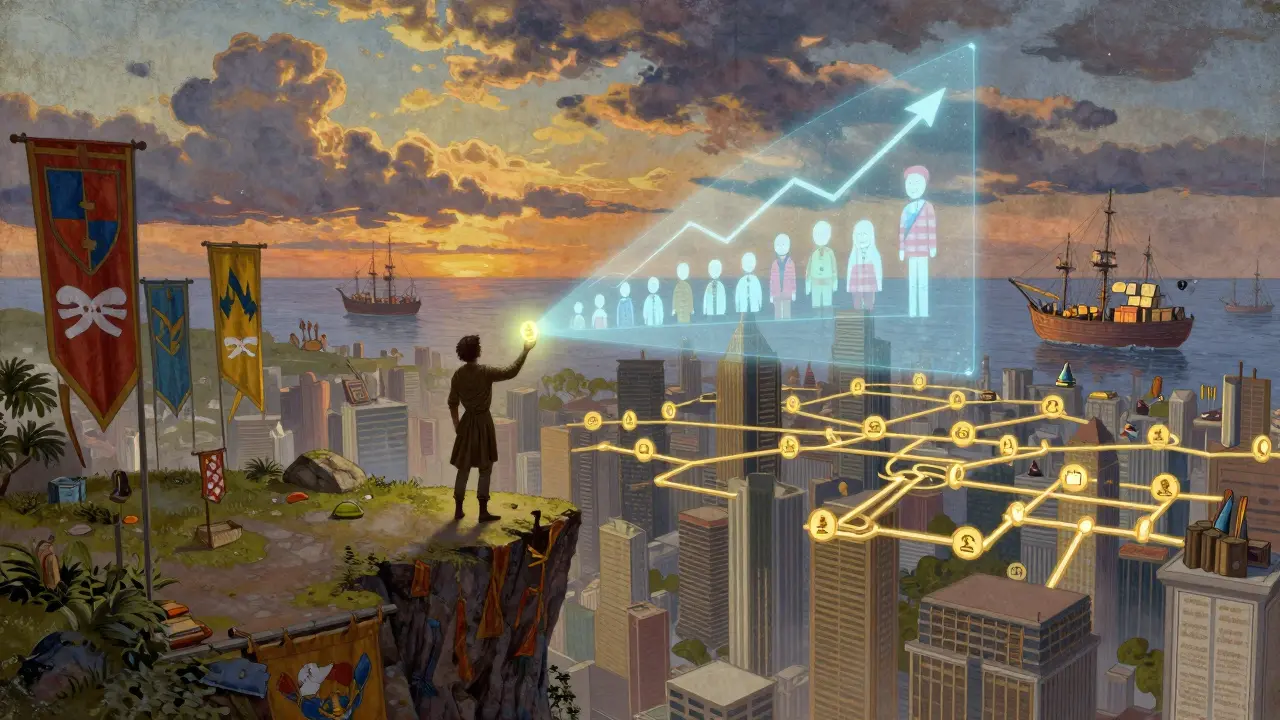
Social tokens are portable. They live in your crypto wallet. You can hold them, trade them, or use them across different platforms. If Twitter shuts down a feature, your tokens still work on Discord. If a creator leaves, the community can keep going - because the value isn’t tied to one person.
Reddit’s Community Points, launched in 2020, were among the first major tests. r/CryptoCurrency users earned Moons for posting and commenting. r/FortNiteBR users got Bricks. These weren’t just badges - they became collectibles with real resale value. The platform didn’t control them. The community did.
Real Risks - And How to Avoid Them
Not every social token succeeds. Some are launched as hype cycles with no real utility. Others collapse when the creator disappears.
The key is structure. Successful tokens have:
- A clear purpose - not just “we’re building a community,” but “we’re building a publishing collective” or “a music label for indie artists.”
- Transparent rules - how tokens are earned, how voting works, how treasury funds are spent.
- Real incentives - access, income, influence - not just FOMO.
- A path to sustainability - whether through sales, royalties, or services.
Don’t launch a token just because it’s trendy. Launch it because you’re ready to share ownership - not just attention.
The Future Is Shared
Web3 isn’t just about money. It’s about rebuilding how we belong to each other.
Social tokens turn communities from temporary groups into lasting institutions. They give creators a way to earn without ads. They give members a way to grow without begging for attention. They let people build something that outlives any single platform.
When you hold a social token, you’re not just a user. You’re a founder. A voter. A contributor. A stakeholder.
The old model - platforms extracting value from users - is crumbling. The new one - communities owning their own value - is just getting started.
Can anyone create a social token?
Yes, but it’s not just about minting tokens. You need a community ready to participate, clear rules for earning and using them, and a reason for people to care. Platforms like Roll, Rally, and Guild make it easier to launch, but success depends on real engagement - not just marketing.
Are social tokens the same as NFTs?
Not exactly. NFTs are unique digital items - like a one-of-a-kind artwork. Social tokens are fungible, meaning each one is identical to the next, like dollars. You can hold 100 of them. You can trade them. They’re designed for participation, not collectibility. But some communities combine both - using NFTs for status and tokens for access.
Do I need cryptocurrency to use social tokens?
Yes - but it’s easier than it sounds. You need a wallet like MetaMask or Phantom, and some crypto to pay for transaction fees (called gas). Many platforms now let you buy tokens with credit cards, and some even offer “walletless” sign-ups using email. The crypto part is the backend - you don’t need to understand it to benefit from it.
Can social tokens replace traditional jobs?
Not entirely - but they’re creating new kinds of work. BanklessDAO hired over 200 contributors in 2022, paying many in community tokens. These weren’t full-time corporate roles - they were part-time gigs for writers, designers, moderators, and developers. For many, it became a primary income stream. It’s not the same as a 9-to-5, but it’s a real alternative.
What happens if a community fails?
If the community dies, the token usually loses value. But because it’s on the blockchain, you still own it - even if no one else wants it. That’s why smart communities focus on sustainability: building real value, not just hype. The best tokens survive because they serve a purpose, not because they’re trendy.