You’ve probably heard the term Blockchain thrown around in tech news or finance podcasts. But what actually holds it together? It’s not just a buzzword; it’s a specific structural design that allows computers to agree on data without trusting each other. Think of it as a digital ledger that everyone can see, but no one can secretly erase or change. This structure is called blockchain network architecture. If you’re trying to understand why Bitcoin takes ten minutes to confirm a payment while Solana claims speed, or why banks prefer different setups than crypto traders, it all comes down to how the network is built.
This guide breaks down the core components, the types of networks, and the trade-offs involved. We’ll skip the heavy math and focus on how these pieces fit together in the real world.
The Core Building Blocks
At its heart, a blockchain isn’t magic. It’s a database with very strict rules. The architecture relies on five main components working in harmony.
- Nodes: These are the individual computers connected to the network. They aren’t all the same. Full nodes store a complete copy of the entire blockchain history. Light nodes only keep the headers, which saves space but reduces their ability to verify transactions independently. Mining or validator nodes do the heavy lifting, processing new transactions and adding them to the chain.
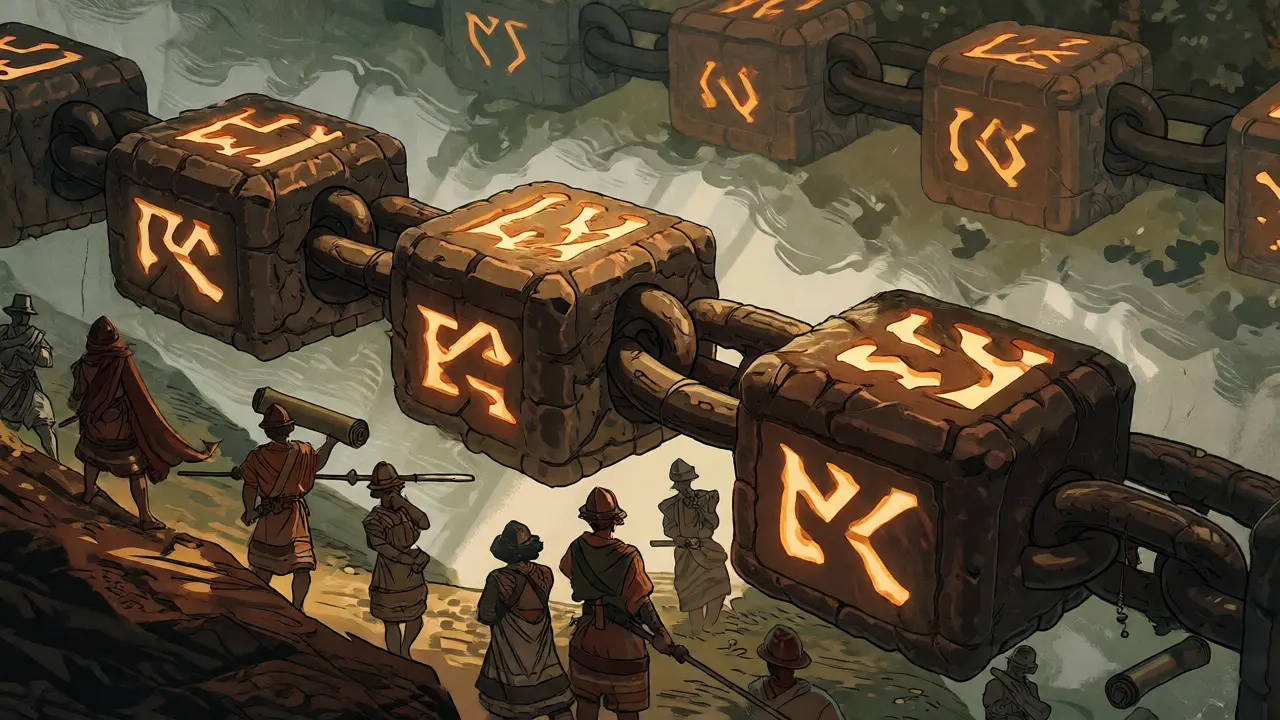
- Blocks: Data is grouped into blocks. Each block contains a list of transactions, a timestamp, and a unique identifier called a hash. Crucially, each block also includes the hash of the previous block. This link is what makes the chain tamper-proof. If someone tries to change an old transaction, the hash changes, breaking the link to every subsequent block.
- Distributed Ledger: Unlike a traditional database stored on one server, a blockchain ledger is replicated across thousands of nodes. Every participant has a copy. This redundancy ensures that if one node goes offline or gets hacked, the data remains safe elsewhere.
- Consensus Mechanisms: How do thousands of strangers agree on the truth? They use algorithms. Proof of Work (PoW), used by Bitcoin, requires miners to solve complex puzzles. Proof of Stake (PoS), now used by Ethereum, requires validators to lock up currency as collateral. These mechanisms prevent double-spending and ensure honesty.
- Cryptographic Functions: Hashing functions like SHA-256 turn data into fixed-length strings. Even a tiny change in input creates a completely different output. This property is essential for security and integrity verification.
Understanding these parts helps you see why scalability is such a big deal. More nodes mean more security, but they also mean slower communication. Fewer nodes might be faster, but they become easier to control.
Public, Private, and Consortium Networks
Not all blockchains are open to everyone. The architecture changes significantly based on who is allowed to participate. There are three primary models, each serving different needs.
| Feature | Public Blockchain | Private Blockchain | Consortium Blockchain |
|---|---|---|---|
| Access | Permissionless (Anyone can join) | Permissioned (Single organization controls access) | Permissioned (Pre-selected group of organizations) |
| Decentralization | High | Low | Moderate |
| Speed (TPS) | Low (e.g., Bitcoin ~7 TPS) | High (e.g., Hyperledger Fabric ~3,500 TPS) | Moderate to High (e.g., R3 Corda ~1,000-5,000 TPS) |
| Transparency | Fully Transparent | Opaque to outsiders | Visible to members only |
| Best For | Cryptocurrencies, NFTs, DeFi | Internal enterprise databases, supply chain tracking within one company | Banking alliances, healthcare data sharing between hospitals |
Bitcoin is the classic example of a public network. You don’t need permission to download the software and start validating transactions. This openness drives high security but limits speed. In contrast, Hyperledger Fabric is designed for businesses. A single entity or a small group manages permissions. Transactions happen much faster because there’s no need to reach global consensus among thousands of anonymous nodes. However, you have to trust the administrators.
Consortium chains sit in the middle. Imagine a group of major banks wanting to settle payments between themselves. They don’t want the public seeing their transactions, but they also don’t want one bank controlling the system. They form a consortium where governance is shared. This balances efficiency with a degree of decentralization.
The Trilemma: Speed, Security, Decentralization
Ethereum founder Vitalik Buterin popularized the concept of the Blockchain Trilemma. The idea is simple but frustrating: you can only optimize two of the three properties at once.
- Decentralization: Many nodes, no central point of failure.
- Security: Hard to attack or manipulate.
- Scalability: Fast transactions and low fees.
Bitcoin chooses decentralization and security. It’s incredibly secure and truly decentralized, but it’s slow. Solana pushes for scalability and decent security but sacrifices some decentralization by requiring high-spec hardware for nodes, which fewer people can afford. Newer modular architectures try to break this trilemma by separating tasks. For instance, Celestia focuses solely on data availability, allowing other layers to handle execution. This specialization lets developers build systems that aim for all three, though it adds complexity.

How Data Moves: From Transaction to Block
Let’s walk through what happens when you send cryptocurrency. It’s not instantaneous.
- Broadcast: You sign a transaction with your private key and broadcast it to the network. It sits in a "mempool" (memory pool) waiting for validation.
- Selection: Miners or validators pick transactions from the mempool. On public chains, they often prioritize those with higher fees.
- Validation: The chosen transactions are bundled into a candidate block. The miner solves the cryptographic puzzle (in PoW) or proposes the block (in PoS).
- Propagation: Once solved, the block is broadcast to other nodes. They check the work and the validity of transactions.
- Finality: If valid, nodes add the block to their local copy of the chain. In Bitcoin, one confirmation isn’t final; six confirmations are generally considered safe. In PoS chains, finality can be probabilistic or deterministic depending on the protocol.
This process highlights why gas fees exist. When the mempool is crowded, users bid higher fees to get their transactions processed first. Understanding this flow helps explain why network congestion spikes during market volatility.
Real-World Implementation Challenges
Building on top of this architecture isn’t easy. Developers face several hurdles.
Storage Requirements: Running a full node is resource-intensive. An Ethereum archive node stores over 15TB of data. Bitcoin full nodes require around 500GB. This barrier prevents everyday users from running nodes, pushing toward light clients or centralized services.
Smart Contract Security: Code deployed on a blockchain is immutable. If there’s a bug, you can’t just patch it easily. In 2023 alone, exploits cost $1.7 billion. Common vulnerabilities include reentrancy attacks and integer overflows. Tools like Hardhat and Truffle Suite help developers test contracts before deployment, but risks remain.
Interoperability: Blockchains don’t naturally talk to each other. Moving assets from Ethereum to Polygon requires bridges. These bridges are frequent targets for hackers, accounting for 67% of exploit value in recent years. Cross-chain messaging protocols are being developed to fix this, but they introduce new trust assumptions.

What’s Next for Architecture?
The industry is moving toward modularity. Instead of one monolithic chain doing everything, specialized layers emerge. Layer 1 handles security and consensus. Layer 2 solutions like rollups handle execution and scaling. Data availability layers like Celestia store raw data cheaply. This separation allows for greater flexibility. Enterprises are also adopting multi-chain strategies. Gartner predicts that by 2027, 60% of enterprise implementations will use multiple chains rather than relying on a single platform.
Regulation plays a role too. The EU’s MiCA regulation provides clear rules for crypto-assets, encouraging institutional adoption. In the US, the landscape is still fragmented, affecting how companies choose their architecture. Compliance-friendly private chains may see growth in regulated sectors like finance and healthcare.
Key Takeaways
- Architecture dictates performance: Public chains prioritize security and decentralization, leading to lower speeds. Private chains prioritize speed and control, sacrificing true decentralization.
- Consensus is key: Whether using Proof of Work or Proof of Stake, the method determines energy usage, transaction speed, and security model.
- Modularity is the future: Separating execution, settlement, and data availability allows networks to scale without compromising security.
- Trade-offs are inevitable: The Blockchain Trilemma means you must choose which two attributes matter most for your use case.
What is the difference between a node and a miner?
A node is any computer that participates in the network by storing and forwarding blockchain data. A miner (or validator) is a specific type of node that actively processes transactions and creates new blocks. All miners are nodes, but not all nodes are miners. Full nodes verify the chain's integrity, while miners compete to add the next block.
Why are public blockchains slower than private ones?
Public blockchains require consensus among thousands of independent, anonymous nodes spread globally. This communication overhead slows down transaction processing. Private blockchains have fewer, known participants who can communicate quickly, allowing for much higher throughput. Additionally, public chains often use resource-intensive consensus mechanisms like Proof of Work to ensure security against unknown attackers.
Can I change a transaction after it’s on the blockchain?
No, once a transaction is confirmed and included in a block, it is immutable. To reverse it, you typically have to create a new transaction that effectively cancels out the original one. In rare cases, a hard fork can rewrite history, but this requires community agreement and splits the network, which is disruptive and uncommon.
What is the Blockchain Trilemma?
The Blockchain Trilemma states that a blockchain system can only optimize two of three properties-decentralization, security, and scalability-at the expense of the third. For example, Bitcoin optimizes for security and decentralization but lacks scalability. Solana optimizes for scalability and security but sacrifices some decentralization due to high hardware requirements for nodes.
Do I need to run a full node to use a blockchain?
No, most users interact with blockchains through wallets or exchanges that act as intermediaries. Running a full node gives you maximum security and privacy because you verify transactions yourself without trusting a third party. However, it requires significant storage and bandwidth. Light nodes offer a compromise, verifying headers but relying on full nodes for transaction data.