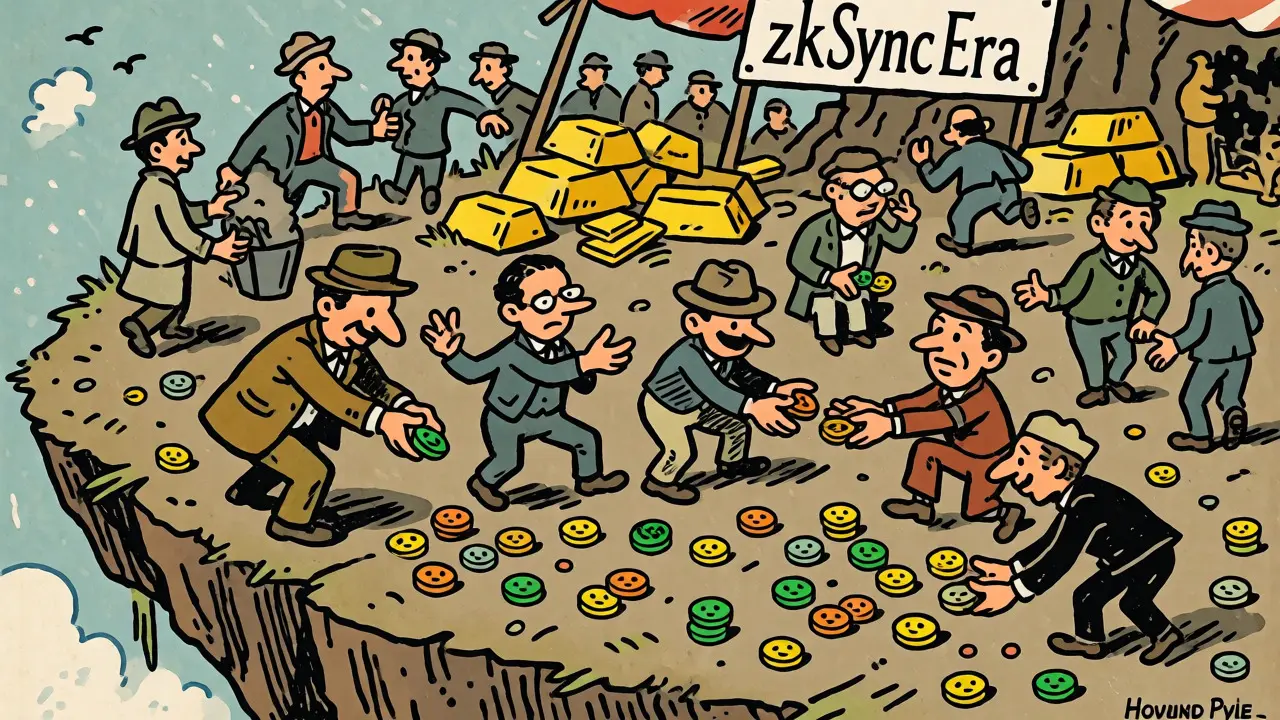
You’ve probably heard the hype around DerpDEX is a decentralized cryptocurrency exchange operating on the zkSync Era Layer 2 network, specifically designed for concentrated liquidity and meme coin creation. It promises near-zero gas fees and a one-click tool to launch your own meme token. But does it actually deliver, or is it just another early-stage project with more roadmap than reality? If you are trading on Ethereum mainnet, you know the pain of $50 gas fees eating into small trades. DerpDEX claims to solve this by leveraging zkSync’s ZK-Rollup technology, offering transaction costs averaging just $0.0003. That sounds great on paper, but as of late 2024, the platform hosts only two trading pairs and has minimal liquidity depth. This review breaks down exactly what DerpDEX offers, where it falls short, and whether it fits your specific trading needs in the current market landscape.
The Core Proposition: Why zkSync?
DerpDEX isn’t trying to be everything to everyone. It is a niche player focused exclusively on the zkSync Era ecosystem. For those unfamiliar, zkSync is a Layer 2 scaling solution that batches transactions off-chain before settling them on Ethereum. This architecture allows DerpDEX to offer significantly lower fees compared to Ethereum-native exchanges like Uniswap. According to L2Beat data from September 2024, while Ethereum mainnet swaps might cost over $1.00, DerpDEX transactions hover around fractions of a cent. This makes it attractive for high-frequency retail traders who would otherwise lose money on gas alone.
The platform uses a concentrated liquidity automated market maker (AMM) model, similar to Uniswap V3. This means liquidity providers can choose specific price ranges to supply funds, rather than spreading capital across all possible prices. In theory, this increases capital efficiency. However, because DerpDEX is still in its infancy, the actual liquidity depth is shallow. Blockchain researcher Maria Chen noted in August 2024 that average pair liquidity sits below $500,000. Compare that to Uniswap’s $15 million average per major pair, and you see the gap. If you try to trade large amounts, say over $1,000, you will likely experience significant slippage-often exceeding 5%. So, while the fees are low, the execution quality suffers due to thin order books.
Key Features and The DERP Token
The heart of DerpDEX is its utility token, DERP, which serves as the governance and fee-discount mechanism within the ecosystem. Launched during a Q4 2023 token generation event, DERP has a maximum supply of 1 billion tokens. Holding DERP grants you up to a 50% discount on trading fees if you are among the top holders. Beyond discounts, the token powers a "Trade to Earn" program where users receive rewards proportional to their trading volume. This incentivizes activity, but it also raises questions about sustainability. Are people trading because they want to buy assets, or just to farm tokens?
One standout feature is the "one-click-to-launch-meme" tool. This allows users to create and list new meme tokens directly through the interface without needing complex smart contract deployments. For creators, this lowers the barrier to entry significantly. There are no listing fees, unlike Uniswap’s community fee structure. User feedback highlights this feature as a major positive; 32 out of 87 reviews on Magic Store specifically praised the intuitive meme creation tool. However, success depends entirely on marketing. As one Reddit user noted, launching a coin is easy, but sustaining liquidity beyond 48 hours is hard when the pool is shallow.
Liquidity and Trading Experience
Let’s look at the numbers. As of October 2024, DerpDEX lists only one coin and two trading pairs according to Coingecko. This is a stark contrast to established platforms. Uniswap reported over 1,000 trading pairs in the same period. With such limited options, DerpDEX functions less as a general-purpose exchange and more as a specialized hub for specific asset classes, primarily memecoins native to the zkSync environment. You won’t find stablecoin pairs or blue-chip altcoins here yet.
The trading interface is straightforward but lacks advanced tools. There are no limit orders, stop-losses, or margin trading features currently available. You are essentially swapping spot assets. For casual users, this simplicity is a benefit. For professional traders, it’s a dealbreaker. The lack of depth means that even moderate sell-offs can crash the price temporarily. Users report frequent transaction failures during periods of network congestion, requiring manual adjustments to gas multipliers-a step not always obvious in the UI.
Comparison with Major Competitors
To understand DerpDEX’s place in the market, we need to compare it against the giants. While it shares the concentrated liquidity mechanic with Uniswap V3, its operational scope is vastly different. PancakeSwap dominates BNB Chain with mature farming mechanisms, while dYdX leads in derivatives. DerpDEX occupies a tiny slice of the zkSync pie, holding less than 2% of the combined DEX volume on that network.
| Feature | DerpDEX | Uniswap V3 | PancakeSwap |
|---|---|---|---|
| Network | zkSync Era Only | Ethereum, Arbitrum, Polygon, etc. | BNB Chain, Ethereum, others |
| Avg. Swap Fee | $0.0003 (Gas) + 0.3% | $1.20+ (Gas) + 0.3% | $0.05 (Gas) + 0.2% |
| Trading Pairs | ~2 | 1,000+ | 500+ |
| Avg. Liquidity/Pair | <$500k | $15M+ | $5M+ |
| Meme Launch Tool | Yes (One-Click) | No (Manual Deploy) | Yes (Creator Hub) |
| Smart Contract Audit | Unaudited (Oct 2024) | Audited | Audited |
This table highlights the trade-off: DerpDEX wins on cost and ease of meme creation but loses heavily on liquidity, variety, and security assurance. The fact that its smart contracts were unaudited as of October 2024 is a critical risk factor. While zkSync itself is secure, the application layer carries its own risks. Without an audit, there is always a potential for bugs or vulnerabilities that could affect user funds.
User Feedback and Community Sentiment
Community sentiment is mixed. On Trustpilot, DerpDEX holds a low 2.8/5 rating based on verified reviews. Common complaints include poor customer support response times, averaging 72 hours via email. Given that crypto moves fast, waiting three days for a reply when your transaction is stuck feels like an eternity. The Telegram group, with roughly 1,200 members, is active but small. Early adopters who participated in the Genesis Mining program report high APYs (300-500%) during the initial launch phase, but these returns have normalized.
Positive feedback often comes from users experimenting with meme coins. They appreciate the low barrier to entry. Negative feedback focuses on technical friction. One recurring issue is front-running attacks on small trades. Experienced users recommend setting low slippage tolerance (0.1-0.3%) to mitigate this, but doing so increases the chance of failed transactions. It’s a balancing act that requires some trial and error.

Risks and Future Outlook
The biggest concern for DerpDEX investors is token concentration. Wallet analysis shows that 62% of the DERP supply is held by the top 10 wallets. This creates a risk of manipulation; if a few whales decide to dump, the price could crater quickly. Additionally, the platform faces regulatory uncertainty. Unlike many competitors, DerpDEX does not geo-block US users. With the SEC tightening regulations on DeFi, this could lead to future compliance issues.
Looking ahead, the team plans to launch the Derp Chain Testnet in late 2024, aiming to transition from a simple DEX to a broader DeFi ecosystem. They also plan a mobile app with multi-language support. If they execute this roadmap well, they could capture a larger share of the zkSync market. Analysts suggest they need 5,000 daily active users to remain viable long-term, a 171% increase from current levels. It’s an ambitious target for a platform with only two trading pairs today.
Who Should Use DerpDEX?
DerpDEX is not for everyone. Skip it if you are a professional trader needing deep liquidity, advanced order types, or a wide selection of assets. It is also risky for large capital allocations due to the unaudited codebase and thin pools.
Consider DerpDEX if:
- You are already active on zkSync Era and want to avoid bridging back to other chains.
- You are a meme coin enthusiast looking to launch or trade micro-cap tokens with minimal gas costs.
- You are willing to tolerate higher slippage and occasional transaction failures in exchange for cheap access.
- You are comfortable with early-stage projects and the associated volatility of the DERP token.
Is DerpDEX safe to use?
DerpDEX operates on the secure zkSync Era network, but its own smart contracts were unaudited as of October 2024. This poses a technical risk. Additionally, the high concentration of DERP tokens in a few wallets introduces market manipulation risks. Users should exercise caution and start with small amounts.
What are the fees on DerpDEX?
The standard trading fee is 0.3% per swap. Gas fees are extremely low, averaging around $0.0003 per transaction due to zkSync's Layer 2 architecture. Holding DERP tokens can provide up to a 50% discount on trading fees for top holders.
Can I trade Bitcoin or Ethereum on DerpDEX?
As of late 2024, DerpDEX has very limited listings, primarily focusing on specific zkSync-native assets and meme coins. It does not currently support major pairs like BTC/USDT or ETH/USDC with deep liquidity. Check the live interface for the most current pair availability.
How do I create a meme coin on DerpDEX?
Users can utilize the "one-click-to-launch-meme" feature directly in the DerpDEX interface. This tool simplifies the deployment process, allowing users to define token parameters and list the asset without writing custom smart contracts. No listing fees are charged.
Does DerpDEX have a mobile app?
A mobile application was in development as of Q2 2024, with closed beta testing ongoing. A full public release with multi-language support was targeted for later in 2024, but users should check official channels for the latest status updates.