
When people talk about blockchain, they often mean the same thing as DLT. But that’s not right. Think of it like this: all blockchains are DLT, but not all DLTs are blockchains. If you’re trying to understand how modern digital ledgers work-whether you’re evaluating tech for your business, curious about crypto, or just tired of hearing the terms used interchangeably-you need to know the difference.
What Exactly Is Distributed Ledger Technology (DLT)?
Distributed Ledger Technology, or DLT, is simply a way to store data across multiple computers at the same time. No single company or person controls it. Every participant in the network holds a copy of the same record, and updates happen simultaneously across all of them. It’s like a shared Google Sheet that no one can delete or secretly edit-only approved changes get added, and everyone sees them right away.
This isn’t new. BitTorrent, launched in 2001, used a form of DLT to share files without a central server. Today, DLT includes everything from blockchain to Hashgraph, IOTA’s Tangle, and enterprise platforms like R3 Corda and Hyperledger Fabric. The core idea? Trust without intermediaries. You don’t need a bank, a notary, or a government agency to verify a transaction. The system itself does it.
DLT doesn’t require blocks. It doesn’t even need a chain. Data can be organized in graphs, trees, or other structures. Some DLTs don’t use tokens. Some don’t even need mining. That’s the big shift from the crypto world: DLT is flexible. It’s designed for real-world use cases-supply chains, land registries, medical records-where speed, privacy, and control matter more than public transparency.
What Is Blockchain, Really?
Blockchain is one type of DLT. It’s the most famous one, thanks to Bitcoin. Created in 2008 by Satoshi Nakamoto, blockchain organizes data into blocks. Each block holds a batch of transactions, a timestamp, and a cryptographic hash of the previous block. That hash links everything together in a chain. If you change even one character in an old block, the entire chain breaks. That’s what makes it immutable.
Blockchain relies on consensus mechanisms to agree on what’s true. Bitcoin uses Proof-of-Work-miners compete to solve complex math puzzles. Ethereum used to do the same, but after its 2022 Merge upgrade, it switched to Proof-of-Stake, where validators are chosen based on how much cryptocurrency they “stake” as collateral. These mechanisms ensure security, but they come with trade-offs.
Public blockchains like Bitcoin and Ethereum are permissionless. Anyone can join. They’re designed for trustless environments-where participants don’t know or trust each other. That’s why they’re perfect for cryptocurrencies. But that same openness makes them slow. Bitcoin handles about 7 transactions per second. Ethereum does 30 before upgrades. For a bank processing thousands of payments a minute? That’s not enough.
Key Differences Between DLT and Blockchain
The confusion between DLT and blockchain comes down to structure and assumptions. Here’s how they really differ:
- Data structure: Blockchain = blocks in a chain. DLT = can be anything: graph, tree, ledger. IOTA’s Tangle, for example, uses a directed acyclic graph (DAG), not blocks.
- Consensus: Blockchain often uses Proof-of-Work or Proof-of-Stake. DLT can use Practical Byzantine Fault Tolerance (PBFT), which is faster and uses far less energy.
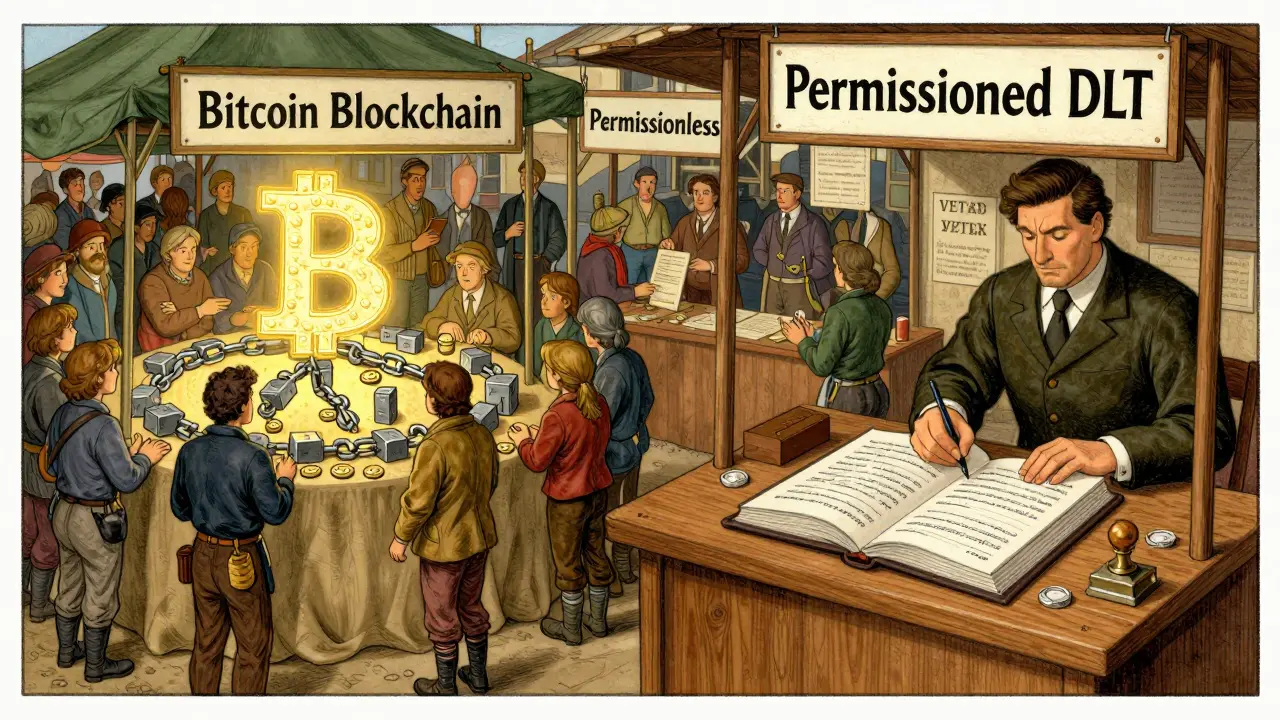
- Permissioning: Most blockchains are public and open. Most enterprise DLTs are private or permissioned-only approved organizations can join.
- Speed: Bitcoin: 7 TPS. Ethereum: 30 TPS. Hyperledger Fabric: up to 4,500 TPS. Hedera Hashgraph: over 10,000 TPS.
- Energy use: Bitcoin consumes about 1,544 kWh per transaction. PBFT-based DLTs use 99% less energy.
- Tokens: Public blockchains need tokens (like ETH or BTC) to pay for transactions. Enterprise DLTs like Corda or Fabric often run without any tokens at all.
Let’s say you’re a bank trying to settle cross-border payments. You don’t need a public ledger where anyone can see your transactions. You need speed, privacy, and compliance. A permissioned DLT like R3 Corda makes sense. Now, if you’re building a global cryptocurrency, you need openness, censorship resistance, and decentralization. That’s where blockchain shines.
Real-World Use Cases: Where Each One Wins
DLT and blockchain aren’t competing-they’re suited for different jobs.
Enterprise DLT wins in:
- Supply chains: Maersk’s TradeLens used Hyperledger Fabric to track shipping containers across 98 companies. No public blockchain needed-just secure, private data sharing.
- Health records: Hospitals in New Zealand and Australia are testing DLT to let patients control who accesses their medical data. Privacy is critical.
- Central bank digital currencies (CBDCs): Over 85% of CBDC projects, including those by the European Central Bank, use non-blockchain DLT because they need to process millions of transactions daily.
- Trade finance: BBVA’s blockchain-based trade finance system reduced document processing time by 80%, but it took 18 months to build. A Corda-based version did the same in 12 months.
Blockchain wins in:
- Cryptocurrencies: Bitcoin, Ethereum, Solana-all rely on blockchain’s public, trustless design.
- Decentralized apps (dApps): DeFi platforms, NFT marketplaces, and DAOs need open access and censorship resistance.
- Public audits: If you want anyone to verify records-like voting data or carbon credits-blockchain’s immutability and transparency are unmatched.
Here’s the reality: 92% of enterprise DLT projects still use blockchain architecture, according to Gartner. But that’s changing. Deloitte found that 65% of banking pilots now use non-blockchain DLTs because they’re faster, cheaper, and easier to regulate.
Why the Confusion? History and Hype
Blockchain got all the attention because Bitcoin made headlines. Media, investors, and startups latched onto the word. “Blockchain” became a buzzword for anything digital and decentralized. But behind the scenes, enterprise tech teams were quietly building better alternatives.
Analyst Avivah Litan from Gartner put it well: “Blockchain provides additional functionality beyond traditional DLTs, particularly in creating trust among untrusted parties.” That’s the key. Blockchain was built for strangers. DLT was built for partners.
Some experts, like Dr. Leemon Baird of Hedera Hashgraph, argue that blockchain’s chain structure is outdated. “The future belongs to non-chain DLTs that solve the scalability trilemma,” he says. Others, like MIT’s David Suter, believe all DLTs will eventually evolve toward blockchain-like principles.
Truth is, the lines are blurring. R3’s Corda 5, released in March 2023, now lets users add blockchain-style chaining where needed. Ethereum’s Merge cut energy use by 99.95%. Hybrid systems are becoming the norm.

Which One Should You Use?
Here’s how to decide:
- Do you need public access? If yes → blockchain. If no → DLT.
- How fast do transactions need to settle? Under 1 second? Use Hashgraph or Corda. Minutes? Blockchain might work.
- Are you dealing with sensitive data? Banks, governments, hospitals? Permissioned DLT gives you control and compliance.
- Do you need a native token? If you’re building a crypto app → yes. If you’re automating contracts between known partners → no.
- What’s your budget for development? Blockchain has better tools (Truffle, Hardhat, Remix) and bigger developer communities. DLT platforms like Hyperledger have steeper learning curves but better enterprise support.
Most businesses don’t need a public blockchain. They need a secure, efficient way to share data with trusted partners. That’s DLT’s sweet spot.
What’s Next? The Hybrid Future
The World Economic Forum predicts that by 2027, 10% of global GDP will be stored on DLT or blockchain platforms. But that doesn’t mean every dollar will be on Bitcoin.
More companies are building hybrid systems: using blockchain for public verification and DLT for internal operations. Imagine a pharmaceutical company using a private DLT to track drug shipments between warehouses, then publishing a hash of the entire log on a public blockchain to prove authenticity to regulators.
The technology isn’t about choosing one over the other. It’s about picking the right tool for the job. DLT is the toolbox. Blockchain is one of the tools inside it.
By 2025, enterprises will stop asking, “Should we use blockchain?” and start asking, “Which DLT architecture fits our needs?” That’s the real evolution.
Is blockchain the same as DLT?
No. Blockchain is a type of DLT, but not all DLTs are blockchains. DLT is the broader category-it includes any decentralized ledger system. Blockchain specifically organizes data into blocks linked by cryptographic hashes. Other DLTs, like Hashgraph or IOTA’s Tangle, use different structures and don’t require blocks.
Why do people confuse DLT and blockchain?
Because blockchain was the first widely known DLT, thanks to Bitcoin. Media, investors, and marketers used “blockchain” as a catch-all term for any decentralized technology. That stuck. But in enterprise tech circles, experts have always known the difference. DLT is the umbrella; blockchain is one under it.
Which is more secure: DLT or blockchain?
It depends on the setup. Public blockchains like Bitcoin are highly secure because they rely on thousands of anonymous nodes and energy-intensive consensus. But that doesn’t mean they’re better for every use case. Permissioned DLTs like Hyperledger Fabric are secure too-they just assume participants are known and vetted. In enterprise settings, that’s actually safer. You don’t want random strangers validating your supply chain data.
Can DLT work without tokens?
Yes, and many enterprise DLTs do. Platforms like R3 Corda and Hyperledger Fabric were designed for businesses that don’t want or need cryptocurrencies. Transactions are authorized by identity and permission, not by paying gas fees. Tokens are useful for public networks to incentivize participation-but not required for private, trusted networks.
Is blockchain dead because of DLT?
No. Blockchain is alive and well-just in its lane. It dominates public, trustless systems like cryptocurrency, DeFi, and NFTs. DLT dominates enterprise, private, high-speed applications like banking, supply chains, and government records. They’re not replacing each other. They’re serving different needs. The future isn’t one replacing the other-it’s both working together.
What’s the fastest DLT technology today?
Hedera Hashgraph leads in speed, handling over 10,000 transactions per second with finality in under 3 seconds. That’s 300 times faster than Ethereum and 1,400 times faster than Bitcoin. For applications needing real-time settlement-like stock trading or IoT networks-that’s a game-changer. But speed isn’t everything. Security, decentralization, and regulatory compliance matter too.
Which is better for beginners: DLT or blockchain?
For learning, blockchain is easier. There are more tutorials, free tools (like MetaMask and Remix), and a huge community. You can deploy a smart contract on Ethereum’s testnet in a weekend. DLT platforms like Hyperledger Fabric require complex network setup, identity management, and enterprise-grade knowledge. But if you’re building for a company, DLT skills are more valuable long-term.