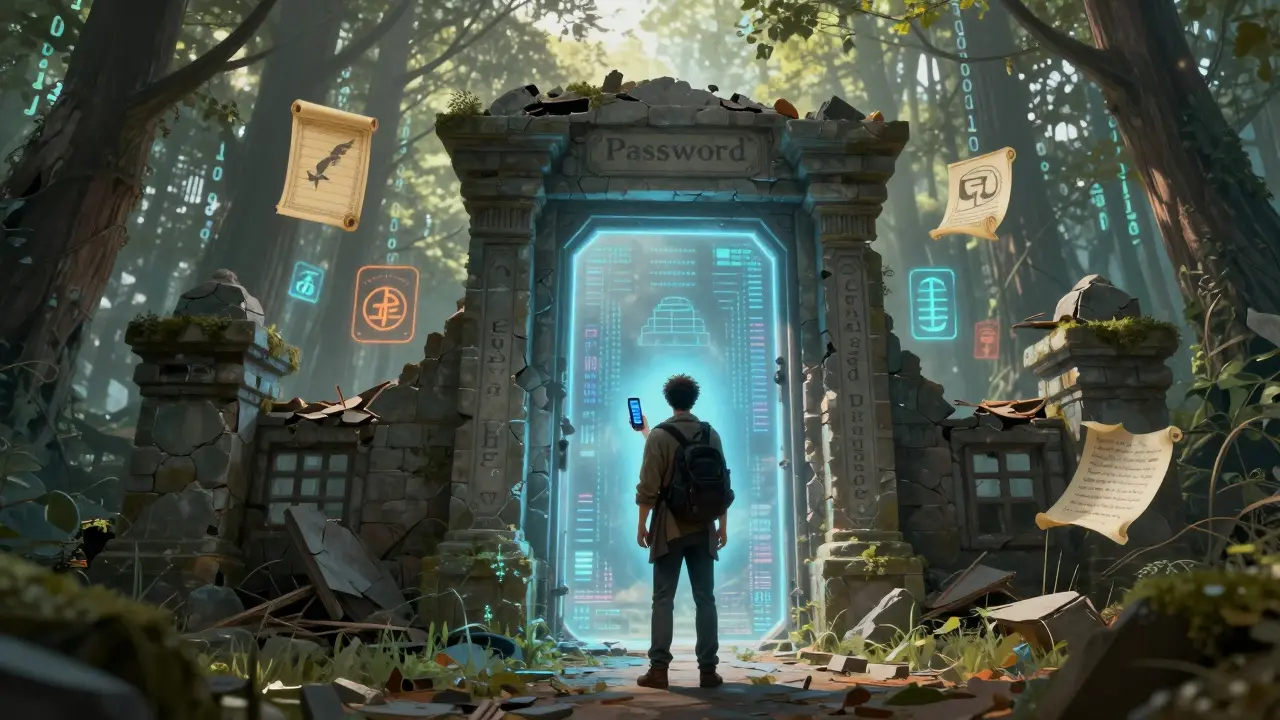
Imagine logging into your bank, hospital, or government portal without typing a password. No username. No security questions. Just a quick scan of your phone - and you’re in. That’s not science fiction. By 2026, this is becoming real for millions of people, thanks to decentralized identity.
What Exactly Is Decentralized Identity?
Decentralized identity flips the script on how we prove who we are online. Instead of relying on companies like Google, Facebook, or your bank to hold your personal data, you own it. Your identity lives in a digital wallet on your phone - encrypted, controlled by you, and shared only when you say so. It works using two key building blocks: Decentralized Identifiers (DIDs) and Verifiable Credentials. DIDs are unique, blockchain-based addresses that don’t need a central authority to exist. Verifiable Credentials are digital versions of your driver’s license, diploma, or passport - but they’re signed with cryptography so no one can fake them. The W3C standardized these in 2024, and now over 67% of Fortune 500 companies are testing them. Why? Because traditional systems are broken. In 2024, 81% of data breaches started with stolen passwords. Decentralized identity removes passwords entirely. No more breached databases = no more mass identity theft.How It Works: No Middlemen, Just Math
Here’s how it plays out in real life. Let’s say you want to prove you’re over 21 to buy alcohol online. With a traditional system, you’d upload a scan of your ID. The website stores it. Someone hacks them. Your ID is out there forever. With decentralized identity, you open your digital wallet. You select the credential: “Age over 21.” You tap approve. Your phone sends a cryptographic proof - not your actual ID - to the store. The system checks: Is this credential signed by a trusted issuer? Is it tampered with? Is it still valid? All in under two seconds. No one sees your birthdate. No one stores your driver’s license number. You didn’t give them anything to steal. This is called selective disclosure. And it cuts data exposure by 76%, according to MIT’s Digital Identity Lab. That’s not a small win. It’s a revolution.Where It’s Already Making a Difference
You won’t see this on TikTok yet. But in healthcare, finance, and government - it’s already saving time, money, and lives. In hospitals, patient records used to take days to transfer between clinics. With decentralized identity, patients grant access to specific parts of their medical history - allergies, medications, lab results - in minutes. No fax machines. No paperwork. Just a secure digital handshake. In banking, KYC (Know Your Customer) checks used to take five days. Now, with verifiable credentials from government-issued IDs, customers get approved in 90 minutes. Javelin Strategy found fraud drops by 92% when systems use cryptographic verification instead of documents. Singapore launched its Trust Framework v3.0 in April 2025. The EU’s Digital Identity Wallet became mandatory in January 2025. California is finalizing its own Decentralized Identity Act. Governments aren’t just experimenting - they’re mandating it.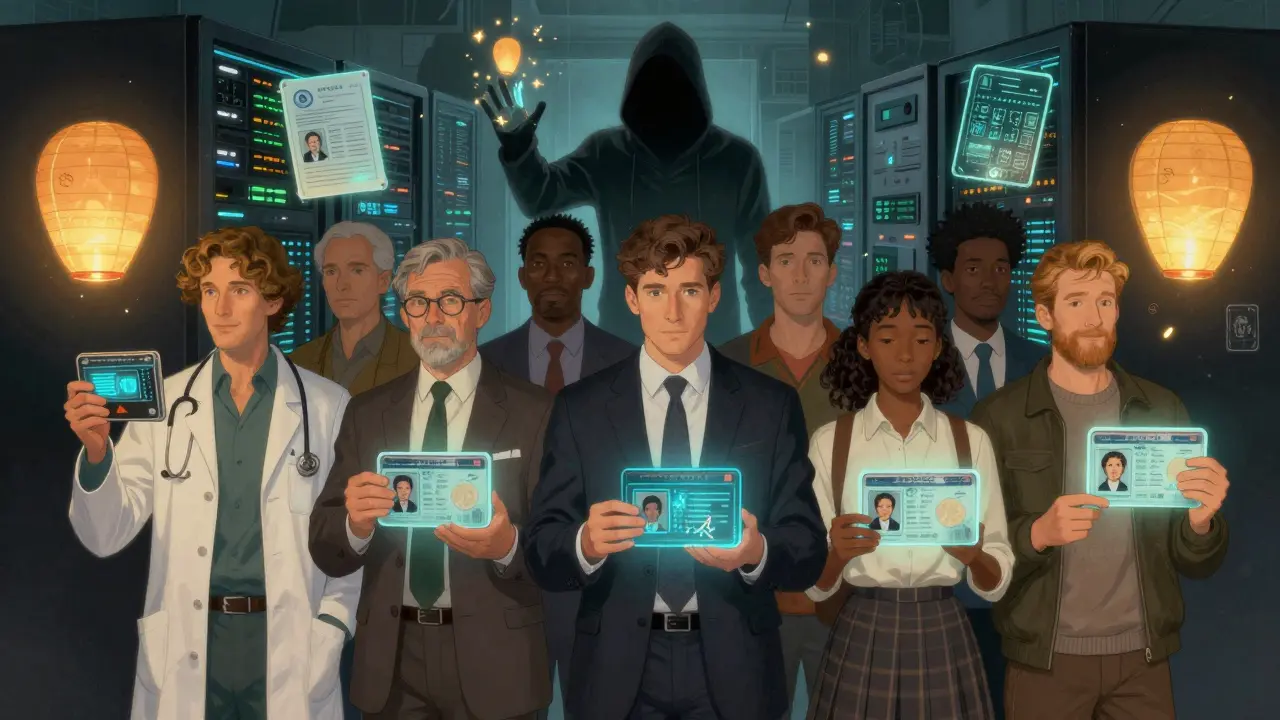
Who’s Building This? The Key Players
This isn’t a wild west. There are clear leaders:- Microsoft Entra Verified ID - Holds 32% of the market. Integrated into Azure and Windows 12 (coming October 2025).
- IBM Verify Decentralized ID - 24% share. Used by banks and insurers for secure KYC.
- Spruce ID - 18% share. Focused on developer tools and open standards.
The Downsides: It’s Not Perfect Yet
If it sounds too good to be true, that’s because it’s still early. There are real problems. First, interoperability. There are 47 different DID methods. Not all talk to each other. A credential from Microsoft might not work with IBM’s system. The Universal Resolver v2, launched in April 2025, helps - but it’s not a full fix. Second, recovery. If you lose your phone and don’t have a backup key? You’re locked out. Forever. That’s not a glitch - it’s by design. But Carnegie Mellon’s Dr. Lorrie Cranor warns this could create a new kind of digital exclusion. That’s why 68% of implementations now use “social recovery” - letting trusted friends or family help you regain access. Third, cost and complexity. Integrating decentralized identity into old HR or billing systems takes 6 months, not 3. One CTO reported $375,000 in extra costs just to connect it to legacy software. Training staff costs $18,500 per employee on average. And while enterprises love it - 83% report higher user trust - consumers? Only 28% understand what it is. That’s the biggest hurdle.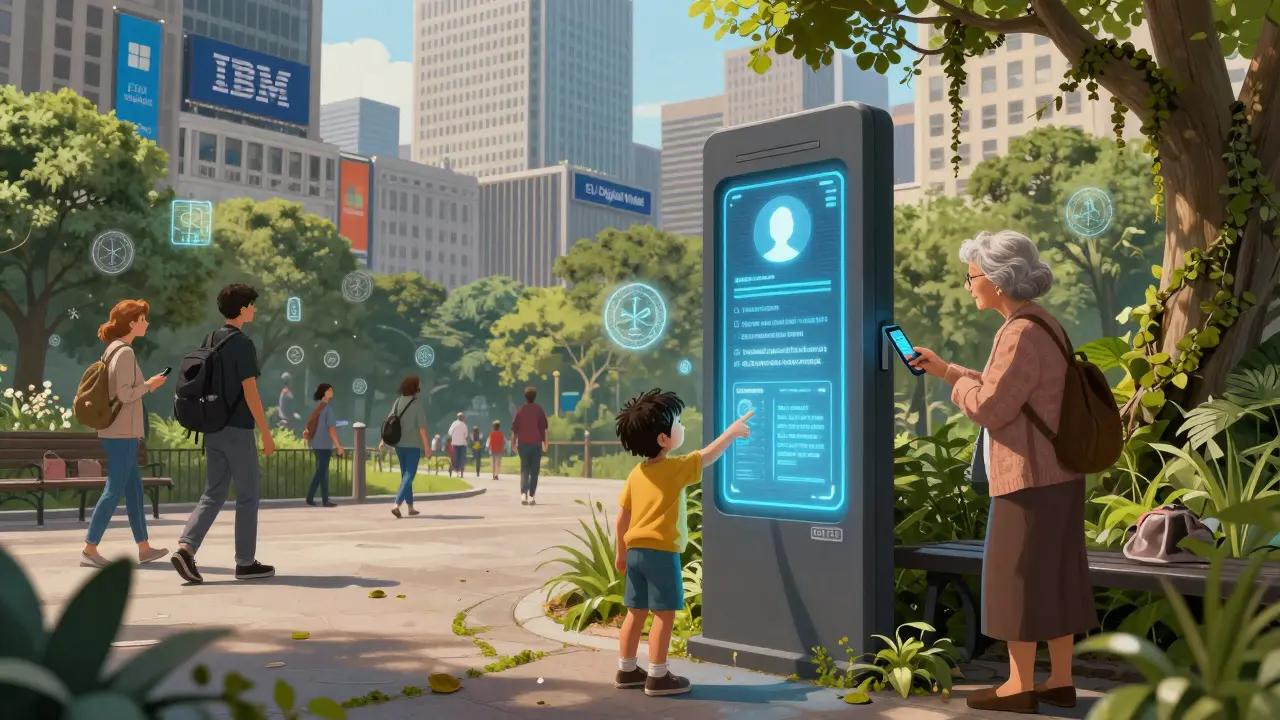
What’s Next? The Roadmap to 2027
The future isn’t just decentralized identity. It’s AI-powered decentralized identity. By 2027, 73% of identity professionals expect AI to analyze behavior patterns - like how you hold your phone, your typing rhythm, your location history - to detect fraud in real time. Think of it as a silent bodyguard that never sleeps. The Linux Foundation plans to merge Hyperledger Indy and Aries into one unified framework by mid-2026. Microsoft’s Windows 12 integration will bring DIDs to every PC. That’s when it stops being a “feature” and becomes the default. Gartner predicts 60% of enterprises will ditch centralized identity stores by 2027. IBM Security says companies save $3.8 million per breach avoided. The math is clear.Can You Use It Today?
Yes - but mostly behind the scenes. If you’re a healthcare patient in the EU, you might already be using your digital wallet to access records. If you’re a bank customer in Singapore, your KYC might’ve been done with a DID. If you work in IT and your company rolled out identity verification in 2025, you’re probably using it without realizing it. For the average person? Not yet. But if you’ve ever used Apple’s Face ID or Google’s Password Manager, you’re already used to passwordless logins. Decentralized identity is the next step: not just easier, but safer, private, and yours.How to Get Started
If you’re a developer, start with the W3C DID Specification and Verifiable Credentials Data Model. Use the Universal Resolver to test cross-platform compatibility. Try Spruce ID’s open-source tools. If you’re a business owner, pilot it in one area: onboarding, KYC, or access control. Don’t try to replace everything at once. Start small. Measure trust. Measure time saved. Measure fraud dropped. If you’re a regular user? Watch for apps that say “Sign in with your digital identity.” Try one. See how it feels. Ask: Did they ask for my full name? My birthdate? My address? Or just what they needed? That’s the point. You’re not giving up control. You’re taking it back.Is decentralized identity the same as blockchain?
No. Decentralized identity uses blockchain as one possible tool, but it’s not the same thing. Blockchain stores transactions. Decentralized identity is about who you are - and who you trust. You can build decentralized identity systems without blockchain, but most real-world systems today use it because it’s tamper-proof and public.
Can I lose my decentralized identity forever?
Yes - if you lose your private keys and don’t set up a recovery method. That’s why most systems now use social recovery: you name 3 trusted contacts who can help you reset access. Think of it like a digital emergency contact. If you don’t set this up, you’re at risk.
Do I need a crypto wallet to use decentralized identity?
Not necessarily. You need a digital wallet - but it doesn’t have to hold Bitcoin or Ethereum. Most enterprise wallets (like Microsoft’s or IBM’s) are simple apps that store your credentials securely. You don’t need to trade crypto or understand wallets like MetaMask.
Is decentralized identity legal?
Yes, in many places. The EU’s Digital Identity Wallet is mandatory as of January 2025. Singapore, Canada, and parts of Australia have legal frameworks. The U.S. is catching up - California’s law is pending final approval. As long as the system meets W3C standards and local privacy laws, it’s legally valid.
Why isn’t everyone using this yet?
Two reasons: legacy systems and user education. Most companies still run on 20-year-old software that can’t talk to modern DIDs. And most people don’t know what it is. It’s like trying to sell email in 1995 - the tech works, but the world isn’t ready. That’s changing fast - but it’s not overnight.
Callan Burdett
January 17, 2026 AT 02:31Bro this is the future and you’re still typing passwords? 😂 I just scanned my face to log into my bank last week - no PIN, no SMS, no ‘what’s your first pet’s name?’ Just… done. Feels like I’m in a sci-fi movie and I didn’t even have to buy a Tesla.
ASHISH SINGH
January 18, 2026 AT 20:48They say ‘you own your data’ but let’s be real - who’s to stop Microsoft or IBM from quietly backdooring their ‘decentralized’ wallets? Blockchain doesn’t mean secure, it just means harder to trace when they sell your fingerprints to the highest bidder. Wake up. This isn’t liberation - it’s rebranding surveillance.
Vinod Dalavai
January 19, 2026 AT 19:49Man I tried the Singapore digital wallet last year. Got my medical records in 2 minutes. No forms. No calls. No ‘we’ll email you in 3-5 business days.’ Just tapped my phone and boom - my allergy history popped up. It’s not magic, it’s just… smart. Why are we still using fax machines in 2026?
Nishakar Rath
January 21, 2026 AT 10:03Decentralized identity my ass they just moved the server to another country and called it blockchain now you gotta trust some anonymous node operator instead of some guy in a cubicle in Ohio. And dont even get me started on social recovery what if your ‘trusted contacts’ are your ex or your crypto bro who stole your keys last week
Jason Zhang
January 21, 2026 AT 20:1083% of enterprises report higher trust? Yeah and 92% of users think ‘zero-knowledge proof’ is a new type of yoga. This tech is brilliant but it’s stuck in enterprise purgatory. Most people don’t care if their ID is on a blockchain - they just want their damn app to stop asking for their birthdate.
Patricia Chakeres
January 23, 2026 AT 06:46Oh please. You think governments aren’t using this to build a global ID database? The EU mandated it - and now they can track your every movement, purchase, and medical visit under the guise of ‘privacy.’ This isn’t freedom. It’s the ultimate control mechanism wrapped in blockchain glitter. They want you to believe you’re the owner - when you’re just the data source.
And don’t even get me started on how Apple and Google will quietly integrate this into their ecosystems and then charge you $5/month to ‘unlock’ your own identity. It’s always about extraction. Always.
Meanwhile, the people who can’t afford a new phone or don’t speak English get locked out forever. That’s not innovation. That’s digital colonialism.
And yes, I’ve read the W3C specs. They’re written like a corporate PR brochure with footnotes from MIT. It’s elegant. It’s dangerous. And it’s coming for your soul.
Andre Suico
January 24, 2026 AT 07:12While the promise of decentralized identity is compelling, the practical hurdles remain substantial. Interoperability between 47 DID methods is a significant technical challenge, and recovery mechanisms are still not standardized across platforms. Many users lack the technical literacy to manage private keys securely, and legacy system integration costs are prohibitive for small institutions. A phased, user-centered rollout - with clear educational resources - is essential before widespread adoption.
Chidimma Okafor
January 25, 2026 AT 18:00Oh my goodness, this is the future we’ve been dreaming of! 🌍✨ Imagine a Nigerian grandmother in Lagos accessing her pension without walking 10km to a bank - just her phone, a fingerprint, and a secure credential from the government. No more bribes. No more queues. No more ‘come back tomorrow.’ This isn’t tech - this is justice. And it’s happening right now, not someday. The world is finally catching up to the dignity of self-sovereignty. Let’s make sure no one is left behind.
Katherine Melgarejo
January 26, 2026 AT 21:42So you’re telling me I need a new app to prove I’m not a robot… and it’s still more complicated than my last Tinder date? 😅
Bill Sloan
January 27, 2026 AT 11:14Wait wait wait - so if I lose my phone and didn’t set up social recovery, I’m just… locked out forever? 😱 That’s wild. But also kinda genius? Like… if you don’t backup your keys, you deserve to lose your digital life. 😅 But seriously - I just used Microsoft’s DID to log into my health portal. No password. No 2FA. Just a tap. Felt like magic. Also - ZKPs are literally wizardry. 🧙♂️