
Imagine filing a claim for a delayed flight and getting paid before you even leave the airport terminal. No paperwork, no waiting weeks for an adjuster to review your case, no endless emails asking for receipts. This isn't a futuristic fantasy; it's happening right now thanks to blockchain technology transforming how insurers handle payouts. For decades, the insurance industry has been bogged down by slow, manual processes that frustrate customers and drain resources. But the shift toward decentralized ledgers is changing the game, turning what used to be a 30-day headache into a matter of minutes.
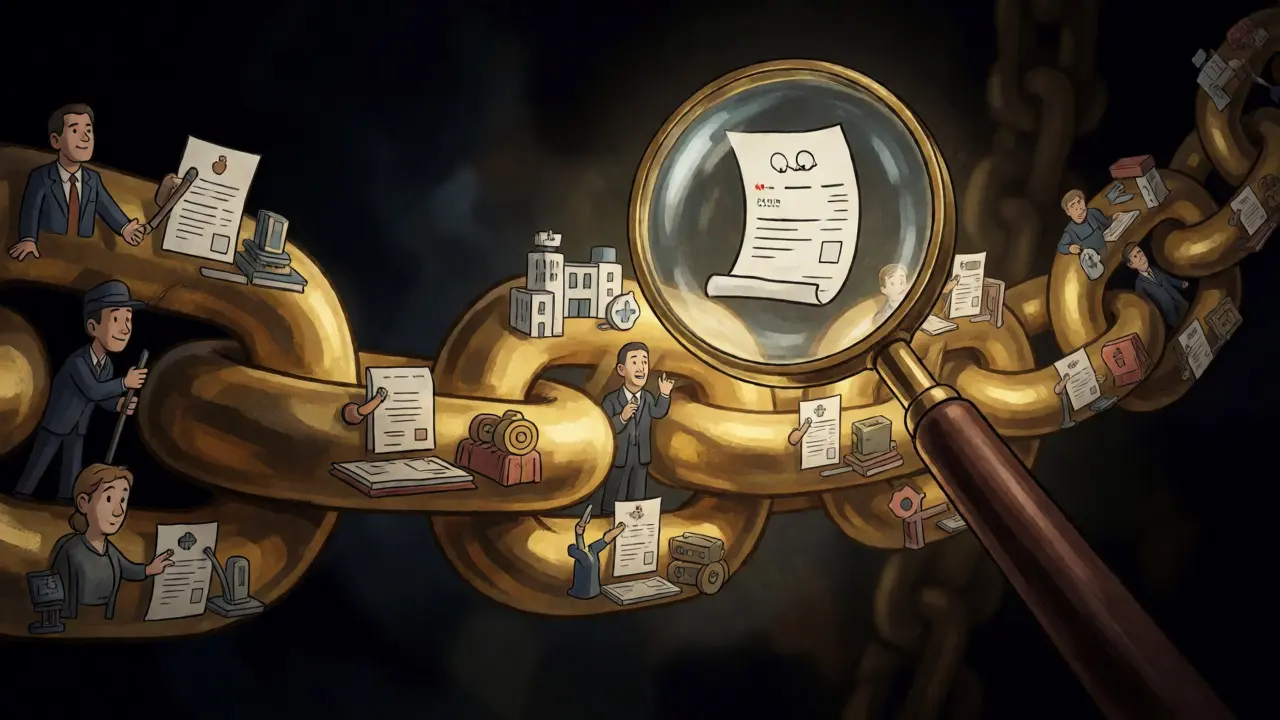
If you've ever waited months for a health or auto claim to settle, you know the pain of opacity. You file, you wait, you call, you wait some more. The core issue isn't usually malice; it's fragmentation. Insurers, reinsurers, hospitals, and repair shops all keep separate records that don't talk to each other efficiently. Blockchain fixes this by creating a single, shared source of truth. When everyone looks at the same immutable ledger, the need for reconciliation vanishes. This transparency doesn't just build trust; it slashes the time required to verify and approve payments.
Why Traditional Claims Take So Long
To appreciate the speed boost, you have to look at where the bottlenecks are in traditional systems. A standard claim involves multiple handoffs. First, the policyholder submits documents. Then, an agent reviews them. Next, data is entered into legacy systems, often manually. After that, fraud checks run, sometimes requiring external database queries. Finally, approval goes through several layers of management. Each step introduces latency. According to industry benchmarks, simple claims can take 15-30 days, while complex cases stretch to 90 days or more. Much of this time is spent not on decision-making, but on verifying that the information provided matches the information held by other parties.
Administrative overhead is another silent killer of speed. Intermediaries like brokers, third-party administrators, and legal teams add cost and time. They exist largely because there was no secure way for direct parties to trust each other's data. With blockchain, that middleman layer shrinks dramatically. By removing the need for intermediaries to validate transactions, insurers cut administrative costs by 10-30%. More importantly, they remove the queues associated with human intervention at every stage.
The Role of Smart Contracts in Automation
The real engine behind rapid claims processing is the smart contract self-executing code stored on the blockchain that triggers actions when conditions are met. Think of a smart contract as a digital if-then statement written directly into the ledger. In travel insurance, for example, a smart contract might say: "If Flight AB123 arrives more than three hours late, pay $200 to Policyholder X."
When the flight lands, a trusted data source (an oracle) feeds the arrival time into the blockchain. The smart contract reads this data, verifies it against the policy terms, and executes the payment automatically. There is no human adjuster to review the boarding pass or check the weather report. This automation delivers up to a 3x increase in speed and significant cost reductions. For parametric products like crop insurance or flight delays, settlement can happen within minutes of the triggering event being verified.

Real-World Impact: From Weeks to Minutes
Let's look at concrete examples. AXA, a major European insurer, launched 'Fizzy,' a blockchain-based flight delay product. Customers don't even need to file a claim. If their flight is delayed beyond the threshold, the system pays them automatically via Ethereum. Satisfaction rates for this automatic payout process hit 92%, compared to 68% for traditional filing methods. Users love the predictability and the lack of friction.
In corporate insurance, IBM and AIG partnered to streamline multinational claims. Before blockchain, processing these complex, multi-jurisdictional claims took about 45 days. With their new platform, that time dropped to under 72 hours. That's a massive reduction in downtime for businesses relying on those funds to rebuild after an incident. The World Economic Forum notes that reducing this "downtime" significantly improves the customer experience, allowing policyholders to move on with their lives faster.
| Metric | Traditional System | Blockchain-Enabled System |
|---|---|---|
| Average Settlement Time (Simple) | 15-30 Days | Hours to Minutes |
| Average Settlement Time (Complex) | Up to 90 Days | Days (if partially automated) |
| Fraud Detection Rate | Reactive (Post-payment) | Proactive (Real-time verification) |
| Administrative Cost Share | High (10-30% of claim value) | Reduced (Lower overhead) |
| Data Transparency | Siloed databases | Shared immutable ledger |
Fraud Prevention Through Immutability
Speed means nothing if it comes at the cost of security. One of the biggest fears insurers have with automation is fraud. However, blockchain actually makes fraud harder to commit. Because the ledger is immutable, once a transaction is recorded, it cannot be altered or deleted. This creates a perfect audit trail. If a claimant tries to submit the same receipt for two different policies, the blockchain flags the duplicate instantly because the hash of that document is already linked to a previous transaction.
This transparency helps detect anomalies early. Insurers can see patterns across the network without exposing sensitive personal data unnecessarily. Estimates suggest blockchain can reduce fraudulent claims by 15-25%. When fewer claims are flagged for deep-dive investigation, the legitimate ones flow through faster. It’s a virtuous cycle: better data integrity leads to fewer false positives, which speeds up the queue for everyone else.
Where Blockchain Doesn't Help (Yet)
It's crucial to be realistic. Blockchain isn't a magic wand that fixes every type of claim. It shines brightest in standardized, data-driven scenarios-things like flight delays, cargo tracking, or parametric weather events. These are binary outcomes: did the plane land late? Yes or no. Did the rain gauge exceed 2 inches? Yes or no.
But what about a fender-bender where fault is disputed? Or a medical claim involving subjective treatment necessity? These require human judgment, negotiation, and nuance. Currently, only about 20-30% of all insurance claims are suitable for full automation via smart contracts. For the rest, blockchain still plays a supporting role by securing the documentation and speeding up the verification of facts, but humans remain in the loop for the final decision. Don't expect your comprehensive home insurance claim for water damage to be settled by code alone tomorrow.
Implementation Challenges and Future Outlook
For insurers looking to adopt this tech, the path isn't always smooth. Integration with legacy systems is tough. Most insurance companies run on mainframes from the 1980s. Connecting a modern distributed ledger to those old beasts requires careful middleware engineering. Data privacy is another hurdle, especially with GDPR in Europe. While the ledger is transparent, personally identifiable information (PII) must be handled carefully, often using zero-knowledge proofs to verify identity without revealing details.
Despite these challenges, adoption is accelerating. By 2027, Gartner predicts that blockchain will handle 30% of all standardized insurance claims. We're seeing consortiums form to create standards, ensuring that an insurer in London can seamlessly share data with a reinsurer in New York. The market for blockchain in insurance is projected to hit $1.4 billion soon, driven largely by the promise of cutting operational costs and boosting customer loyalty.
If you're a policyholder, keep an eye on products labeled "parametric" or "automated." These are likely powered by blockchain under the hood. If you're in the industry, start small. Pilot programs for narrow use cases, like travel insurance, offer the best ROI with the lowest risk. The technology is maturing, and the days of waiting 90 days for a simple payout are numbered.
How much faster is blockchain claims processing compared to traditional methods?
For standardized claims like flight delays, blockchain can reduce settlement times from days or weeks to mere minutes. Complex claims may see reductions from 90 days to a few days, depending on the level of automation achieved.
Do I need to understand cryptocurrency to use blockchain-based insurance?
No. Most consumer-facing blockchain insurance products hide the technical complexity. You interact with a familiar app or website, and the blockchain works in the background to verify and process your claim automatically.
Can blockchain prevent all types of insurance fraud?
It significantly reduces fraud related to duplicate claims and altered documents by providing an immutable record. However, it cannot fully prevent fraud involving fabricated incidents or subjective misrepresentation, which still require human investigation.
What are smart contracts in the context of insurance?
Smart contracts are self-executing agreements with the terms directly written into code. They automatically trigger claim payments when predefined conditions, such as a flight delay or weather event, are verified by trusted data sources.
Is my personal data safe on a public blockchain?
Insurers typically use permissioned blockchains or store only hashed references to data on-chain, keeping sensitive personal information off-ledger. This ensures compliance with privacy regulations like GDPR while maintaining the benefits of a shared ledger.
Ferdinand Friday
September 9, 2026 AT 22:52The very notion that a distributed ledger could untangle the Gordian knot of bureaucratic inertia is, frankly, a philosophical triumph over the entropy of human error. We have spent centuries building cathedrals of paper and digital silos, only to realize that trust is not something you can forge with ink but must be mathematically proven through consensus. When we speak of blockchain in insurance, we are not merely discussing a technological upgrade; we are witnessing the architectural restructuring of faith itself. The immutability of the chain serves as a digital panopticon where truth is no longer subjective but objective, immutable, and universally accessible. This shift from opaque intermediation to transparent verification represents a profound evolution in how society allocates risk and responsibility. It forces us to confront the uncomfortable reality that our previous systems were designed for inefficiency, perhaps even benefiting from the obfuscation of data. By removing the middlemen who thrived on information asymmetry, we restore agency to the individual policyholder. The smart contract becomes an arbiter that cannot be bribed, swayed by emotion, or delayed by holiday schedules. It is pure logic applied to the messy realm of human misfortune. In this new paradigm, the claim is not a request for mercy but a mathematical certainty triggered by predefined conditions. This democratization of financial liquidity changes the power dynamic entirely. We move from a relationship defined by dependency to one defined by contractual precision. The speed at which funds arrive is not just a convenience; it is a restoration of dignity to those suffering loss. To ignore this potential is to cling to the vestiges of a pre-digital age that no longer exists. The future is not written in code alone, but in the clarity that code brings to human interaction.
Gabriela Gonzalez
September 10, 2026 AT 04:39OMG YES!!! 🚀 Finally someone gets it! Waiting weeks for money after a disaster is literally soul-crushing 😭📉 Blockchain fixes this so fast it feels like magic ✨💸 I love seeing tech actually help people instead of just confusing them!! Keep spreading the word everyone!! 🌟🙌
Abid Bhatti
September 10, 2026 AT 18:23You call it transparency, I call it surveillance capitalism on steroids. Who really owns that 'immutable' ledger? Is it the insurers who pay for the nodes? Or is it the tech giants pulling strings behind the scenes? They say it removes middlemen, but they just replace them with algorithmic overlords who don't answer to anyone. If your flight is delayed, sure, get paid. But what happens when the oracle feeds bad data? Who do you sue then? The code? There is always a catch with these decentralized promises. They want your data, they want your habits, and they will use this 'trustless' system to track every penny you spend. Don't believe the hype until you see the fine print.
Jess Emmerson
September 11, 2026 AT 07:30I think the key here is distinguishing between parametric and indemnity claims. Parametric stuff like flight delays is perfect for this because the trigger is binary and external. Indemnity claims require human judgment which blockchain can support but not replace. It's important to manage expectations so people aren't disappointed when their complex medical claim still takes time. But yeah, the reduction in admin overhead is real and measurable.
Paige Ray
September 11, 2026 AT 08:54This gives me such hope for people going through tough times. Knowing that the financial stress won't drag on forever makes such a difference emotionally.
lea terrade
September 12, 2026 AT 10:07i wonder though about the energy consumption part of this. does it really offset the environmental cost if its mostly for small payouts? seems like a lot of compute for a few hundred dollars back to the user. maybe i am missing something but the green angle worries me a bit.
Rachel Leet
September 14, 2026 AT 03:58Let's be honest, most people don't understand what a hash is, let alone how a consensus mechanism works. You're selling a solution to a problem most consumers didn't know they had. Insurance companies aren't adopting this for customer satisfaction; they're doing it to cut labor costs. The 'transparency' is a marketing spin. The real beneficiary is the shareholder, not the policyholder. Until we see actual consumer savings passed down, this is just corporate efficiency dressed up as innovation. It's performative utility.
Rachel Aldaco
September 15, 2026 AT 11:43Ugh, why does everything have to be so complicated now?? Just give me my money already!! Why do I need a blockchain to prove my car crashed?? It feels like they are making it harder to hide their mistakes by adding more layers. I hate change and I hate tech words. Make it simple or make it stop!! 😤😤
liam & the bees
September 15, 2026 AT 21:31From an Irish perspective, we've seen similar shifts with open banking. The key is interoperability. If UK insurers and EU reinsurers can talk seamlessly, that's huge for cross-border claims. The regulatory sandbox approach in Europe has been helpful too. It's not just about the tech, it's about the legal framework supporting it. Great read!
John Martin
September 17, 2026 AT 04:34Spot on regarding the fraud detection aspect 👍👍. Real-time verification is a game changer. No more duplicate receipts slipping through the cracks. This saves billions globally 💰💰. Insurers need to embrace this fully to stay competitive 🏆🏆. The future is automated and secure 🔒🔒.
Courtney Parker
September 19, 2026 AT 00:44Meh. Sounds like another buzzword soup. 🥣 I bet the UI is terrible and half the users can't figure out how to connect their wallet anyway. 🙄 Typical tech bros solving problems that don't exist for regular folks. 🤷♀️
Saket Kulkarni
September 21, 2026 AT 00:04It is indeed fascinating to observe the paradigm shift occurring within the insurance sector. The elimination of intermediary layers contributes significantly to operational efficiency. Furthermore, the integrity of data ensures that all parties involved have access to a single source of truth. This reduces disputes and accelerates resolution times considerably. One must also consider the long-term implications for global trade and logistics. Standardized protocols will likely emerge, facilitating smoother international transactions. The potential for cost reduction is substantial, provided implementation challenges are addressed methodically. It appears we are moving towards a more equitable and efficient system. I appreciate the detailed analysis presented here. Thank you for sharing this insight.
Eliza Stein-Dodd
September 21, 2026 AT 15:25Smart contracts are just if/then statements. Not magic. 🧠✨ But yes, faster payouts = happier customers. Simple as that. 📉➡️📈
Maegan Rust
September 22, 2026 AT 09:19This resonates deeply with me. As someone who has navigated the labyrinthine corridors of health insurance bureaucracy, the promise of immediate relief is intoxicating. It’s not just about the money; it’s about the validation of one’s experience. When the system acknowledges the event instantly, it feels like being heard. That emotional weight shouldn't be underestimated. Technology, at its best, should serve humanity’s need for connection and certainty. This feels like a step toward that ideal, stripping away the cold indifference of traditional processes. Let’s hope the implementation remains humane.
Harish Ramaiah
September 25, 2026 AT 08:14I feel so anxious reading this... 😰 What if the code breaks?? What if the internet goes down?? 😱 Then we wait even longer than before... 😢 The uncertainty terrifies me... 😩 I prefer the slow, predictable misery of the old ways... at least I knew what to expect... 😔 New tech brings new fears... 😰😰
Idowu Emmanuel
September 26, 2026 AT 16:55This is fantastic news for emerging markets! Speed of capital is crucial for economic mobility. If farmers in Nigeria can get paid for crop failure in minutes rather than months, that changes lives. The scalability of this tech is its biggest strength. Go Africa! 🇳🇬🚀