
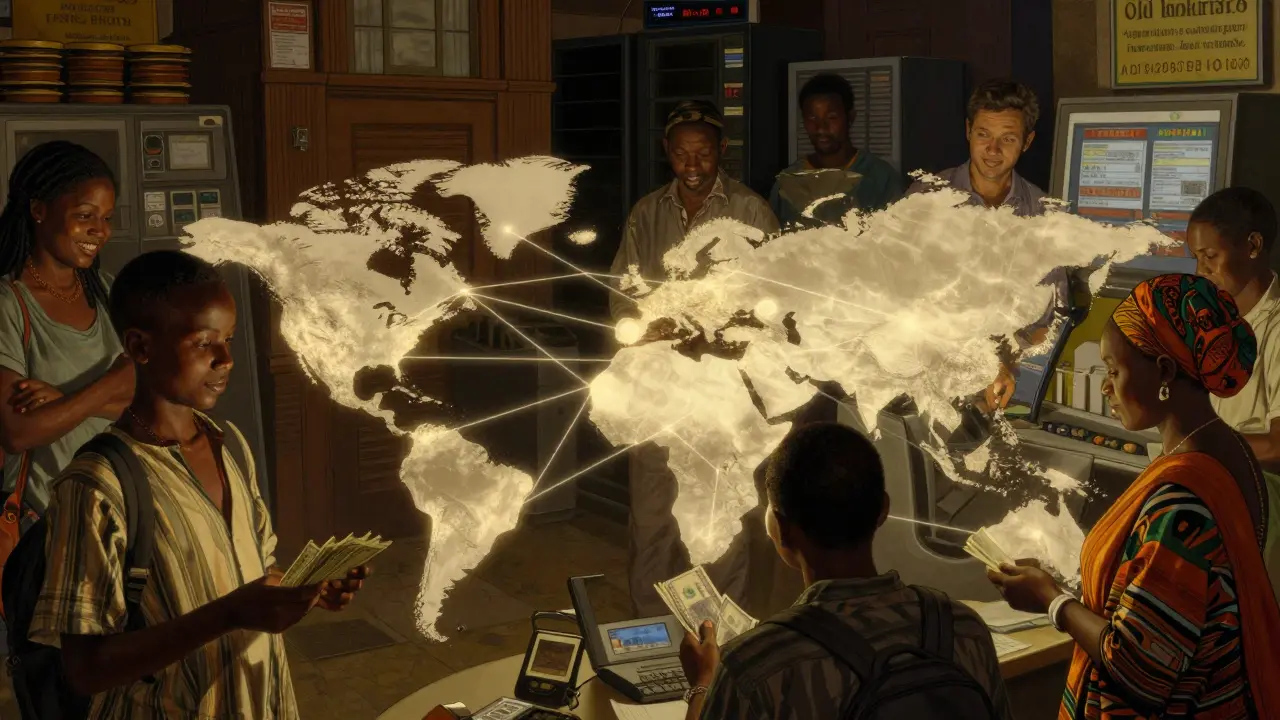
Sending money across borders used to mean waiting days, paying $15 in fees, and dealing with banks that don’t even move the money-they just pass messages back and forth. In 2024, the average cost to send $200 internationally was still 6.62%, or $13.24. That’s money taken out of the pockets of families relying on help from abroad. But now, a quiet revolution is happening: people are using cryptocurrency, especially stablecoins, to bypass the old system entirely.
Why Traditional Remittances Are Still Broken
The current system isn’t broken because it’s inefficient-it’s broken because it’s designed to be slow and expensive. When you send money from the U.S. to Nigeria, your bank doesn’t send cash. It sends a message to another bank, which sends a message to another, and so on. Each step adds time, fees, and risk. The money doesn’t move until every intermediary has confirmed the request. That’s why it takes 3-5 business days and why fees stay high, even when the sender and receiver are just a few clicks apart online.Companies like Western Union and Wise have improved the experience, but they’re still playing by the same rules. They’re middlemen in a system built for middlemen. And when you’re sending money to support a child’s school fees or a parent’s medical bills, every dollar matters.
How Stablecoins Cut the Cost to Pennies
Stablecoins like USDC and USDT are digital tokens backed one-to-one by U.S. dollars. They’re not speculative like Bitcoin-they’re meant to move value like cash, but faster and cheaper. In 2024, stablecoins moved $15.6 trillion globally, matching Visa’s entire annual volume. And the cost? On networks like Polygon or Solana, sending a stablecoin transaction can cost less than $0.01.Here’s how it works: A sender in California uses an app to send 200 USDC to a relative in Manila. The transaction is recorded on a blockchain. Within seconds, it’s verified by multiple computers around the world. No bank intermediary. No currency conversion delay. No hidden fees. The recipient gets the exact amount-no deductions.
Businesses are already feeling the difference. One manufacturing company in Texas started paying its Singapore-based supplier in USDC. What used to take 4 days now takes 12 minutes. They saved $2,800 in fees over six months. That’s not a fluke-it’s the new norm for companies using blockchain-based payment platforms like BVNK or Ripple.
But It’s Not Perfect-Here’s Where It Falls Short
The problem isn’t the technology. It’s the people on the other end.Most families receiving remittances don’t have crypto wallets. They don’t know how to use them. They need cash. So the recipient has to convert the stablecoin into local currency through an exchange or agent. And guess what? Those conversion services often charge 3-5%-eating up most of the savings.
One Reddit user in Nigeria said it plainly: “My brother sends me USDC, but I have to go to a shop to turn it into naira. They charge me 4%. So I’m still paying $8 in fees on a $200 transfer. Where’s the win?”
That’s the gap. The tech works. But the last-mile infrastructure-cash-out points, local partnerships, regulatory compliance-is still underdeveloped in many countries. In the Philippines, cryptocurrency remittances grew 217% in 2024, but they still only make up 4.3% of total inflows. The rest still flows through banks and money transfer operators.

Regulation Is the Biggest Hurdle
Governments are catching up-but slowly, and unevenly.The European Union has MiCA, a clear set of rules for crypto assets. The U.S. is still debating whether stablecoins are securities, commodities, or something else. In Vietnam, regulators see blockchain as a tool for lower costs but warn that without a unified legal framework, adoption will stall. The Bank for International Settlements says the real challenge isn’t tech-it’s getting 190 countries to agree on how to supervise digital money.
Companies trying to operate globally now need licenses in multiple jurisdictions. A payment processor might be approved in the U.S. but banned in Brazil. Or required to collect KYC data in one country but forbidden from storing it in another. That’s why only 38% of Fortune 500 companies use blockchain for cross-border payments-not because they don’t want to, but because compliance is a maze.
Who’s Winning Right Now?
The leaders aren’t the big banks. They’re the startups building bridges.Circle’s Cross-Chain Transfer Protocol (CCTP), launched in 2024, lets USDC move seamlessly between Ethereum, Solana, and Avalanche. That means users aren’t locked into one network. Ripple’s xRapid system connects banks in Latin America and Africa using XRP as a bridge currency. Yellow Card and BVNK offer apps that let businesses send stablecoins and auto-convert them to local currency upon receipt.
But the real winners are the users who bypass the system entirely. In Kenya, a farmer’s son in Chicago sends rent money as USDC. His mother uses a local agent with a phone app to cash out. No bank account needed. No wire fee. No waiting. That’s the future-and it’s already live in places where traditional finance failed.
What’s Next? CBDCs and the Global Reset
Central banks aren’t sitting still. Around 90% of them are experimenting with Central Bank Digital Currencies (CBDCs). The Bank for International Settlements’ mBridge project has already tested cross-border payments between China, Thailand, UAE, and South Africa-settling transactions in seconds.Imagine if every country issued its own digital currency that could talk to others. No stablecoin issuers. No third-party processors. Just direct, instant, low-cost transfers between central banks. That’s the endgame.
But it’s not here yet. And even if it arrives, stablecoins will still play a role-especially for people who don’t trust governments or can’t access state-run systems. They’re the people’s alternative.
How to Start Using Cryptocurrency for Remittances
If you’re thinking about switching:- Use a licensed provider like Circle, BVNK, or Yellow Card-never a random exchange.
- Make sure the recipient has a way to cash out locally. Ask them first.
- Compare total cost: crypto fee + cash-out fee vs. Western Union’s fee.
- Start small. Send $50 first. See how it works.
- Check local laws. Some countries restrict crypto inflows.
It’s not about replacing banks. It’s about giving people a better option. And that’s what matters.
Can I send crypto remittances legally in my country?
It depends. Countries like the U.S., Canada, and most of Europe allow crypto remittances if you use licensed providers. In Nigeria, Kenya, and the Philippines, it’s legal and widely used. But in China, India, and some parts of Latin America, restrictions apply. Always check your country’s central bank or financial regulator before sending.
Do I need a bank account to use stablecoins for remittances?
No. You only need an internet connection and a crypto wallet. Many users in emerging markets use phone apps like Trust Wallet or Phantom to receive and hold stablecoins. The recipient doesn’t need a bank account-they just need access to a cash-out agent, which are common in urban areas and growing in rural ones.
Are stablecoin transactions really cheaper than Western Union?
Yes-when you account for the full cost. Western Union charges 6-8% on average. A stablecoin transfer might cost $0.01, but if the recipient uses a local exchange to cash out, that adds 3-5%. So total cost is around 3-5%, still half of traditional options. In corridors like U.S. to Philippines or U.S. to Nigeria, users report saving 40-60% overall.
What’s the fastest way to send crypto remittances?
Use USDC on the Solana or Polygon network. Transactions settle in under 10 seconds. Pair it with a cash-out partner like Yellow Card or Paxful that has local agents. The whole process-from sending to cash-in-can be done in under 15 minutes if both parties are prepared.
Is it safe to use crypto for family remittances?
It’s safer than cash if done right. Blockchain transactions are permanent and traceable, reducing fraud risk. But you must use trusted platforms with KYC and AML compliance. Never send to a wallet address you didn’t verify. Always confirm the recipient’s wallet address with them over a call or text before sending.
Jeffrey Dufoe
January 27, 2026 AT 21:24Been using USDC to send money to my cousin in Manila for months now. Pays for her kid’s school supplies. Total cost? Like 12 cents. No bank delays. No surprise fees. I wish more people knew this was even an option.
Ashok Sharma
January 29, 2026 AT 10:28This is a well-structured overview of a critical shift in global finance. The reduction in transaction costs is not just an economic benefit-it’s a humanitarian one. For families relying on remittances, every dollar saved translates into meals, medicine, or education. The infrastructure gap remains, but the momentum is undeniable.
Margaret Roberts
January 31, 2026 AT 05:36Let me guess-this is just the crypto bros trying to get rich while pretending they’re helping the poor. Who’s really behind these stablecoins? Big Wall Street banks. The Fed’s got a backdoor. You think you’re bypassing the system? You’re just letting them own your money in a new color.
And don’t get me started on ‘cash-out agents.’ They’re all sketchy. One day your wallet gets frozen, next day the government seizes it, and suddenly you’re stuck with digital IOUs no one will honor. This isn’t freedom-it’s financial surveillance with a blockchain veneer.
Tselane Sebatane
February 1, 2026 AT 01:21Listen, I come from a place where your uncle sends money from Johannesburg to his sister in Limpopo and it takes a week and half the cash. I’ve seen it. I’ve lived it. So when I saw someone send USDC to my cousin in Durban and she got cash in 10 minutes through a local shop? I cried. Not because it’s tech-it’s because it’s dignity. No more begging banks for mercy. No more waiting for someone else’s approval to feed your family. This isn’t just cheaper-it’s revolutionary. And yes, the cash-out fees still suck. But guess what? We’re building the next layer. People are opening pickup points in villages now. It’s spreading. You think it’s slow? It’s faster than the colonial system ever was.
Harshal Parmar
February 1, 2026 AT 14:59Bro, I’ve been sending USDC to my mom in Delhi since last year. She doesn’t even have a phone that can do crypto-but she has a neighbor who runs a small shop with a QR code. She walks in, shows the code, gets rupees. No bank. No forms. No ‘verification.’ I send it from my phone, she gets cash in 5 minutes. Cost? Like 2%. Compared to Western Union’s 8%? It’s a no-brainer. Everyone in my village is talking about it now. My aunt even asked me to teach her how to send money to her granddaughter in Dubai. It’s not the future. It’s already here. Just not in the news.
Abdulahi Oluwasegun Fagbayi
February 3, 2026 AT 12:45The real win isn’t the tech. It’s the silence. No calls from banks asking for documents. No waiting for SWIFT codes. No middlemen taking their cut while pretending to help. When my brother sends me USDC from Texas, I don’t have to explain my life to a stranger in a call center. I just get the money. The rest is noise. The system was never meant for us. Now it doesn’t have to be.
Andy Marsland
February 3, 2026 AT 23:43Let’s be honest-stablecoins are just a workaround for people who can’t handle basic banking. You think this is innovation? It’s a patch on a broken system. The real solution is central bank digital currencies. At least those are backed by actual sovereign authority. Stablecoins? They’re privately issued, unregulated, and vulnerable to counterparty risk. Circle? They’re a fintech startup with a balance sheet that could vanish overnight. And you’re trusting your family’s rent money to that? Wake up. This isn’t finance-it’s gambling with your livelihood.
Also, the claim that it’s ‘$0.01’? That’s on Solana. But most people use Ethereum. Gas fees there are $5. And if you’re sending from the U.S. to Nigeria? You’re probably using a custodial wallet that charges 3%. So you’re still paying $5. That’s not cheaper-it’s just different. And way less secure.
Anna Topping
February 5, 2026 AT 00:37I keep thinking about how this changes power. Not money. Power. The people who used to control the flow-banks, regulators, middlemen-they’re losing their grip. And they’re terrified. That’s why the regulations are so messy. It’s not about safety. It’s about control. We’re not just sending money anymore. We’re sending a message: we don’t need you to tell us how to live. And that’s scarier than any hack or crash.
Clark Dilworth
February 6, 2026 AT 08:45From a protocol architecture standpoint, the real breakthrough is the interoperability layer-CCTP enabling atomic swaps across heterogeneous L1s. The composability of USDC across Polygon, Solana, and Ethereum creates a unified liquidity pool that supersedes traditional correspondent banking models. The velocity of capital is now governed by consensus mechanisms rather than bilateral clearing agreements. This is the first time in history that cross-border value transfer has been decoupled from institutional intermediation. The implications for monetary sovereignty are profound.
Mathew Finch
February 6, 2026 AT 18:15Oh great, another article glorifying crypto as some kind of savior for the poor. Meanwhile, the U.S. government is still printing trillions and letting banks inflate prices. You think a $0.01 transaction fee fixes systemic inequality? You’re delusional. This is just another way for Silicon Valley to extract value while pretending to be altruistic. And let’s not forget-crypto is used by drug cartels, sanctions evaders, and tax cheats. You want to help families? Fix the banking system. Don’t hand them a digital weapon they don’t understand.
Jessica Boling
February 7, 2026 AT 11:43So let me get this straight-you’re telling me the solution to poverty is… more apps? Congrats, you turned grandma’s rent money into a blockchain transaction. Next you’ll say she needs to learn how to sign a tx with MetaMask. Meanwhile, the guy running the cash-out kiosk in Lagos is charging 5% and still making more than the CEO of Circle. This isn’t revolution. It’s capitalism with a blockchain logo.
Roshmi Chatterjee
February 8, 2026 AT 02:56My sister in Mumbai uses this to get money from my dad in Canada. She didn’t even know what a stablecoin was until I showed her. Now she uses it every month. The cash-out place is just a tea shop with a phone. She doesn’t care about blockchain. She just cares that she gets the full amount. That’s what matters. Not the tech. Not the hype. Just the money. And it works.
MICHELLE REICHARD
February 9, 2026 AT 03:23Everyone’s so excited about crypto remittances but no one talks about the environmental cost. Solana? Ethereum? All that mining and staking? It’s a carbon nightmare. You’re saving $8 on a $200 transfer but destroying the planet for future generations. And you call this progress? This isn’t empowerment-it’s environmental exploitation disguised as innovation. If you really cared about people, you’d push for green alternatives. But you won’t. Because convenience is easier than conscience.