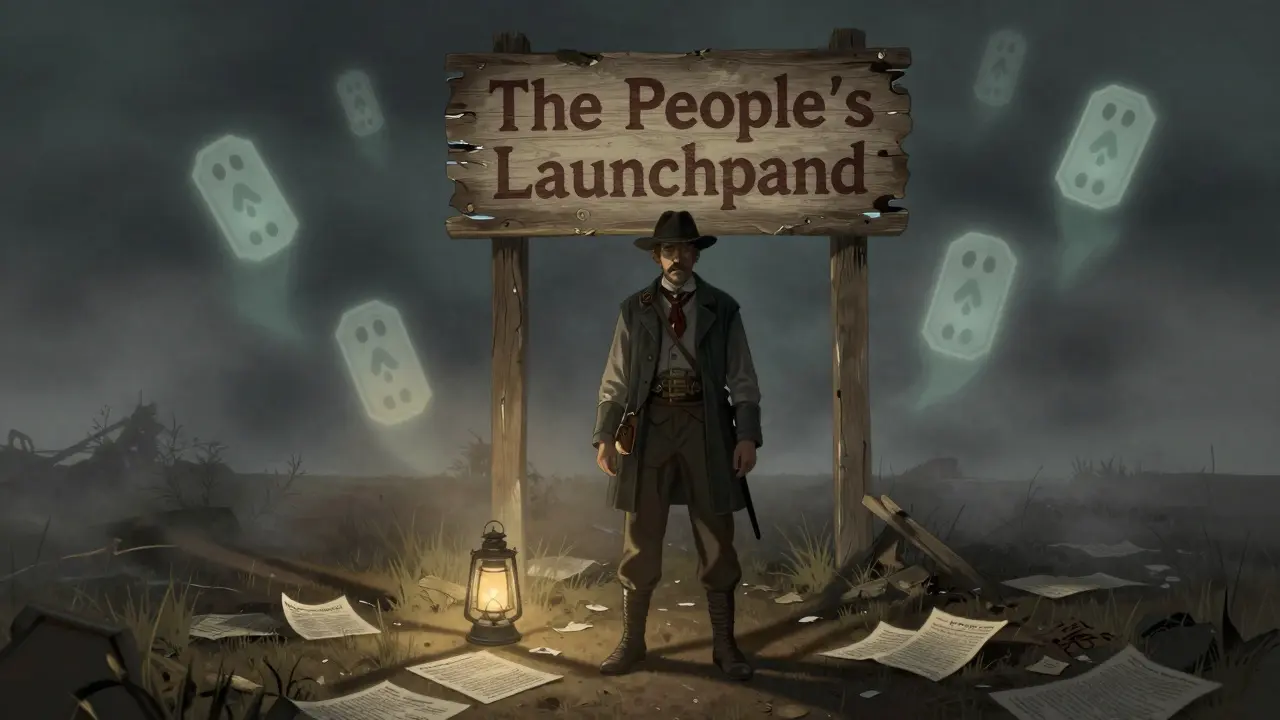
Back in July 2021, a small crypto project called KCCPad quietly launched with a $25,000 market cap and a promise: "The People's Launchpad." It wasn’t meant to be the next Binance Launchpad or CoinList. It was built for small investors-people who didn’t have thousands to stake, but still wanted a shot at early-stage tokens. And part of that promise? An airdrop.
But here’s the problem: no one knows what happened to it.
You won’t find official announcements on Twitter anymore. The website is offline. The Telegram group is silent. Even the KuCoin Community Chain (KCC), which it claimed to be built on, doesn’t list it among active projects. So if you’re asking, "Did I qualify for the KCCPad airdrop?" or "How do I claim my tokens?"-the truth is, you probably didn’t get anything. And there’s a reason why.
What Was KCCPad Supposed to Be?
KCCPad positioned itself as a launchpad for new crypto projects, specifically targeting users on the KuCoin Community Chain (KCC). Unlike big platforms that require you to lock up thousands of dollars in tokens to get access to new sales, KCCPad claimed to be "fair"-no VIP tiers, no whale advantage. Everyone got an equal shot.
The idea was simple: developers would submit their projects. KCCPad would vet them for scams. If they passed, the project would launch on KCCPad’s platform. Users could then buy tokens during the sale. And before that sale? There was supposed to be an airdrop.
But unlike most launchpads that give you tokens just for joining their Discord, KCCPad’s airdrop was never clearly explained. No official blog post. No step-by-step guide. No wallet address to connect. Just rumors.
The Airdrop That Never Showed Up
Here’s what we know for sure:
- The project launched on July 12, 2021.
- It claimed to have anti-bot protection to keep big players out.
- It had a $25,000 initial market cap-tiny by today’s standards.
- No official airdrop rules were ever published.
- No token contract address was ever verified on KCCScan or any blockchain explorer.
- There are no public records of token distribution.
That’s not normal. Even the smallest airdrops-like those from obscure DeFi protocols-usually have a snapshot date, a claim window, and a smart contract you can check. KCCPad had none of that.
Some users claim they signed up on a website that’s now dead. Others say they were told to hold KCC tokens to qualify. But KCCPad didn’t even have its own token at launch. That’s like promising free pizza and then saying, "We don’t have a kitchen."
There’s no evidence that KCCPad ever issued tokens. No transaction history. No wallet activity. No blockchain records. If the airdrop happened, it was invisible.

Why Did It Disappear?
Three possibilities:
- It was a rug pull. The team collected early adopters, took their attention, and vanished. No code, no tokens, no explanation.
- It was abandoned. The team ran out of money or interest after the initial launch. The airdrop was just a marketing tactic that never got funded.
- It was a scam from day one. The whole thing was designed to attract social media followers, then disappear before anyone could ask for their tokens.
The fact that the website is gone and the team is silent makes #1 and #3 the most likely. This wasn’t a failed startup-it was a ghost.
How to Spot a Fake Airdrop Like This
If you’re looking at a crypto airdrop today, here’s how to avoid another KCCPad:
- Check the contract address. If they don’t give you a blockchain address you can look up, walk away.
- Look for audits. Even small projects get audited by CertiK or Hacken. If they say they’re "audited" but won’t show you the report, it’s fake.
- Search for token transactions. Go to KCCScan or BscScan. Search for the token name. If there are zero transfers, it doesn’t exist.
- Check the team. Anonymous teams with no LinkedIn, no GitHub, no past projects? Red flag.
- Don’t trust Telegram hype. If 500 people are saying "I got my tokens!" but you can’t verify it, they’re either bots or scammers.
Real airdrops don’t ask for your private key. They don’t ask you to send crypto to "claim" your free tokens. They don’t disappear after a week.
What You Can Do Now
If you think you signed up for the KCCPad airdrop:
- Check your wallet history from July 2021. Look for any incoming tokens labeled KCCPAD or similar. If you see nothing, you weren’t included.
- Search the Wayback Machine for web.archive.org and type in the old KCCPad URL. If you find a snapshot, look for any mention of token distribution dates or wallet requirements.
- Don’t waste time trying to contact them. No one is responding.
There’s no recovery. No refund. No second chance. This is why crypto is dangerous-and why you need to do your own research before trusting any "free" token.
What Happened to the People’s Launchpad?
The name "The People’s Launchpad" sounded noble. It promised to level the playing field. But in crypto, names don’t matter-actions do.
KCCPad never delivered on its promise. No tokens were distributed. No community was built. No projects were launched after the initial one.
It’s a lesson in disguise. Not all launchpads are created equal. Not all airdrops are real. And sometimes, the quietest projects are the ones that vanish the fastest.
If you want to find real airdrops today, stick to platforms with history: PancakeSwap, Binance Launchpool, or even smaller ones like Polkastarter that have public track records. Avoid anything that sounds too good to be true-and especially anything that disappeared before you could even claim your tokens.
KCCPad was never a launchpad. It was a ghost story.
Sammy Tam
December 16, 2025 AT 12:49Man, I remember seeing KCCPad pop up in my Telegram feed back then. Everyone was hyped, but no one could explain how to actually get the tokens. I thought I missed something-turned out, nobody knew. Crypto’s wild like that. One day you’re chasing free tokens, the next day you’re digging through the Wayback Machine like an archaeologist. RIP The People’s Launchpad.
Jonny Cena
December 17, 2025 AT 23:13This is why I always tell new folks: if it sounds too fair, it’s probably too good to be true. Real projects don’t hide their contracts. They don’t vanish after a week. They build. They communicate. They show up. KCCPad didn’t just fail-it ghosted. And now we’re all left wondering if we were the only ones who believed the hype.
Elvis Lam
December 19, 2025 AT 21:03Let’s cut through the noise. If there’s no contract address on KCCScan, no token transfers, no audit, and no team info-it’s not a failed project. It’s a scam. Period. No ‘maybe,’ no ‘perhaps.’ You don’t need to dig through archives to know this. The blockchain doesn’t lie. And if the blockchain says zero activity, then zero tokens were ever issued. Don’t romanticize it. Call it what it was.
Sue Bumgarner
December 20, 2025 AT 13:49Oh please, this is why Americans think crypto is a joke. You people just give up too easily. Back in my day, if a project disappeared, you dug harder. You found the devs on LinkedIn. You traced the IP. You didn’t just shrug and say ‘ghost story.’ You fought for your tokens. This isn’t about trust-it’s about discipline. And nobody’s got any anymore.
Chevy Guy
December 21, 2025 AT 13:56Wait… what if KCCPad was never real? What if it was a honeypot set up by the SEC to catch dumb investors? I mean, think about it. The website vanishes, the team ghosts, the tokens don’t exist-perfect cover. They let everyone sign up, collect wallet addresses, then disappear. Now they’ve got a database of crypto fools. That’s not a scam. That’s intelligence gathering.
Sally Valdez
December 21, 2025 AT 23:55Stop acting like this is some deep mystery. It was a trash project run by guys who thought ‘The People’s Launchpad’ sounded cool on a flyer. They didn’t care about you. They cared about the hype. They got their 5000 Discord members, took their attention, and vanished. No one owes you free tokens. And no one’s coming back. Move on. Get over it. The crypto graveyard is full of these ghosts.
George Cheetham
December 22, 2025 AT 07:11There’s a quiet beauty in how crypto teaches us through absence. KCCPad didn’t fail because it was bad-it failed because it never truly existed. It was a mirage. And in its absence, it taught us more than any whitepaper ever could. We learn not from what’s built, but from what’s erased. The real launchpad was the lesson. The tokens? Just smoke.
Dionne Wilkinson
December 22, 2025 AT 19:19I signed up for it too. I didn’t even know what KCC was at the time. I just saw ‘free tokens’ and clicked. No harm done. I learned that day: if you don’t understand the tech, don’t chase the hype. I still hold KCC, but I never touch anything without a verified contract. Simple lesson. Hard to remember when everyone’s shouting ‘moon.’
Rebecca Kotnik
December 22, 2025 AT 23:03While the narrative surrounding KCCPad is often framed as a cautionary tale of deception, it is also, more profoundly, an indictment of the structural fragility inherent in decentralized ecosystems that rely on social trust rather than verifiable infrastructure. The absence of a publicly accessible token contract, the lack of transparent governance mechanisms, and the total erasure of digital artifacts suggest not merely negligence, but a systemic failure in the foundational architecture of community-driven financial initiatives. The fact that no blockchain explorer records any token transfers-despite the project’s purported launch date-indicates that the very premise of the airdrop was ontologically unsound. This is not merely a case of a rug pull; it is a case of a phantom economic actor that never materialized in any measurable, accountable, or traceable form. One might argue that the true tragedy lies not in the loss of tokens, but in the loss of epistemic certainty-the erosion of the belief that digital promises can be grounded in verifiable reality.
Amy Copeland
December 24, 2025 AT 06:54Oh wow, someone actually wrote a 2000-word essay about a $25k scam? How quaint. You people really think this matters? The only people who lost anything here are the ones who still care. The rest of us moved on. You’re still mourning a ghost while the rest of the world is building real things. Get a life.
Kayla Murphy
December 24, 2025 AT 10:45I just want to say-this post helped me feel less alone. I spent weeks trying to figure out if I missed something. I checked my wallet a hundred times. I even DM’d people in the old Telegram. Turns out, I wasn’t crazy. I just got scammed by a ghost. Thanks for saying it out loud. We’re all just trying to learn.
Terrance Alan
December 25, 2025 AT 21:20People like you who cry about losing free tokens are the reason crypto is a joke. You wanted something for nothing and now you’re mad it didn’t happen. Grow up. The only thing that matters is your wallet. If you didn’t get tokens, you weren’t meant to have them. The system worked. You lost. Move on. Your emotional investment in a scam is your problem, not mine.
Samantha West
December 26, 2025 AT 01:30It’s worth noting that the very linguistic construction of the phrase "The People’s Launchpad"-with its overtly populist, almost socialist undertones-was itself a performative gesture designed to evoke trust through ideological resonance rather than material substance. The rhetorical framing of inclusivity, fairness, and egalitarian access served as a psychological vector for mass participation, masking the absence of technical infrastructure. The project’s collapse, therefore, was not an accident-it was the inevitable outcome of a symbolic architecture built upon the illusion of equity. One cannot build a launchpad on sentiment alone. The blockchain does not honor metaphors. It only records transactions. And in this case, the ledger remained empty. Not because the team was malicious-but because the entire premise was semantically bankrupt.