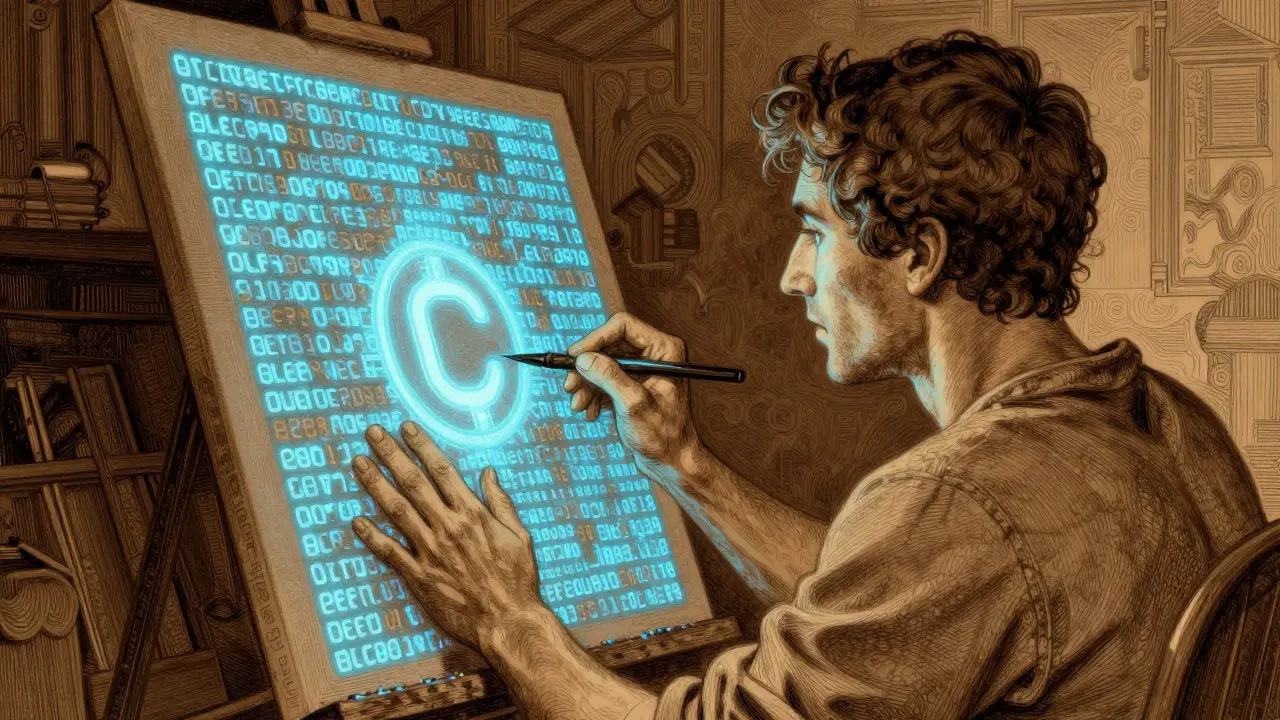
Imagine painting a masterpiece, selling it to a collector, and then watching that same painting change hands five times over the next decade. In the traditional art world, you get paid once. After that, every subsequent sale is money in your pocket? Zero. It belongs to the gallery, the auction house, or the lucky reseller.
Now imagine if you earned a small cut of every single one of those resale transactions. That is the promise of NFT royalties, a mechanism that allows digital creators to earn continuous income from their artistic works through blockchain-based smart contracts. For artists working in digital mediums-whether that’s generative code, pixel art, music loops, or 3D models-this shift changes everything. It turns a one-time transaction into a potential lifetime revenue stream.
How NFT Royalties Actually Work
To understand why this matters, you have to look under the hood. The engine driving NFT royalties is the smart contract, which is a self-executing program with agreement terms directly written into blockchain code. When you mint an NFT, you aren’t just uploading a file; you are deploying a piece of code that lives on the blockchain forever.
This code contains instructions. One of those instructions says: "Whenever this token is sold again, take X% of the sale price and send it to Wallet Address Y." There is no middleman checking your bank account. No accountant sending an invoice. No waiting three months for payment processing. The moment the buyer sends funds, the smart contract automatically deducts the royalty and transfers it to you. It is instant, transparent, and immutable.
Typically, artists set these royalties between 5% and 10%. Some go lower to attract buyers; others go higher to maximize long-term gains. The key point is that this percentage applies to the *secondary* market-the resale market. If someone buys your NFT for $1,000 and sells it later for $10,000, your 5% royalty isn’t calculated on the original $1,000. It’s calculated on the new $10,000 price tag. You benefit directly from the appreciation of your work.
The Financial Impact: Real Numbers, Not Hype
Skeptics often dismiss NFTs as speculative bubbles. But when you look at the data regarding creator compensation, the numbers tell a different story. According to a 2022 report by Galaxy Digital, over $1.8 billion was distributed in NFT royalties specifically on the Ethereum blockchain. That is not theoretical money; that is cash transferred to wallets worldwide.
Consider the case of musician Jacques Greene. He released a six-second audio loop and GIF as an NFT. From that tiny fragment of work, he earned approximately $16,000 in royalties. To put that in perspective, that amount represented nearly half of what he earned from 7 million streams of the full song on Spotify. Traditional streaming platforms pay fractions of a cent per play. NFT royalties paid him for ownership and scarcity, not just consumption.
On a larger scale, collections like Bored Ape Yacht Club (created by Yuga Labs) generated over $147 million in royalties for their creators. While most artists won’t hit those stratospheric figures, even mid-tier success can be transformative. Many digital creators report earning consistent monthly passive income ranging from $1,000 to $10,000 simply because their early works continue to trade hands among collectors.
Why This Beats Traditional Art Sales
The traditional art market has a broken incentive structure. An artist sells a canvas for $500. Ten years later, that canvas sells for $50,000. The artist sees none of that $49,500 gain. Galleries and auction houses take huge commissions on both ends, leaving the creator with a single payout that rarely covers living expenses.
NFT royalties fix this asymmetry. Here is how the comparison breaks down:
| Feature | Traditional Art Market | NFT Secondary Market |
|---|---|---|
| Revenue Source | Primary sale only | Primary + Secondary sales |
| Payment Speed | Weeks to months (via intermediaries) | Instant (via smart contracts) |
| Transparency | Opaque (private sales) | Public (visible on blockchain) |
| Intermediary Fees | High (10-50% to galleries/auctions) | Low (platform fees + gas costs) |
| Global Reach | Limited by physical location/galleries | Borderless internet access |
This transparency is crucial. In the physical world, you might never know if your work was resold. On the blockchain, every transaction is recorded publicly. You can see exactly who bought your work, for how much, and verify that your royalty was processed. This builds trust between creators and collectors, fostering a community rather than a transactional relationship.
The Reality Check: Challenges and Limitations
If it sounds too good to be true, it’s worth noting where the system stumbles. NFT royalties are powerful, but they are not perfect. The biggest issue today is enforcement.
Not all marketplaces respect royalty settings. Major platforms like OpenSea have faced criticism for making royalties optional rather than mandatory. If a buyer uses a marketplace that doesn’t enforce royalties, your smart contract cannot force them to pay. They can technically bypass the fee entirely. This has led to a fragmented ecosystem where some creators worry about losing income if their community migrates to low-fee exchanges.
There is also the problem of "NFT wrapping." Sophisticated users can sometimes wrap an existing NFT into a new token, effectively resetting its history and removing the original royalty clause. While this requires technical knowledge, it represents a vulnerability in the current standard.
Furthermore, high royalty rates can kill demand. If you set your royalty at 15%, potential buyers may look elsewhere. The market seems to have found a sweet spot between 5% and 7%. Setting it too high discourages trading; setting it too low undermines the value proposition. Finding that balance is part of the strategy.
How to Set Up Your Royalties Correctly
Getting started doesn’t require you to be a coder. Most major platforms provide user-friendly interfaces for configuring these terms during the minting process. Here is a practical checklist for artists looking to implement royalties effectively:
- Choose the Right Platform: Select a marketplace known for enforcing royalties. Look for platforms that have built-in support for the ERC-721 or ERC-1155 standards with royalty compliance.
- Set a Competitive Rate: Start with 5-7%. This is widely accepted as fair compensation without deterring buyers. You can always adjust this for future drops based on community feedback.
- Secure Your Wallet: Ensure your wallet address is correct. Smart contracts do not forgive typos. If you send funds to the wrong address, there is no customer service team to reverse the transaction.
- Engage Your Community: Royalties rely on secondary trading. If no one trades, you earn nothing. Build a community that values your work enough to hold and occasionally flip pieces. Active communities drive volume.
- Monitor Analytics: Use tools that track your NFT’s performance across different marketplaces. This helps you identify where your work is being traded and whether royalties are being collected correctly.
Documentation varies wildly across platforms. Established sites offer detailed guides, while newer ones may lack resources. Join Discord servers and Reddit forums dedicated to specific blockchains or art styles. Peer-to-peer knowledge sharing is currently the best way to stay updated on technical changes and best practices.
The Future of Creator Economics
We are still in the early stages of this evolution. Regulatory frameworks are slowly emerging, with governments exploring how to tax digital assets and protect creator rights. Industry analysts predict that future standards may mandate royalty enforcement across all compliant platforms, solving the current fragmentation issue.
Beyond visual art, this model is expanding into music, gaming, and even software development. Imagine a game developer earning a micro-royalty every time a skin or item they designed is traded between players. Or a writer receiving a cut every time their e-book is resold. The underlying technology of smart contracts enables any form of intellectual property to participate in this secondary market economy.
For artists, the message is clear: NFT royalties represent a fundamental shift toward a creator-centric digital economy. It is not a get-rich-quick scheme, but a sustainable tool for valuing digital labor. By leveraging blockchain technology, you reclaim control over your work’s lifecycle, ensuring that your creativity continues to support you long after the initial sale.
Are NFT royalties guaranteed?
No, NFT royalties are not universally guaranteed. While smart contracts automate payments, enforcement depends on the marketplace. Some platforms make royalties optional, allowing buyers to avoid paying them. Additionally, technical workarounds like NFT wrapping can bypass royalty structures. Creators must choose platforms that prioritize royalty compliance to maximize reliability.
What is the ideal royalty percentage for NFTs?
The industry standard typically ranges between 5% and 10%. However, many creators find that 5-7% offers the best balance. Higher percentages can discourage buyers from engaging in secondary sales, reducing overall trading volume. Lower percentages ensure more frequent transactions, potentially leading to higher total earnings over time.
How do I receive my NFT royalty payments?
Payments are sent directly to your cryptocurrency wallet address specified in the smart contract. There is no intermediary bank or agency involved. The transfer happens instantly upon the completion of a secondary sale. You will need to manage your own crypto holdings, including converting to fiat currency if desired, using exchanges or withdrawal services.
Can I change my royalty rate after minting?
It depends on the smart contract implementation. Some contracts allow the owner to update royalty parameters, while others lock the rate permanently at the time of minting. Always check the documentation of the platform you are using before deploying your NFT. Once locked, immutable contracts cannot be changed.
Do NFT royalties apply to primary sales?
No, royalties specifically apply to secondary sales (resales). Primary sales involve the initial purchase from the creator, where the artist sets the listing price. Royalties activate only when that asset is traded between two other parties on the secondary market. This distinction ensures creators are rewarded for the ongoing value and appreciation of their work.