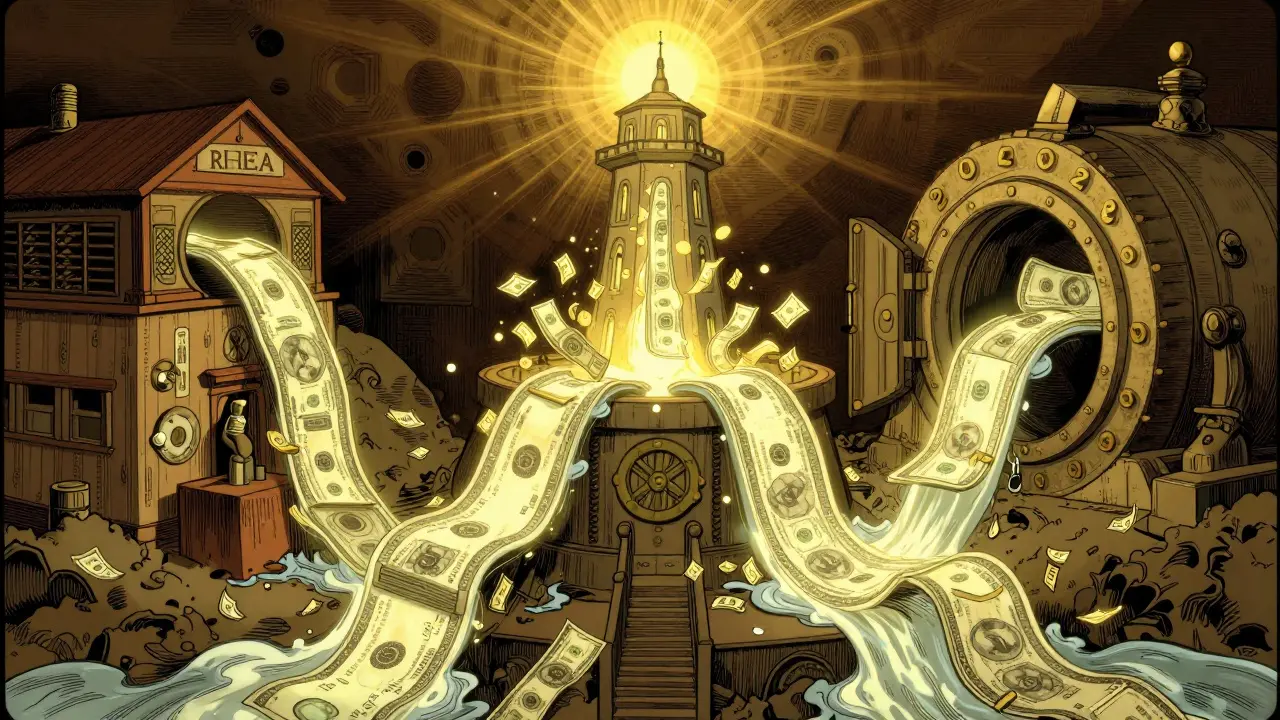
DeFi has always been a fragmented mess. You want to swap tokens? Go to a DEX. You want to lend? Go to a lending protocol. You want to use Bitcoin on Ethereum? Good luck bridging. It feels like juggling chainsaws. RHEA Finance is a unified, chain-abstracted decentralized finance hub built on the NEAR Protocol designed to solve this exact problem. It emerged from the merger of Ref Finance and Burrow Finance in March 2025, creating a single interface for swapping, lending, and borrowing across multiple blockchains. If you are holding crypto across different chains, this platform aims to make your life significantly easier by removing the friction of manual bridging and wallet switching.
As of March 2026, the platform has solidified its position as the backbone of NEAR DeFi. It is not just another exchange; it is a liquidity aggregation layer. The goal is borderless liquidity, allowing capital to move freely. Whether you are a day trader looking for the best execution price or a long-term holder wanting yield, understanding how RHEA works is crucial for navigating the current ecosystem.
The Origin Story: Ref Finance and Burrow Finance
Before RHEA existed, the NEAR ecosystem had two heavyweights. Ref Finance was a decentralized exchange (DEX) known for its automated market maker (AMM) model and efficient trading pairs. It handled the swapping side of things. On the other hand, Burrow Finance was a lending platform that allowed users to borrow assets against their collateral. Both were successful independently, but they operated in silos. Users had to manage liquidity separately and often faced inefficiencies when trying to combine strategies.
In March 2025, the teams announced a merger. This wasn't just a rebranding exercise. It was a strategic consolidation to address the fragmentation within the DeFi landscape. By combining the DEX capabilities of Ref with the lending infrastructure of Burrow, they created a unified contract system. This move was designed to streamline maintenance and improve scalability. Instead of interacting with two different smart contracts, users now interact with one main contract (v2.ref-finance.near). This consolidation reduces gas costs and simplifies the user experience, which is a massive win for the average investor.
How Chain Abstraction Works
The biggest selling point of RHEA Finance is its chain-abstraction technology. In traditional DeFi, if you want to trade Bitcoin on a platform built on Ethereum, you need to wrap it or bridge it. This involves multiple transactions, high fees, and security risks. RHEA changes the game.
Through chain abstraction, the platform allows you to interact with assets from external blockchains like Bitcoin, Ethereum, and Solana directly through the RHEA interface. You do not need to manually bridge assets or switch wallets. The system handles the complexity in the background. This means your Bitcoin can be used as collateral for a loan in the RHEA ecosystem without you needing to touch a bridge interface. It feels like a single app, even though the assets live on different networks.
This is powered by the NEAR Protocol infrastructure. NEAR is a blockchain platform known for its sharding technology and user-friendly account model. RHEA leverages NEAR's core technologies, including AI modules, to serve as the foundational financial application layer. The platform supports major networks including BASE, Arbitrum, Binance Smart Chain (BSC), and NEAR itself. This multi-chain support ensures that you are not locked into a single ecosystem.
Technical Architecture and Features
Under the hood, RHEA Finance uses a sophisticated mathematical model. It integrates multiple models to ensure efficiency. For basic token swaps, it uses the Traditional AMM Curve (x * y = k). For stablecoin trading, it employs StableSwap Curve optimization. These models are inspired by protocols like Uniswap v2, Curve Finance, and iZiSwap. However, RHEA runs them natively on NEAR's blockchain as open source, permissionless systems.
Here are the key features that set it apart:
- Permissionless Liquidity Pool Creation: Anyone can launch new trading pools. You do not need approval from protocol developers. This democratizes liquidity provision.
- Customizable Pool Fees: Liquidity providers can set their own transaction fees. This allows for nuanced risk-reward tradeoffs depending on the asset volatility.
- Slippage Protection: Large traders often suffer from slippage. RHEA lets users define minimum output or maximum input for trades, ensuring you get the price you expect.
- Specified Output Swaps: You can input the desired token amount, and the system auto-calculates the required payment. This is intuitive for users who know exactly how much they want to receive.
- Multi-Pool Routing: The system finds the best path for your trade across multiple pools, even without direct trading pairs.
All these pools and trading pairs are consolidated under a single main contract. This design contrasts with Uniswap's more fragmented structure. It improves system maintenance and scalability. For developers, there is also a Rhea SDK. This Software Development Kit enables building applications on top of the Rhea infrastructure, further expanding the ecosystem.

Tokenomics: RHEA, xRHEA, and oRHEA
Understanding the tokens is critical if you plan to participate. The platform operates on a multi-token system designed to align incentives. The total supply of the primary token is capped at 1 billion RHEA tokens with a 3-year vesting schedule. This emphasizes long-term ecosystem growth rather than quick flips.
Here is the breakdown of the three-token framework:
| Token | Function | Acquisition Method |
|---|---|---|
| RHEA | Governance and ecosystem participation | Primary asset |
| xRHEA | Staking rewards, gas fees, yield boosting | Staking RHEA |
| oRHEA | Incentive reward, convertible to RHEA | Platform activity |
The RHEA token serves as the main asset for governance. Holding it gives you a say in the protocol's future. xRHEA is earned through staking RHEA. It unlocks protocol utilities, including the ability to pay gas fees and boost lending yields. This creates a direct incentive to hold and stake. oRHEA is an incentive reward token earned through platform activity. It can be converted to RHEA based on user reputation. This reputation system encourages long-term, reliable behavior.
Additionally, the platform maintains governance through the REF Token. REF is the core governance token for the RHEA protocol that also enables revenue sharing. It has a total supply of 100 million REF tokens. The distribution is strategic: 60% goes to liquidity incentives over four years, with the highest allocation in year one. 2.5% goes to liquidity reserves for seeding protocol-owned liquidity pools. 2% is allocated to strategic airdrops for partners and contributors. The REF token was held via auction on Skyward Finance in July 2021, facilitating early fundraising and wide governance token distribution.
Market Status and Pricing
As of March 2026, the live RHEA Finance price is reported at varying points across different data sources. On CoinMarketCap, the price is around $0.01122 USD with a 24-hour trading volume of $375,442.34 USD. BlockExplorer reports the price at $0.0167 USD. The disparity in pricing across platforms may reflect different market conditions, trading pairs, and data aggregation methods. The 24-hour trading volume indicates moderate market activity for the token.
The platform currently offers 41 coins with 85 trading pairs available on the exchange according to CoinGecko. This variety is essential for users looking for specific assets. While the volume is moderate compared to giants like Uniswap, the focus is on quality and integration rather than just raw numbers. The pricing data suggests a stable but growing asset, reflecting the confidence in the underlying technology.

Comparison with Competitors
How does RHEA stack up against the established players? Let's look at the competitive landscape. Uniswap is the industry standard, but it operates primarily on Ethereum. This means high gas fees and a single-chain focus. Curve Finance is great for stablecoins but lacks the lending integration. RHEA Finance consolidates trading, lending, and liquidity services into a single unified interface.
The chain-abstraction capability represents a significant technological advantage. It allows RHEA to serve as a seamless gateway to cross-chain assets without manual bridging. This is a feature not universally available in competing platforms. The unified contract design improves system maintenance and scalability. However, RHEA Finance's primary limitation is its reliance on the NEAR Protocol ecosystem. NEAR has a smaller total value locked (TVL) and user base compared to Ethereum-based competitors. This potentially limits liquidity depth and trading volume compared to more established platforms.
RHEA operates as NEAR's flagship DeFi destination rather than as a truly independent competitor to major cross-chain aggregators. Its success is partially dependent on NEAR ecosystem growth. If NEAR grows, RHEA grows. This is a double-edged sword. It provides structural importance to ecosystem success, potentially creating network effects that strengthen the protocol over time.
Getting Started with RHEA
Using the platform is straightforward. The getting started process involves connecting a NEAR-compatible wallet. You then access the unified RHEA interface. This interface abstracts away the technical complexity of bridge operations and chain switching. The platform supports both basic traders seeking simple swaps and sophisticated users implementing complex yield strategies.
For advanced strategies, you can combine lending, borrowing, and margin trading capabilities. The Rhea SDK enables developers to build specialized applications on top of the infrastructure. Documentation is comprehensive, covering detailed tokenomics structures, pool architecture, and technical specifications. The native operation on NEAR's fast and low-cost infrastructure ensures transaction costs remain competitive. Learning curve varies by user type. Basic trading operations are straightforward due to the simplified interface. Advanced strategies like yield farming require deeper DeFi knowledge.
Future Outlook
Current developments indicate active protocol evolution. The merger completion in March 2025 consolidated the previous separate functions. The announced integration of NEAR's chain abstraction and AI modules into RHEA infrastructure suggests planned technological enhancements. The modular design enables future feature additions and community incentive mechanisms with relative ease. The roadmap positions RHEA to become a pivotal bridge in the next wave of DeFi resurgence. Success metrics will include NEAR ecosystem TVL growth, user adoption rates, and governance participation. Long-term viability depends on NEAR Protocol ecosystem growth and competitive differentiation.
Is RHEA Finance safe to use?
RHEA Finance operates on open source, permissionless smart contracts. Like all DeFi platforms, there are inherent risks. However, the unified contract design and integration with NEAR's security infrastructure provide a robust foundation. Always do your own research and start with small amounts.
What is the difference between RHEA and REF tokens?
RHEA is the primary asset for governance and ecosystem participation with a cap of 1 billion tokens. REF is the core governance token for the RHEA protocol that enables revenue sharing, with a total supply of 100 million tokens. They serve different roles within the incentive structure.
Can I trade Bitcoin on RHEA Finance?
Yes. Through chain-abstraction technology, you can interact with Bitcoin assets directly through the RHEA interface without needing to manually bridge assets or switch wallets. This simplifies the cross-chain user experience significantly.
How do I earn xRHEA?
xRHEA is earned through staking RHEA tokens. It unlocks protocol utilities including the ability to pay gas fees and boost lending yields. This creates a direct incentive to hold and stake your primary tokens.
What happened to Ref Finance and Burrow Finance?
They merged in March 2025 to form RHEA Finance. This consolidation was designed to address fragmentation within the DeFi landscape by creating a single, integrated liquidity solution accessible to users across multiple blockchain ecosystems.
The DeFi space is evolving rapidly. Platforms that offer simplicity without sacrificing power will win. RHEA Finance is positioning itself exactly there. By merging the best of Ref and Burrow, and leveraging NEAR's chain abstraction, it offers a compelling case for users tired of fragmented interfaces. Whether you are here for the yield, the governance, or the technology, RHEA provides a comprehensive toolkit for modern crypto management.
Justin Credible
March 25, 2026 AT 11:15honestly bridging stuff is just a pain in the neck for most people
everyone keeps talking about how easy it is but its not really
i remember trying to move some eth to near last year and it took forever
gas fees ate up like half my profit just to get the tokens over there
so seeing this rhea thing actually merge ref and burrow makes sense
it feels like they finally listened to what users actually want
instead of building silos they are making one big hub
i think the tokenomics look pretty solid too with the vesting schedule
nothing makes me happier than seeing a project that cares about long term growth
short term flips are just gambling and i am tired of that
the fact that you can use bitcoin as collateral without wrapping it is huge
security risks are always a worry but the near protocol seems robust enough
hopefully the liquidity deepens as more people jump on this train
i am deff gonna try swapping some tokens on the testnet first
just to see how the interface feels before i commit any real money
overall this looks like a massive step forward for the whole defi space
Mansoor ahamed
March 26, 2026 AT 09:53The chain abstraction layer is technically impressive.
It removes the need for manual bridging transactions.
This reduces the attack surface for users significantly.
NEAR's sharding technology supports this well.
Efficiency is key for mass adoption.
Jackie Crusenberry
March 26, 2026 AT 16:17It all sounds so complicated and exhausting to keep up with all these new tokens.
Shelley Dunbrook
March 28, 2026 AT 07:36One must admire the audacity of relying so heavily on a single ecosystem.
NEAR is promising but it is not Ethereum.
Putting all eggs in one basket is a bold strategy.
It feels like a gamble disguised as innovation.
Only time will tell if this abstraction holds up under pressure.
Aman Kulshreshtha
March 30, 2026 AT 04:05Yeah NEAR is growing fast though.
It is chill to see them pushing this tech.
Maybe it will work out better than we think.
People always underestimate new chains.
Just gotta wait and see what happens.
Misty Williams
March 31, 2026 AT 18:08It is imperative that users understand the risks involved.
DeFi platforms often promise security but deliver vulnerabilities.
One must always prioritize capital preservation over yield.
Blindly trusting a new protocol is irresponsible behavior.
Research is the only shield against financial loss.
Do not let greed cloud your judgment regarding these tokens.
kavya barikar
April 1, 2026 AT 15:11Safety is the most important factor here.
Users should read the smart contract audits.
It is good to be cautious with new platforms.
Protecting funds comes before making profits.
aravindsai pandla
April 2, 2026 AT 02:55Welcome to the community of learners here.
It is important to start small when testing new infrastructure.
Ensure you connect a wallet with limited funds initially.
This approach minimizes potential risks for everyone.
Knowledge is the best tool for navigating these markets.
namrata singh
April 2, 2026 AT 05:58I feel a bit overwhelmed by the complexity of it all.
There is so much to learn before I can participate safely.
Hope the platform remains stable for us new users.
It is scary to put money in something so technical.
But I am willing to try if it helps the ecosystem.
Andrea Zaszczynski
April 4, 2026 AT 02:01I want to know what specific assets you are holding.
People rarely share their actual portfolio allocations.
It would be interesting to see the real distribution.
Privacy is a myth in this digital age anyway.
I am tracking this closely myself.