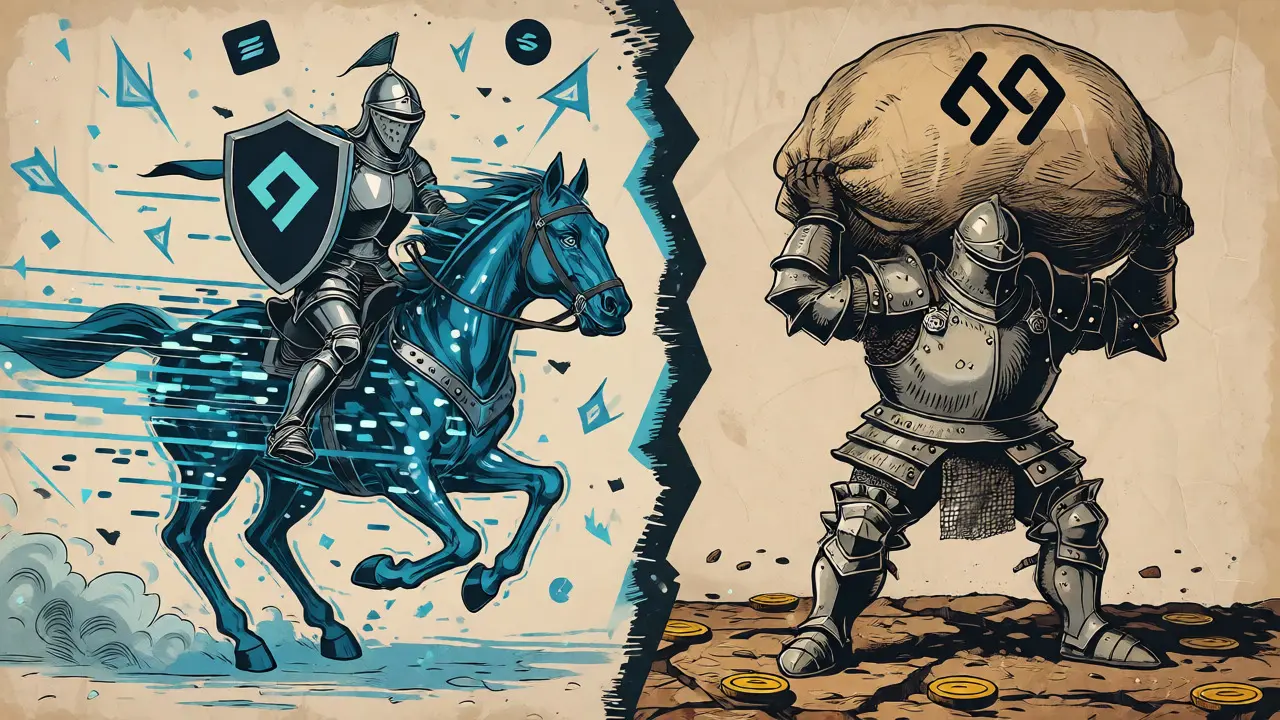
You bought SPURDO. You checked the price. It looked promising. Then you tried to sell it, and nothing happened. Or worse, you realized you bought the wrong version of SPURDO. If this sounds familiar, you are not alone. The confusion around this token isn't a bug; it's a feature of how low-cap meme coins operate in the current market.
Here is the hard truth: There isn't just one SPURDO. There are at least two major versions running on completely different blockchains, with vastly different supplies, prices, and risks. One lives on Solana, the other on Ethereum. They share the same name but behave like strangers. Before you put another dollar into this speculative asset, you need to know exactly which SPURDO you are holding, why the data looks so weird, and whether this project has any real future or if it’s just internet noise.
The Identity Crisis: Two Blockchains, One Name
Most cryptocurrencies have a unique ticker that points to one specific contract address. SPURDO breaks this rule. As of late 2025, market data shows significant discrepancies because traders are mixing up tokens from different networks. This creates a nightmare for beginners who rely on simple price charts.
On the Solana network, SPURDO operates as a high-speed, low-cost meme token with a fixed supply of 1 billion units. Its smart contract was deployed in 2023, featuring a 0% transaction tax and a burned liquidity pool. Burning liquidity means the developers sent their initial stake into a wallet no one can access, theoretically preventing a "rug pull" where they steal the money and run. This version trades at a higher unit price-around $0.08 as of October 2025-but has extremely low trading volume, often under $200 per day.
Meanwhile, on the Ethereum network, SPURDO exists as an ERC-20 token with a massive supply of 69 quadrillion units. Yes, quadrillion. This huge number creates a psychological pricing effect, making the token look incredibly cheap at fractions of a cent. However, this version lacks the security features of its Solana counterpart. There is no evidence of locked liquidity, meaning the developers could still withdraw funds at any time. The contract address for this version starts with 0x59C6... and is verified on Etherscan, but it carries a much higher risk profile due to its unverified team and lack of transparency.
Why does this matter? Because if you buy the Solana version thinking it’s the Ethereum one, or vice versa, your wallet won’t recognize the token properly, or you’ll be stuck with an asset that has zero liquidity on your chosen exchange. Always check the contract address before swapping.
Where Did SPURDO Come From?
Meme coins usually ride the wave of viral internet culture. Dogecoin rode dogs. Shiba Inu rode dog memes too. SPURDO rides a very specific niche: Swedish internet humor. The name comes from "Spurdo Spärde," a character from Swedish children's television that became a surreal meme on social media platforms like Twitter and Reddit.
The project describes itself not just as a meme, but as "a vibe." This vague branding is typical for projects that lack utility. There is no whitepaper detailing technical specifications. There is no roadmap with clear milestones. The website, spurdo.io, lists a "Phase 3: Ecosystem Expansion" but offers no timeline or specifics. For most investors, this is a red flag. A serious project explains what it solves. SPURDO simply asks you to join the community.
The appeal here is cultural rather than technological. For Swedes and those who follow Nordic internet trends, owning a piece of this digital joke feels like being part of an inside club. But for global investors, the connection is weak. Unlike Doge, which has universal recognition, Spurdo requires you to understand the reference to fully appreciate the "value." If you don't get the joke, you're likely just buying volatility.
Technical Specs: Speed vs. Security
If you ignore the hype and look at the code, the differences between the two SPURDOs become stark. Let’s break down the engineering reality.
| Feature | Solana SPURDO | Ethereum SPURDO |
|---|---|---|
| Total Supply | 1,000,000,000 (1 Billion) | 69,000,000,000,000,000 (69 Quadrillion) |
| Transaction Speed | ~400-600ms finality | ~15 seconds block time |
| Transaction Fee | <$0.00025 | Variable (Gas fees apply) |
| Liquidity Status | Burned (Safer) | Unlocked (High Risk) |
| Contract Type | SPL Token | ERC-20 Token |
| Audit Status | No public audit found | No public audit found |
The Solana version leverages the blockchain’s high throughput. With theoretical speeds of 65,000 transactions per second, it handles micro-transactions easily. If you want to trade small amounts without eating up your capital in fees, Solana is the practical choice. The burned liquidity pool adds a layer of trust, though it doesn’t guarantee the project will survive.
The Ethereum version suffers from the network’s congestion issues. While Ethereum is more secure and decentralized overall, using it for a meme coin with no utility is inefficient. You pay gas fees to move a token that might never go up in value. Plus, the unlocked liquidity means if the developer decides to sell their holdings, the price could crash instantly. There is no smart contract mechanism stopping them.
Market Performance and Liquidity Traps
Let’s talk about the elephant in the room: liquidity. In crypto, liquidity refers to how easily you can buy or sell an asset without affecting its price. SPURDO, in both versions, suffers from severe illiquidity.
Data from CoinGecko in October 2025 showed the Solana version had a 24-hour trading volume of just $154.16. That’s less than the cost of a nice dinner. When volume is this low, slippage becomes a killer. Slippage is the difference between the expected price of a trade and the price at which the trade is executed. If you try to sell $1,000 worth of SPURDO when only $50 is being traded daily, you might crash the price by 20% or 30% just to exit your position.
The Ethereum version fares slightly better in terms of absolute dollar volume on some aggregators, but it’s still negligible compared to established coins. For context, Bonk (BONK), another Solana meme coin, saw over $28 million in daily volume during the same period. SPURDO represents roughly 0.00017% of the total meme coin market cap. You are swimming in a pond, not an ocean.
This lack of volume creates a feedback loop. Low volume leads to wide bid-ask spreads. Wide spreads discourage new buyers. Fewer buyers mean lower volume. Eventually, the token becomes "dead," meaning you can hold it forever, but you can’t turn it back into cash.
Risk Assessment: Is It a Scam or Just Bad Timing?
Is SPURDO a scam? Not necessarily in the traditional sense of stealing money immediately. It’s more accurately described as a highly speculative gamble with poor fundamentals. Experts rate it with extreme caution. CryptoBureau gave it a 9.8/10 risk score, citing "extremely low liquidity, no utility, and multiple token versions creating market confusion."
User sentiment reflects this anxiety. On Reddit’s r/CryptoMoonShots, sentiment analysis from late 2025 showed 87% negative comments regarding SPURDO. Common complaints include:
- Inability to sell due to lack of buyers.
- Confusion over which network the token is on.
- Stale social media presence (the official Twitter hasn't posted since mid-2025).
- Fake volume claims.
However, there are outliers. Some traders report quick gains. One user claimed a 200% profit in three hours after buying on Uniswap. These stories exist, but they suffer from survivorship bias. You hear from the winners, not the thousands who lost their principal investment. The Telegram community has about 12,450 members, but activity is sparse, with only 2-3 messages per day. A quiet community is rarely a bullish signal.
How to Buy and Store SPURDO Safely
If you still want to take the bet, you must do it correctly. Buying the wrong token is the most common mistake.
For the Solana Version:
- Install a Solana-compatible wallet like Phantom Wallet (version 2.12.0 or later).
- Fund your wallet with SOL (Solana) to cover transaction fees.
- Go to a decentralized exchange (DEX) like Raydium or Jupiter.
- Paste the correct SPURDO contract address. Do not search by name alone.
- Swap SOL for SPURDO.
For the Ethereum Version:
- Install MetaMask (or another ERC-20 compatible wallet).
- Fund your wallet with ETH.
- Use a DEX like Uniswap.
- Verify the contract address (starting with 0x59C6...) matches the one you intend to buy.
- Approve the token spend, then swap ETH for SPURDO.
Never keep large amounts of meme coins on an exchange like Binance or Coinbase unless they explicitly list the specific version you own. Many exchanges delist low-volume tokens, leaving you stranded. Self-custody is safer, provided you back up your seed phrase offline.
The Future Outlook: Will SPURDO Survive?
Industry analysts are pessimistic. Delphi Digital predicts that 95% of low-volume meme coins launched recently will become completely illiquid within 18 months. Given SPURDO’s current trajectory-declining engagement, stale updates, and regulatory scrutiny-it fits this category well.
The SEC has started warning about tokens with identical tickers across multiple blockchains, viewing them as potential enforcement targets for investor confusion. If regulators crack down further, projects like SPURDO could face listing removals from major aggregators, further reducing visibility.
That said, meme coins are irrational. A single viral tweet or a celebrity mention can pump the price temporarily. But relying on that is gambling, not investing. If you treat SPURDO as lottery ticket money-money you are okay losing entirely-you might enjoy the ride. If you expect steady returns or fundamental growth, you will likely be disappointed.
Ultimately, SPURDO is a lesson in due diligence. It teaches you to check contract addresses, verify liquidity locks, and read beyond the hype. In the world of crypto, clarity is rare, and SPURDO proves that sometimes, the name says everything.
Which blockchain is SPURDO on?
There are two main versions of SPURDO. One is on the Solana blockchain (SPL token), and the other is on the Ethereum blockchain (ERC-20 token). They have different contract addresses, supplies, and prices. Always verify the contract address before purchasing to ensure you are buying the version intended for your wallet.
Is SPURDO a good investment?
SPURDO is considered a high-risk, speculative asset. It lacks utility, has very low trading volume, and faces confusion due to multiple implementations. Most financial experts classify it as a gambling vehicle rather than a long-term investment. Only invest money you can afford to lose completely.
Why are there different prices for SPURDO?
The price differences arise because you are looking at different assets sharing the same ticker symbol. The Solana version has a smaller supply (1 billion) and trades at a higher unit price. The Ethereum version has a massive supply (69 quadrillion) and trades at a fraction of a cent. Market data aggregators sometimes mix these up, causing apparent inconsistencies.
Can I sell SPURDO easily?
Selling can be difficult due to low liquidity. With daily trading volumes often under $200 for the Solana version, large sell orders can significantly impact the price (slippage). You may need to use decentralized exchanges (DEXs) like Raydium for Solana or Uniswap for Ethereum, as centralized exchanges may not support the token or have limited pairs.
Does SPURDO have a whitepaper?
No, SPURDO does not have a formal technical whitepaper. The project relies on social media presence and community vibes rather than detailed technical documentation or a defined roadmap. This lack of transparency is a significant risk factor for investors looking for substantive projects.