Election Cost Savings Calculator
How Blockchain Voting Reduces Costs
Blockchain voting can reduce election costs by 30-50% according to real-world implementations. This calculator estimates potential savings based on traditional voting costs.
Estimated Savings
Total Traditional Cost:
Estimated Blockchain Cost:
Potential Savings:
Based on article data: 30-50% cost reduction for blockchain voting systems. Actual savings may vary based on infrastructure and implementation.
Imagine casting your vote from your couch, your phone, or even overseas - and knowing with absolute certainty that your ballot was counted exactly as you intended. No lost ballots. No long lines. No tampering. That’s the promise of blockchain voting.
It’s not science fiction. Estonia’s i-Voting system has been handling nearly half of all national votes since 2019. West Virginia let its overseas troops vote via blockchain in 2018. Switzerland’s tiny town of Zug ran a fully digital vote in 2023 with zero security breaches. These aren’t theory tests. They’re real-world trials - and they’re revealing what blockchain can actually do for democracy.
Why Blockchain Makes Voting More Secure
Traditional voting systems - paper or digital - have one fatal flaw: they rely on a single point of control. A server. A ballot box. A central database. Take that down, and the whole system collapses. Hackers only need to crack one door.
Blockchain changes that. Instead of one server holding all votes, thousands of computers around the world each hold a copy of the ledger. Every vote is a transaction, cryptographically sealed and added to a chain. To change a vote, you’d need to hack more than half of those computers at the exact same time. It’s not just hard - it’s practically impossible with today’s technology.
That’s called the 51% rule. And it’s why Bitcoin has never been hacked. The same math protects blockchain votes. Even if someone breaks into one voting terminal, the rest of the network rejects the fake entry. No single government, tech company, or hacker group can manipulate the outcome alone.
Transparency Without Sacrificing Privacy
People worry: if everyone can see the votes, how is my privacy protected?
The answer is cryptography. Your vote isn’t stored as “John Smith votes Yes.” It’s stored as a scrambled code - a hash - linked to your public key, like an anonymous email address. You can verify your own vote was counted correctly using a public blockchain explorer. But no one else can link that hash to your identity.
This is called zero-knowledge proof. It’s the same tech that lets you prove you’re over 18 without showing your ID. In blockchain voting, you prove you’re eligible without revealing who you are. Election officials can audit every single vote in real time. Citizens can check their own ballot. Journalists can run independent counts. Everyone sees the same truth - without anyone seeing who voted for whom.
Cost Savings and Efficiency Gains
Running an election is expensive. Printing millions of ballots. Transporting them. Hiring poll workers. Securing polling stations. Counting by hand. In the U.S. alone, local elections cost an average of $1.50 per vote.
Blockchain voting cuts that cost by 30-50%. No paper. No trucks. No temporary staff. One 2023 analysis estimated a national election could save over $200 million using blockchain. That money could go toward voter education, outreach to rural communities, or fixing broken voting machines.
Results come in within minutes, not days. No more waiting for absentee ballots to arrive. No more recounts triggered by a few hundred misplaced slips. The blockchain records every vote instantly. And because it’s immutable, you never need to recount. The record is final.

Accessibility for Everyone - Especially the Hard-to-Reach
Think about the people who struggle to vote today:
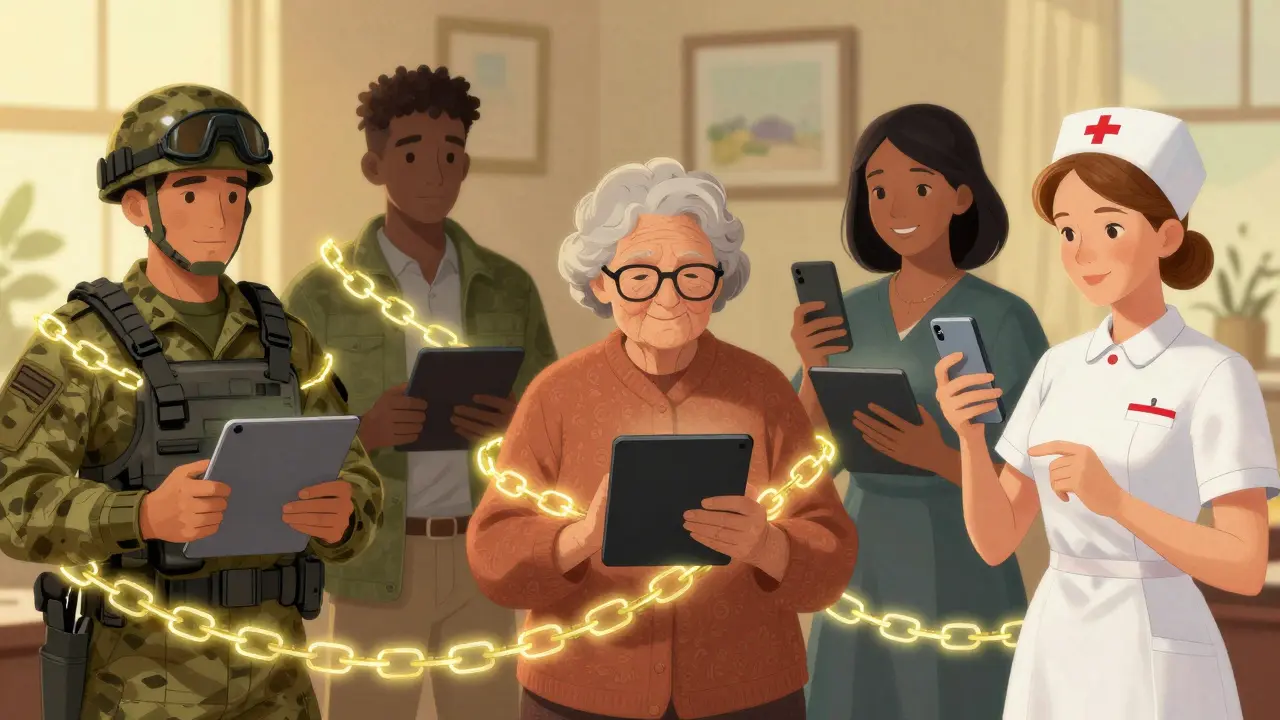
- A soldier stationed in Syria
- A nurse working a 12-hour shift on Election Day
- A senior citizen with mobility issues
- A citizen living abroad
With blockchain voting, they all vote the same way: from their own device. No mailing. No travel. No waiting. In West Virginia’s 2018 pilot, a Marine in Afghanistan said, “Being able to vote from a combat zone gave me real confidence my vote would count.”
It’s not just about convenience. It’s about inclusion. When voting becomes as easy as sending a text, participation rises. Countries with high digital access saw up to 18% higher turnout in blockchain pilot programs compared to traditional methods.
Real-World Use Cases Beyond National Elections
Don’t think blockchain voting is only for governments. It’s already working in places where trust matters just as much:
- Corporate voting: Nasdaq’s Linq platform has handled over 10,000 shareholder votes since 2015 - all traceable, all tamper-proof.
- Unions and associations: The Canadian Union of Public Employees tested blockchain voting in 2022 and cut vote-counting time from weeks to hours.
- Student governments: Universities in Australia and Germany now use blockchain for student council elections, with near-perfect audit trails.
These aren’t experiments. They’re proven models. And they show that blockchain doesn’t need to scale to millions overnight to deliver value. It works best where transparency and trust are critical - and where traditional systems fall short.
The Real Barriers: Tech Access and Public Trust
But here’s the truth: blockchain voting isn’t magic. It has serious challenges.
First, not everyone has reliable internet. Around 27% of the global population still doesn’t have regular access. That’s 2.1 billion people. If you design a system that only works on smartphones, you’re excluding seniors, low-income communities, and rural residents.
Second, the tech is complex. Most voters don’t understand hashes, public keys, or distributed ledgers. If they can’t verify their vote in a way that feels real - not just a screen saying “Your vote was recorded” - they won’t trust it.
Third, there’s the “last mile” problem. Even if the blockchain is secure, what if someone hacks your phone? Or installs malware that changes your vote before it’s sent? That’s not a blockchain flaw - it’s a device flaw. And it’s hard to fix at scale.
MIT researchers found serious security holes in Voatz, the app used in West Virginia. They showed how a malicious app could alter votes without detection. That’s why experts like Dr. J. Alex Halderman say: “No remote voting system can currently match the security of paper ballots.”
And trust? Only 38% of Americans say they’d believe results from a blockchain system, compared to 57% for paper. That’s not about the tech. It’s about perception. People don’t trust what they can’t see or understand.
How to Make It Work - And Avoid the Pitfalls
So how do we get from pilot programs to real adoption?
Start small. Use blockchain for organizational elections first - corporate boards, student councils, neighborhood associations. Build confidence. Train staff. Educate users.
Combine it with paper. A hybrid system - where blockchain records votes digitally but prints a verifiable paper backup - satisfies both tech lovers and skeptics. Switzerland’s 2023 pilot did exactly that. Zero breaches. Full auditability. Everyone felt safe.
Use government-issued digital IDs. Estonia ties blockchain voting to its national e-Residency system. Your ID card, with a chip and PIN, becomes your voting key. No app needed. No phone needed. Just a card reader.
Invest in education. Don’t just hand people an app. Show them how it works. Let them test it. Let them see their vote on the public ledger. Make the invisible visible.
And never forget: technology should serve democracy - not replace it. The goal isn’t to make voting faster. It’s to make it fairer.
What’s Next? The Road to 2030
By 2026, blockchain voting will be standard for corporate and organizational elections. By 2030, we may see it used in national elections - but only in countries with strong digital infrastructure, high public trust, and strict security standards.
South Korea is planning a national rollout by 2027. The EU’s eIDAS 2.0 framework, effective in 2024, is laying the legal groundwork for digital voting across member states. And researchers are already testing biometric authentication - fingerprint or facial recognition - to tie identity to votes without exposing personal data.
The future isn’t about replacing paper ballots. It’s about giving voters more options. Secure ones. Verifiable ones. Accessible ones.
Blockchain voting won’t fix every problem in democracy. But it can fix a few big ones: secrecy without obscurity, speed without sacrifice, and access without exclusion. If we get the design right - and we listen to the people who’ve been left out - it could be the most important upgrade to voting since the secret ballot.
Tara Marshall
December 5, 2025 AT 09:53Blockchain voting is cool in theory but the real issue is accessibility. Not everyone has a smartphone or reliable internet. You’re not solving democracy if you leave out 27% of the population.
Nelson Issangya
December 5, 2025 AT 11:45Stop pretending this is secure. Voatz got hacked in a lab test. If your voting system can be compromised by a malware-laced app, it’s not a solution-it’s a joke. Paper ballots aren’t perfect, but they’re not hackable by a 14-year-old with a USB stick.
Billye Nipper
December 6, 2025 AT 16:18I love this idea so much… I really do. But I’m scared. What if my grandma, who still uses a flip phone, gets left behind? What if the system looks fancy but feels cold? We can’t trade human connection for efficiency. Let’s make it inclusive, not just innovative.
Maybe we start with local elections? School boards? PTA votes? Let people feel the magic before we roll it out nationally.
I want to believe. But I need to feel safe too.
And honestly? I’d rather wait five years for something bulletproof than rush it and lose trust forever.
Let’s not turn democracy into a tech demo.
Regina Jestrow
December 7, 2025 AT 02:19Wait-so if I can verify my vote on a public ledger, why can’t I see who voted for whom? That’s the whole point of transparency, right? Or is this just privacy theater with fancy math?
And how do you prevent vote buying if no one can prove how they voted? If I pay you $500 to vote a certain way, and you can prove you did, isn’t that a loophole?
Just saying. This isn’t as clean as it looks.
Mariam Almatrook
December 7, 2025 AT 23:58How delightfully naive. You speak of blockchain as if it were a divine gift from the technocratic gods. Meanwhile, the majority of Americans can’t even correctly pronounce 'cryptographic hash.' You propose a system that requires a degree in computer science just to vote, and you call it 'accessible'?
Let us not forget: democracy was never meant to be efficient. It was meant to be deliberate. Slow. Human. Fallible. And above all-tangible.
Blockchain voting is not progress. It is a seductive illusion for those who worship silicon over soul.
rita linda
December 9, 2025 AT 17:24Let’s be real-this is just a Trojan horse for globalist elites to erase national sovereignty. Estonia? Switzerland? They’re tiny. They don’t have real voter fraud. The U.S. needs paper trails, not blockchain fairy tales. This is how they rig elections without the ballots.
And don’t even get me started on biometrics. They’re already tracking us through our phones. Now they want to tie our faces to our votes? No thanks.
This isn’t innovation. It’s surveillance with a pretty UI.
Scott Sơn
December 10, 2025 AT 11:46Imagine this: You’re in a warzone, your buddy’s dead, and you vote via an app that says ‘Your vote was recorded!’-but you don’t know if it actually was. You’re not voting. You’re praying to a black box.
That’s not empowerment. That’s emotional manipulation dressed up as tech.
And don’t tell me about ‘transparency.’ If I can’t hold a ballot in my hands, I can’t trust it. Not one bit.
Blockchain won’t fix democracy. It’ll just make it feel like it’s fixed.
Barb Pooley
December 10, 2025 AT 16:19Who owns the blockchain nodes? Big tech? The government? Who’s auditing them? What if the whole system is rigged from the inside? You think they’d let you know?
And what about the 2020 election? You think they didn’t test this stuff then? You think they didn’t already have a backdoor?
This isn’t security. It’s a honeypot. And we’re the flies.
Ben VanDyk
December 10, 2025 AT 17:15Cost savings? Really? You’re ignoring the cost of onboarding, training, cybersecurity, audits, and public relations campaigns to convince people it’s not a scam. You think $200 million is a saving? That’s just the tip of the iceberg.
And your ‘zero breaches’ in Zug? That’s because they had 200 voters. Try scaling that to 150 million.
Also, your source? A tech blog. Not a peer-reviewed study.
Annette LeRoux
December 11, 2025 AT 16:38Love the idea 🌟 but… what if your phone dies right before you vote? Or you lose your digital ID? Or your kid accidentally taps ‘yes’ instead of ‘no’? 😅
Democracy shouldn’t be a game of tech roulette. We need backups. Always. Paper. Always.
Hybrid = smart. Pure digital = risky.
Tom Van bergen
December 12, 2025 AT 19:48You keep saying blockchain is immutable but you ignore that the input is still human. If I can trick your phone into sending a different vote, the blockchain just records the lie. The tech doesn’t care if you’re lying. It just records.
This isn’t democracy. It’s automated gullibility.
Also, ‘zero-knowledge proof’? That’s just a buzzword for ‘we’re hiding the truth behind math.’
miriam gionfriddo
December 13, 2025 AT 01:18Wait so the system is secure but your phone isnt? So the weak link is the user? Then why are we trusting users with a system that requires them to be cybersecurity experts?
Also I think I saw a typo in the article. It said 'cryptographically sealed' but I think it meant 'cryptographically sealed.' I'm not sure. My eyes are tired. But it's still wrong.
Also I'm pretty sure the Swiss used blockchain in 2023 but I think it was actually 2022? Or was it 2024? I forgot. I didn't read the whole thing.
Jonathan Sundqvist
December 15, 2025 AT 00:04America doesn’t need blockchain voting. We need to fix the damn polling places. Close the gaps. Hire more workers. Stop gerrymandering. Stop purging voters. Stop making it hard to vote in the first place.
This isn’t a solution. It’s a distraction. A shiny object while the house burns down.
And don’t bring up Estonia. We’re not Estonia. We’re not a tiny country with one language and one culture. We’re a mess. And you can’t code your way out of that.
Thomas Downey
December 16, 2025 AT 06:56It is profoundly disturbing that anyone would consider replacing the sacred, tactile ritual of ballot casting with a digital transaction mediated by corporate servers and opaque algorithms.
The secret ballot was not invented to be convenient. It was invented to protect the soul of the voter from coercion, intimidation, and the corrosive influence of power.
Blockchain voting is not an evolution-it is a surrender.
Renelle Wilson
December 18, 2025 AT 00:15I get the appeal. I really do. But let’s not forget who gets left behind when we go all-digital: elderly folks, low-income families, rural communities, people with disabilities who rely on tactile interfaces, and those who don’t trust tech because of past betrayals.
Technology should lift people up-not create new barriers disguised as progress.
Hybrid systems aren’t compromise. They’re wisdom.
We can have blockchain for verification and paper for trust. We don’t have to choose.
And we owe it to every voter-not just the ones who can afford a smartphone-to make sure they can vote with dignity, not just with convenience.
Democracy isn’t a startup. It’s a covenant.
Let’s honor it with care, not code.
Manish Yadav
December 18, 2025 AT 12:13Blockchain? In India? No way. We have millions who can't even read. You think they'll use an app? This is for rich countries. We need more schools, not more apps.
Nicole Parker
December 19, 2025 AT 09:54What if the real problem isn’t the voting system but the fact that people feel disconnected from politics? Why are we so obsessed with making voting easier when so many don’t even care?
Maybe we should spend more time rebuilding trust in institutions than building trust in algorithms.
People don’t fear hacked ballots-they fear being ignored. A blockchain vote won’t fix that.
And honestly? I think we’re mistaking speed for justice. Faster doesn’t mean fairer.
Maybe the answer isn’t more tech. Maybe it’s more listening.
What if we started by asking voters what they actually need? Not what tech bros think they need.
Just a thought.
michael cuevas
December 20, 2025 AT 00:45Wow. You really think people are gonna trust a system where their vote is a hash? Like, congrats, you turned democracy into a crypto wallet. Next you’ll be asking us to sign in with our Twitter.
Meanwhile, my uncle still uses a fax machine to send birthday cards. He’s gonna vote via QR code? 😂
Let’s fix the damn paper system before we invent a new one that only engineers understand.
Shane Budge
December 21, 2025 AT 19:05Blockchain voting is a scam. The real goal is to centralize control under the guise of decentralization. You think the nodes are distributed? Nah. They’re owned by five tech giants. And guess who controls the keys?
It’s not about security. It’s about control.
And don’t tell me about Estonia. They have a national ID system built over 20 years. We don’t. We have a patchwork of broken systems and voter suppression.
This isn’t innovation. It’s a power grab.
Adam Bosworth
December 22, 2025 AT 18:23So let me get this straight-you want to replace paper ballots with something that can be hacked through your phone’s camera? And you call that secure? 😭
Meanwhile, your ‘zero breaches’ in Zug? That’s because they had 300 voters. Try 10 million. Try a nation. Try a hack that changes 10,000 votes and no one notices because the blockchain says it’s ‘valid’.
And don’t even get me started on the fact that you can’t audit the device that’s sending the vote.
This isn’t democracy. It’s a horror movie written by a Silicon Valley intern.