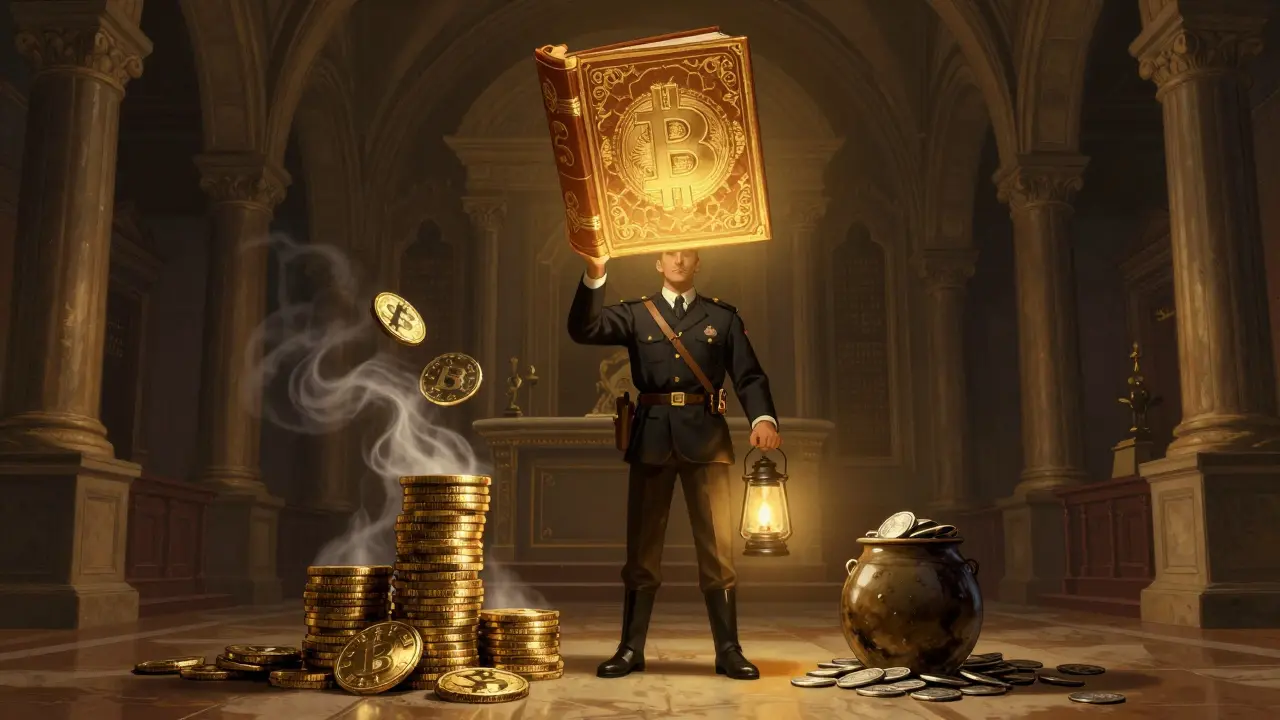
Imagine you are a security guard for a massive bank. You get paid a salary every month, but customers also tip you if they want their deposit processed faster. Now, imagine the bank slowly cuts your salary by half every few years. Eventually, your tips have to cover all your bills. This is exactly what is happening in the world of cryptocurrency.
The backbone of networks like Bitcoin is a decentralized digital currency that relies on miners to secure its ledger through proof-of-work. These miners don't work for free. They are compensated through two main sources: the block reward (newly minted coins) and transaction fees (tips from users). Understanding the difference between these two income streams is crucial because it determines how secure the network stays as time goes on.
What Is a Block Reward?
A block reward is the total package a miner or validator receives for adding a new block of transactions to the blockchain. Think of it as the paycheck for doing the heavy lifting of verifying data and securing the network against attacks.
This reward has two distinct parts:
- Block Subsidy: This is newly created cryptocurrency. It comes out of thin air, following a strict mathematical schedule set by the network's code. In Bitcoin, this is often called "minting."
- Transaction Fees: These are small amounts of crypto that users voluntarily attach to their transactions to encourage miners to include them in the next block.
In the early days of Bitcoin, the block subsidy made up almost 100% of the reward. When Satoshi Nakamoto launched Bitcoin in 2009, the subsidy was 50 BTC per block. Today, after several halvings, that number is much lower. The transaction fee component, once negligible, is becoming increasingly important.
The Block Subsidy: A Shrinking Pie
The block subsidy is designed to be deflationary. It follows a predetermined schedule known as the "halving" in Bitcoin's case. Approximately every four years (or every 210,000 blocks), the amount of new Bitcoin created per block is cut in half.
Here is how the math works:
- 2009: 50 BTC per block
- 2012: 25 BTC per block
- 2016: 12.5 BTC per block
- 2020: 6.25 BTC per block
- 2024: 3.125 BTC per block
- 2028 (Projected): 1.5625 BTC per block
This mechanism ensures that there will never be more than 21 million bitcoins. The last bitcoin is expected to be mined around the year 2140. As the subsidy shrinks, miners earn less from creating new coins. This forces them to rely more heavily on the second part of the equation: transaction fees.
| Year | Halving Event | Subsidy per Block (BTC) |
|---|---|---|
| 2009 | Genesis | 50.0000 |
| 2012 | 1st Halving | 25.0000 |
| 2016 | 2nd Halving | 12.5000 |
| 2020 | 3rd Halving | 6.2500 |
| 2024 | 4th Halving | 3.1250 |
| 2028 | 5th Halving (Est.) | 1.5625 |
Transaction Fees: The User's Tip Jar
If the block subsidy is the salary, transaction fees are the tips. Users pay these fees to prioritize their transactions. When you send Bitcoin, you specify a fee rate (usually measured in satoshis per byte). Miners look at the "mempool"-a waiting room for unconfirmed transactions-and pick the ones with the highest fees first.
Why do fees matter? Because they create a market for block space. If everyone tries to transact at once, the block fills up. Users who want their money moved quickly must outbid others. This competition drives up fees during periods of high demand.
Consider December 22, 2017. During a massive bull run, network congestion was extreme. On that single day, transaction fees accounted for 78% of the total block reward. Miners earned nearly four times more in fees than in block subsidies. While such extremes are rare, they prove that fees can become the dominant source of income when the network is busy.

Bitcoin vs. Ethereum: Two Different Models
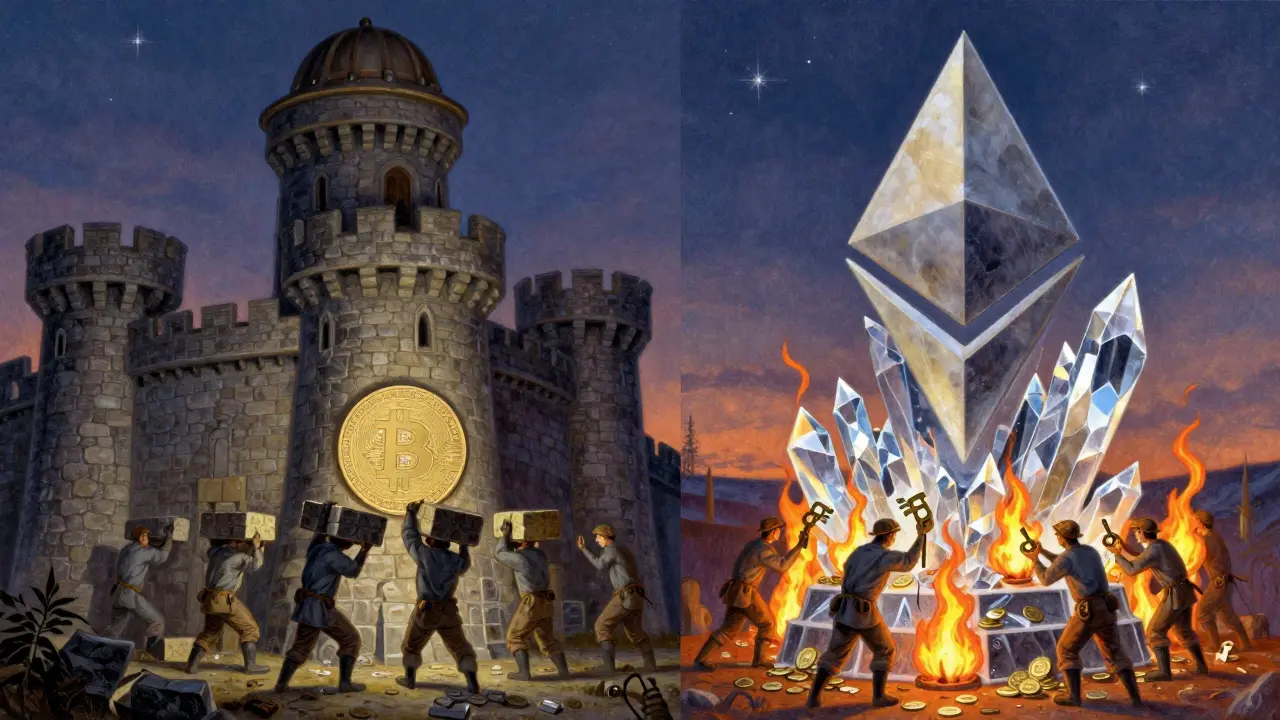
Not all cryptocurrencies handle rewards the same way. Comparing Bitcoin and Ethereum highlights two different approaches to network security and economics.
Bitcoin uses Proof-of-Work (PoW). Miners spend electricity and hardware to solve puzzles. Their reward is the block subsidy plus fees. The supply is hard-capped at 21 million.
Ethereum, however, transitioned to Proof-of-Stake (PoS) in 2022. Instead of miners, we now have validators who lock up ETH to secure the network. Here is where it gets interesting:
- No Hard Cap: Ethereum does not have a fixed maximum supply like Bitcoin.
- Fee Burning: Under EIP-1559, a portion of transaction fees is burned (destroyed) rather than going to validators. This creates deflationary pressure when network activity is high.
- Variable Rewards: Validator rewards depend on how much ETH is staked overall. If more people stake, individual rewards decrease slightly due to dilution.
This means Ethereum's monetary policy fluctuates. It can be inflationary or deflationary depending on usage. Bitcoin, by contrast, is always inflationary until the last coin is mined, but the rate of inflation drops predictably over time.
Why the Shift Matters for Security
You might wonder why any of this matters to you. If you just hold crypto, doesn't the price go up regardless? Not necessarily. Network security depends on miners and validators being profitable.
If block subsidies disappear and transaction fees remain low, miners might shut down their equipment. With fewer miners, the network becomes easier to attack. This is known as the "post-halving adjustment." Historically, Bitcoin has survived every halving because the price of Bitcoin increased enough to offset the reduced subsidy. But eventually, the subsidy will be so small that fees must carry the entire load.
Experts from firms like River Financial argue that transaction fees are essential for long-term sustainability. As the subsidy approaches zero, the network must generate enough fee revenue to incentivize participants to keep the lights on. If fees stay low, security could weaken. If fees spike too high, regular users might find the network unusable, pushing them to other chains.
How Users Can Navigate Fee Markets
As a user, you are directly involved in this economic game. Every time you send a transaction, you are bidding for space in a block. Here is how to manage it effectively:
- Check the Mempool: Use tools like mempool.space to see current network congestion. If the mempool is empty, you can use a lower fee. If it's full, expect to pay more.
- Use Dynamic Fee Estimators: Most wallets offer "Slow," "Medium," and "Fast" options. These estimate how many blocks it will take for your transaction to confirm based on recent data.
- Time Your Transactions: Network usage varies by time zone. Sending Bitcoin late at night (UTC) might result in lower fees compared to peak hours in Asia or Europe.
- Consider Layer 2 Solutions: For small payments, using a Layer 2 network like the Lightning Network (for Bitcoin) or rollups (for Ethereum) can drastically reduce costs, bypassing the main chain's fee market entirely.
The Future of Crypto Economics
We are living in a transitional period. Bitcoin's next halving in 2028 will cut the subsidy to 1.5625 BTC. By then, transaction fees will need to play a much larger role in keeping miners happy. Meanwhile, Ethereum continues to experiment with its fee-burning model, aiming to make ETH a scarce asset while maintaining robust validator incentives.
The ultimate goal for both networks is a sustainable equilibrium. Miners and validators must earn enough to cover their costs and make a profit, while users must pay fees that are reasonable enough to keep using the network. Striking this balance is one of the biggest challenges in blockchain design today.
What happens when the Bitcoin block subsidy reaches zero?
When the block subsidy reaches zero (around the year 2140), miners will rely entirely on transaction fees for compensation. The network will still be secure as long as users are willing to pay sufficient fees to incentivize miners to process transactions and protect the ledger from attacks.
Why are transaction fees higher during bull markets?
During bull markets, more people buy and move cryptocurrency, leading to higher network congestion. Since each block has limited space, users compete by offering higher fees to ensure their transactions are included quickly. This increased demand drives up the average fee rate.
Does Ethereum have a block reward like Bitcoin?
Ethereum no longer has traditional mining block rewards. After switching to Proof-of-Stake, validators receive rewards for proposing and attesting to blocks. However, a significant portion of transaction fees is burned, meaning it is removed from circulation rather than given to validators.
Can I avoid paying high transaction fees?
Yes, you can avoid high fees by timing your transactions during low-traffic periods, using lower fee rates if you don't need immediate confirmation, or utilizing Layer 2 scaling solutions like the Lightning Network for Bitcoin or various rollups for Ethereum.
How does the Bitcoin halving affect miners?
The halving cuts the block subsidy in half, reducing miners' immediate revenue. To stay profitable, miners must either improve efficiency, lower electricity costs, or rely more on transaction fees. If the Bitcoin price rises significantly, it can offset the reduced subsidy.