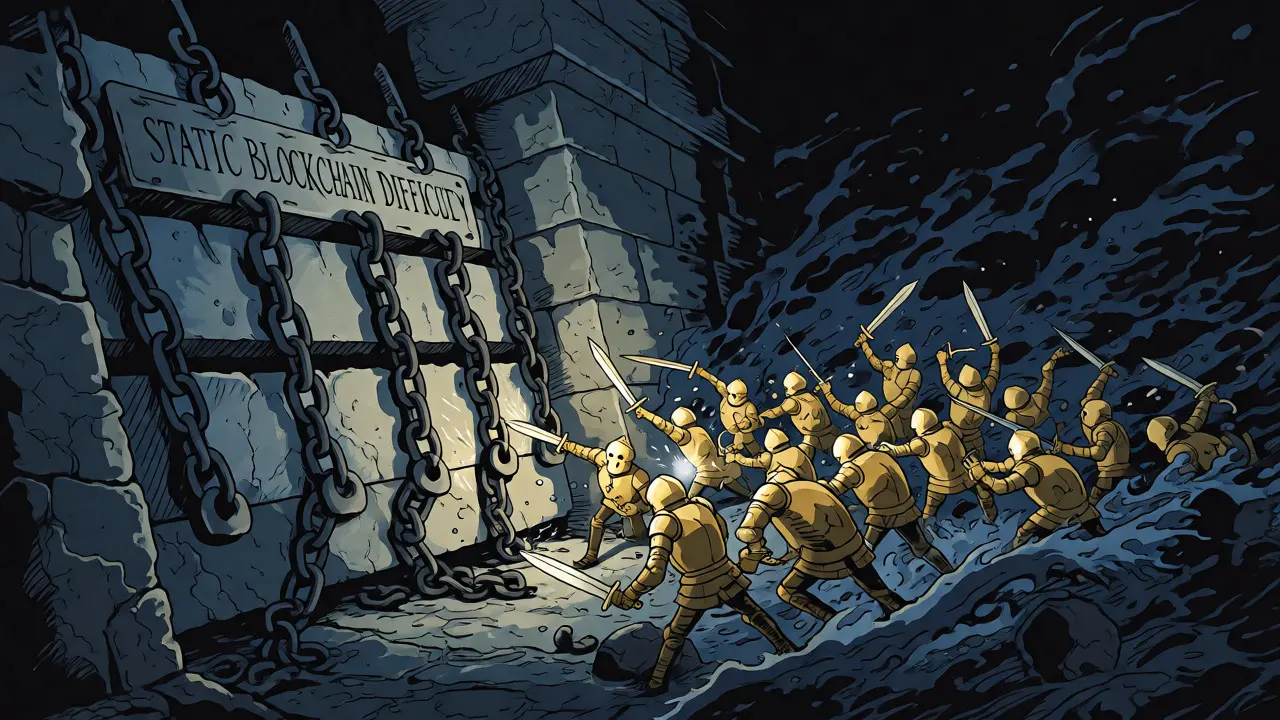
Imagine trying to drive a car where the speed limit changes only once every two weeks. If you suddenly hit a highway with no traffic, you’d be crawling at 10 mph for days before the sign updated. That’s essentially how Bitcoin handles its mining difficulty today. It adjusts based on a rigid, bi-weekly schedule. But what if the road conditions changed instantly? What if an attacker could game that slow update cycle?
This is where the concept of adaptive mining difficulty enters the chat. It’s not just a theoretical tweak; it’s a proposed evolution designed to make blockchain networks smarter, faster, and more resistant to manipulation. Instead of waiting for a calendar date to change the rules, adaptive systems react in real-time. Let’s break down why this shift matters, how it works, and whether your favorite crypto network will actually adopt it.
The Problem With Static Adjustments
To understand the future, you have to look at the flaws of the present. Currently, most Proof-of-Work (PoW) chains use static or semi-static adjustment algorithms. Take Bitcoin. Every 2,016 blocks-roughly every two weeks-the network calculates how long it took to mine those blocks compared to the target time (10 minutes per block). If it was too fast, difficulty goes up. Too slow, it goes down.
This seems logical, but it creates massive blind spots. During those two weeks, the network is vulnerable. If a huge chunk of hash power drops offline suddenly-like when China banned mining in 2021-the network doesn’t adjust immediately. Blocks start coming in slower than expected. Miners are left grinding against a difficulty level that is now way too high for the available computing power. This hurts profitability and can destabilize smaller miners who can’t afford to wait out the lag.
| Feature | Static Adjustment (e.g., Bitcoin) | Adaptive Adjustment (Proposed) |
|---|---|---|
| Adjustment Frequency | Every 2,016 blocks (~2 weeks) | Real-time or per-block micro-adjustments |
| Vulnerability Window | High (up to 2 weeks) | Minimal (seconds to minutes) |
| Response to Hash Rate Spikes | Slow, leads to orphaned blocks | Immediate correction |
| Complexity for Miners | Predictable, easy to plan | Dynamic, requires advanced monitoring |
On the flip side, if hash power surges unexpectedly, blocks get mined too quickly. This floods the network with transactions and increases the risk of forks because nodes don’t propagate new blocks fast enough relative to the generation rate. Static systems simply can’t keep up with the volatility of modern hardware markets and geopolitical shifts.
How Adaptive Protocols Actually Work
So, how do we fix this? An adaptive protocol moves away from pure time-based metrics. Instead, it looks at a broader set of data points to calculate difficulty continuously. Think of it as a thermostat that doesn’t check the temperature once a day, but constantly monitors humidity, air pressure, and outdoor temp to adjust the heating perfectly.
Research suggests these protocols analyze several key variables:
- Hash Rate Distribution: How spread out is the mining power? If one pool controls 40% of the hashrate, the system might adjust difficulty to discourage centralization.
- Block Propagation Times: How fast are blocks traveling across the globe? Slow propagation means higher fork rates, so difficulty might increase slightly to slow down block creation and allow better synchronization.
- Network Latency Patterns: Real-time monitoring of node communication health.
One promising approach involves recording "abandoned" blocks (orphaned blocks) as special transactions in the main chain. In a standard setup, if you mine a block that gets beaten by another miner, it’s wasted energy. In an adaptive model, that effort isn’t lost; it contributes to the difficulty calculation. This ensures that the difficulty reflects the actual work done by the network, not just the accepted blocks. This method helps resist selfish mining attacks, where large pools withhold blocks to gain an advantage.
Security Benefits: Killing Selfish Mining
Selfish mining is a nightmare for network integrity. A large mining pool finds a block but keeps it secret. They continue mining on their private chain while broadcasting nothing. When they finally reveal their longer chain, other miners waste their work. In a static system, the attacker can exploit the delay between difficulty adjustments to maximize their profit during these stealth periods.
Game theory models show that adaptive difficulty neutralizes this advantage. By adjusting difficulty in near real-time, the window of opportunity for attackers shrinks dramatically. If a pool tries to hoard blocks, the network detects the anomaly in block intervals and adjusts parameters to reduce the profitability of withholding. It turns a strategic game where big players dominate into a fairer playing field.
Consider the October 2024 scenario where Bitcoin’s difficulty hit a record 95.7 trillion. In a static system, miners had to endure months of squeezed margins before the next adjustment. An adaptive system would have smoothed out that spike, allowing smaller miners to stay online rather than capitulating to larger operations with cheaper energy costs. This resilience is crucial for decentralization.

Economic Impact and Energy Efficiency
Let’s talk money. Mining is expensive. The global cryptocurrency mining market was valued at approximately $2.8 billion in 2024. For miners, predictability is king. They buy rigs based on projected returns over 12-24 months. If difficulty swings wildly every hour, financial modeling becomes a guessing game.
Critics argue that adaptive difficulty adds complexity. Small-scale miners might struggle to monitor real-time metrics without sophisticated software. However, proponents point to energy efficiency. Studies suggest adaptive systems could cut overall network energy consumption by 15-25%. How? By preventing "over-mining." When difficulty is too low, miners rush to solve puzzles, burning electricity for marginal gains. When it’s too high, they burn electricity with little chance of success. Real-time calibration keeps the network operating at optimal efficiency, reducing wasted computational power.
For investors and users, this means a more stable supply issuance curve. Block rewards remain consistent in value terms, avoiding the boom-bust cycles associated with sudden difficulty crashes or spikes. It also aligns better with environmental goals, a growing concern for institutional investors entering the space.
Implementation Challenges and Barriers
If this sounds perfect, why hasn’t Bitcoin switched yet? Because changing consensus rules is like steering an ocean liner. It takes time, and everyone needs to agree.
First, there’s the technical overhead. Full nodes need to store more data. Tracking abandoned blocks and real-time metrics increases storage requirements. While the elimination of forked chains might reduce total data long-term, the immediate burden on older hardware running full nodes is significant.
Second, backward compatibility. You can’t just push an update. Bitcoin uses soft forks for many upgrades, which allows older nodes to still validate transactions, but adaptive difficulty might require deeper changes. Developers are cautious. The conservative culture of Bitcoin Core prioritizes stability over innovation. Any bug in the difficulty algorithm could halt the network or cause a permanent fork.
Third, community consensus. Miners hate unpredictability. Many prefer the current two-week cycle because they can plan their cash flow. Convincing them to accept hourly fluctuations requires demonstrating clear economic benefits. Testnet implementations have shown mixed reactions. Some users love the improved confirmation times during stress tests; others find the constant monitoring stressful.

The Road Ahead: Hybrid Models and AI
We likely won’t see a hard switch from static to fully adaptive overnight. Instead, expect hybrid models. These combine periodic major adjustments with minor, real-time micro-corrections. Imagine a baseline difficulty set every week, with small tweaks allowed every few blocks to handle sudden spikes.
Machine learning is also entering the picture. Predictive algorithms could analyze historical patterns, energy prices, and even weather forecasts (which affect hydro-powered mining farms) to anticipate difficulty changes. Ethereum’s post-merge research offers clues here, though Ethereum moved to Proof-of-Stake. Other PoW chains like Litecoin, which already adjusts every 2.5 minutes, serve as testing grounds for faster cycles.
Industry analysts predict that new blockchain networks launching in 2026-2027 will include adaptive difficulty as a standard feature. Established giants like Bitcoin will move slower, perhaps adopting hybrid approaches within the next decade. The pressure comes from both sides: regulators demanding energy efficiency, and competitors offering faster, smoother user experiences.
Key Takeaways
- Current Flaws: Static difficulty adjustments create vulnerability windows lasting up to two weeks, exploited by selfish miners and disrupted by sudden hash rate changes.
- Adaptive Solution: Real-time protocols use multiple metrics (hash distribution, latency, orphan rates) to calibrate difficulty continuously, enhancing security and stability.
- Economic Trade-off: Adaptive systems may improve energy efficiency by 15-25% but add complexity for miners who prefer predictable planning.
- Implementation Hurdles: Storage overhead, backward compatibility issues, and lack of community consensus slow adoption in major networks like Bitcoin.
- Future Outlook: Expect hybrid models and AI-driven predictions to emerge first in newer blockchains, with legacy networks gradually adapting.
Why doesn't Bitcoin use adaptive difficulty right now?
Bitcoin prioritizes stability and decentralization over rapid optimization. Changing the difficulty algorithm requires broad consensus among developers, miners, and node operators. Additionally, the conservative upgrade process ensures that any change is thoroughly tested to avoid catastrophic failures like accidental network halts or unintended forks.
Does adaptive difficulty help save energy?
Yes, potentially. By preventing scenarios where miners burn excess electricity due to miscalibrated difficulty levels, adaptive systems optimize resource allocation. Research suggests this could reduce overall network energy consumption by 15-25%, making mining more sustainable and cost-effective.
How does adaptive difficulty stop selfish mining?
It reduces the profitability of withholding blocks. In static systems, attackers can exploit the time between adjustments to hide their progress. Adaptive protocols detect anomalies in block timing and adjust difficulty almost instantly, closing the window of opportunity for manipulative strategies and enforcing Nash equilibrium in mining behavior.
Will small miners be disadvantaged by adaptive systems?
There is a learning curve. Small miners rely on predictable income for equipment financing. Adaptive systems introduce variability that requires better monitoring tools. However, by stabilizing block times and reducing extreme difficulty spikes, adaptive systems may actually protect small miners from being wiped out during sudden hash rate crashes, offering long-term fairness.
What are the risks of implementing adaptive difficulty?
The main risks include increased storage requirements for full nodes, potential bugs in complex real-time algorithms, and resistance from the mining community accustomed to static cycles. If the algorithm reacts too aggressively to noise, it could cause unnecessary volatility, confusing users and miners alike.