You lock up your crypto to earn rewards. You pick a reputable validator. You wait for the yield. Then, overnight, a chunk of your stake vanishes. It wasn't hacked. It wasn't stolen. The network simply penalized you because the validator went offline or made a technical error. This is slashing, and it is the silent killer of passive income in the world of decentralized finance.
For years, this was just an accepted risk. If you wanted high yields on Proof-of-Stake networks, you had to accept that mistakes cost money. But as institutions with billions of dollars enter the space, "accepting the risk" is no longer an option. Enter slashing insurance. This emerging financial product acts as a safety net, reimbursing delegators when validators trigger automatic penalties. It is rapidly becoming the standard for serious staking operations.
What Is Slashing in Proof-of-Stake Networks?
To understand why you need insurance, you first have to understand the threat. In traditional banking, if a bank makes a mistake, they might pay a fine. In blockchain, specifically Proof-of-Stake (PoS) consensus mechanisms, the protocol itself enforces rules. Validators are responsible for proposing and attesting to new blocks. If they fail, the smart contract automatically deducts a portion of their staked assets. This is slashing.
There are three main ways this happens:
- Downtime Slashing: The validator node goes offline. Maybe the internet cuts out, maybe the server crashes, or maybe the operator forgets to update software. The network sees silence where there should be activity and penalizes the stake.
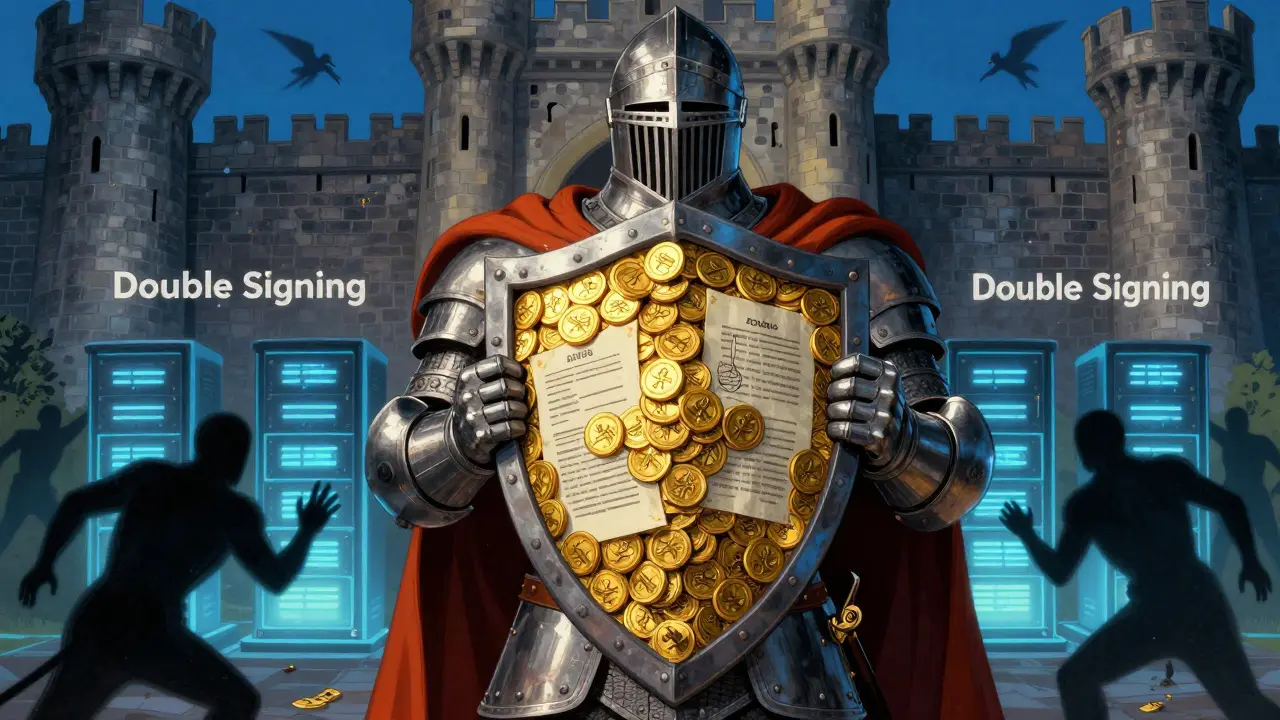
- Double Signing: This is more severe. A validator signs two different blocks at the same height in the chain. This breaks the consensus and can lead to a fork. The penalty here is usually much higher than downtime.
- Malicious Behavior: Attempting to attack the network or collude with others to manipulate the ledger results in the most severe penalties, often leading to total loss of stake.
The key thing to remember is that these systems are impartial. The code does not care if you are a Fortune 500 company or a hobbyist running a node in your garage. If the rule is broken, the penalty is executed. This automatic nature is what makes insurance necessary. There is no customer service line to call and ask for a refund after a slash event.
How Slashing Insurance Works
Slashing insurance functions similarly to property insurance but with a digital twist. Instead of covering fire or theft, it covers protocol-enforced financial losses. The model typically involves three layers of protection.
First, there is the primary coverage provided by the staking infrastructure provider. Companies like Luganodes include this in their institutional agreements. They absorb the initial shock of minor slashing events using internal reserves. Second, specialized blockchain insurers step in. Chainproof and Nexus Mutual are examples of entities that underwrite specific risks, such as double signing on Ethereum. Finally, traditional reinsurance giants like Munich Re provide tertiary coverage. This means if the specialized insurer faces a massive claim, Munich Re backs them up. This multi-layered approach ensures that even large-scale slashing events do not bankrupt the protection provider.
The process for a user is generally straightforward. When a slashing event occurs, the protocol records it on-chain. Monitoring tools detect the event. The insurance provider verifies the claim against the policy terms-checking if the cause was covered (e.g., accidental downtime vs. malicious intent). Once verified, the payout is issued, often in stablecoins or the native asset of the chain, restoring the delegator's capital.
Key Players in the Slashing Insurance Market
The market for slashing protection is consolidating around a few major providers, each with a different value proposition. Understanding these differences helps you choose the right partner for your staking strategy.
| Provider | Coverage Focus | Key Partnerships | Target Audience |
|---|---|---|---|
| Blockdaemon | Comprehensive coverage across 29 PoS assets | Internal risk management | Fortune 500 enterprises, banks, custodians |
| Figment | Double Sign Slashing Alerting & Coverage | Nexus Mutual (for Ethereum) | Institutional investors requiring SOC 2/ISO 27001 compliance |
| DAIC Capital | Downtime slashing via dedicated fund | Internal DevOps teams | Delegators seeking uptime guarantees |
| Luganodes | Standard institutional coverage | Chainproof, Munich Re | Institutional clients (included in fee) |
Blockdaemon positions itself as the pioneer in this space, offering broad coverage across many different blockchains. Their appeal lies in simplicity for large enterprises that want a single point of contact for multiple assets. Figment takes a more technical route, emphasizing certified infrastructure. Their partnership with Nexus Mutual allows Ethereum stakers to get specific coverage for double-signing errors, which are rare but catastrophic. DAIC Capital focuses heavily on downtime. They maintain a dedicated fund and employ rigorous DevOps practices to prevent slashing before it happens, paying out refunds based on the specific slashing fraction of the network. Luganodes integrates insurance seamlessly into their institutional contracts, backed by the financial stability of Munich Re, making it an attractive option for those who want hassle-free protection.
Why Institutions Are Demanding This Protection
You might wonder why retail investors don't see these products everywhere. The answer lies in the size of the stakes. For a person staking $1,000, a 1% slash is annoying but manageable. For a pension fund staking $100 million, a 1% slash is a $1 million loss that triggers regulatory scrutiny and board-level panic.
Institutional adoption of cryptocurrency requires risk mitigation that matches traditional finance standards. Banks and custodians cannot expose client funds to uninsurable risks. Slashing insurance transforms a volatile, unpredictable penalty into a calculated, insured expense. It allows operators to offer "risk transfer strategies" to their customers, increasing the overall value of their staking services.
Furthermore, the involvement of traditional insurers like Aon and Munich Re signals mainstream validation. These companies do not enter markets lightly. Their participation indicates that slashing risks are now actuarially viable-they can be modeled, priced, and underwritten. This brings a level of maturity to the blockchain industry that was previously absent.

Limitations and Risks to Consider
While slashing insurance is powerful, it is not a magic bullet. There are important limitations to keep in mind.
First, coverage is rarely 100%. Most policies have caps. For example, Figment’s coverage might reach 100% only at scale through combined internal and external partnerships, but smaller accounts may face partial reimbursement. DAIC Capital’s fund is subject to availability; if a massive network-wide outage causes widespread slashing, the fund could be depleted.
Second, malicious behavior is often excluded. If a validator intentionally attacks the network, insurance will not cover it. This is similar to how car insurance won't pay out if you deliberately crash your car. The distinction between "accidental" and "malicious" can sometimes be blurry in complex technical failures, leading to potential disputes.
Third, access is still largely institutional. Retail investors often lack direct access to these comprehensive policies. They rely on the validators they delegate to having proper insurance. This creates a dependency chain: your protection depends on your validator's business practices. Always check if your chosen validator has third-party insurance backing.
Choosing the Right Protection Strategy
So, how do you protect yourself? If you are an individual staker, your best defense is diversification and due diligence. Do not put all your eggs in one validator's basket. Choose validators who publicly disclose their insurance arrangements. Look for partners like Luganodes or Figment who prioritize transparency.
If you represent an institution, the conversation shifts to compliance and capacity. You need to evaluate the counterparty risk of the insurer. Is the backing from a well-capitalized entity like Munich Re, or a smaller startup? You also need to define your risk tolerance. Are you willing to pay higher premiums for full coverage, or will you self-insure against minor downtime events while buying coverage only for double-signing incidents?
The future of slashing insurance points toward greater integration. We will likely see staking platforms offering insurance as a default feature, much like fraud protection on credit cards today. As more Proof-of-Stake networks launch, the demand for these products will grow. The technology is maturing, and the financial safeguards are catching up. For anyone serious about long-term staking, ignoring slashing insurance is no longer a viable strategy.
Is slashing insurance available for retail investors?
Currently, most comprehensive slashing insurance products are designed for institutional clients due to the high minimum stakes involved. However, retail investors benefit indirectly by delegating to validators who carry this insurance. Some decentralized insurance protocols like Nexus Mutual may offer more accessible options in the future, but direct institutional-grade coverage is rare for small accounts.
Does slashing insurance cover all types of validator errors?
No. Most policies cover accidental downtime and double-signing errors caused by technical failures. Malicious behavior, such as intentional attacks on the network, is typically excluded. Additionally, some policies may have exclusions for force majeure events or specific network upgrades that cause widespread instability.
How quickly are claims paid out?
Payout speeds vary by provider. Since slashing events are recorded on-chain, verification can be automated for clear-cut cases like downtime. Complex cases involving double-signing may require manual review. Generally, payouts occur within days to weeks after the event is confirmed, depending on the insurer's processes.
Which blockchains currently offer slashing insurance?
Ethereum is the most widely covered network due to its size and institutional interest. Other major Proof-of-Stake chains like Solana, Cardano, and Polkadot are increasingly included in multi-asset policies offered by providers like Blockdaemon. Coverage availability depends on the specific insurer and the risk profile of the network.
What is the role of reinsurance in slashing protection?
Reinsurance, provided by companies like Munich Re, acts as a backstop for primary insurers. It ensures that if a catastrophic slashing event occurs, the primary insurer does not go bankrupt trying to pay claims. This adds financial stability and credibility to the entire slashing insurance ecosystem, making it safer for large institutions to participate.
Terry Hyland
June 16, 2026 AT 17:56It is disgusting how these people think they can just insure their greed. You lock up money to make more money and when you lose it because you are lazy or stupid you want someone else to pay for it. This whole system is built on sand and lies. The validators are criminals in my eyes. They take your trust and break it. Insurance does not fix the moral rot of this industry. It just makes it easier for thieves to operate without fear. I hope the whole thing collapses so we can go back to real money that has value.
Monica Pathammavong
June 17, 2026 AT 12:54u r totally wrong about teh moral aspect lol. look at the data. slashing is a technical failure not a moral one. u dont see banks crying when they have server outages do u? its just code executing rules. if u cant handle risk then dont stake. but institutions need protection because their boards are scaredy cats. also ur spelling is bad which shows u didnt read the article properly. typical troll behavior.
Tim Lefebvre
June 17, 2026 AT 16:30hey there i think both sides have points here. technically speaking slashing is automatic so insurance makes sense for big players. i work with nodes sometimes and downtime happens even to good operators. its not always malicious intent. maybe we should focus on better infrastructure rather than blaming everyone. lets keep the discussion friendly ok
Kumaran sowkarpet
June 17, 2026 AT 19:08Hello friends from India! :) This is very interesting topic for us too. In our culture we believe in saving for rainy days. Slashing insurance is like umbrella for crypto rain. Very smart idea for institutions. But small people like me still struggle to find good coverage. Maybe someday it will be available for everyone. Keep learning and stay safe! :)
Abby Sivertsen
June 17, 2026 AT 20:51I am watching this space closely. The integration of traditional reinsurance like Munich Re is huge. It means the old guard is finally taking notice. However, I remain skeptical about the claims process. Will it be as easy as filing a car claim or will it be a nightmare of paperwork? We shall see. The market needs transparency above all else right now.
Benjamin Eisen
June 18, 2026 AT 02:34Great point about transparency. I think the key is education. Most retail investors dont know what slashing really is. They just see red numbers and panic. If we can explain that insurance exists for big players it might calm nerves. Also diversification is free insurance basically. Spread your eggs around buddy.
Kenneth Riley
June 19, 2026 AT 19:22Oh please spare me the retail advice nonsense. This is about institutional grade risk management not your grandma's savings account. The fact that you are comparing it to diversification shows you don't understand the scale of capital at play here. Millions vanish in seconds. Diversification doesn't save you from correlated network failures. Wake up sheeple.
ravi mahla
June 21, 2026 AT 09:11Wow calm down Ken! No need to get so aggressive. We are all here to learn. Your passion is noted but maybe tone it down a bit? Everyone has different perspectives. Some of us are just trying to understand how the tech works. Let's keep it positive and helpful for everyone involved. Cheers!
Mark Brunschwiler
June 23, 2026 AT 01:55Why do we need insurance at all? Is it not just shifting the risk around? I feel like this creates a false sense of security. People will take bigger risks knowing they are covered. It is like wearing a seatbelt and driving faster. The soul of decentralization is being lost here. We are becoming just another bank with extra steps. Sad day for freedom.
Sonya O'Brien
June 24, 2026 AT 03:35I completely agree with the sentiment regarding the loss of pure decentralization ideals, yet one must consider the practical realities of scaling financial systems to accommodate larger entities who require certain assurances before committing significant resources, which ultimately could lead to greater adoption and stability for the network as a whole despite the philosophical compromises that some may find distasteful or concerning in the long run.
Filbert Reeves
June 25, 2026 AT 04:07They are lying to you about the safety. These insurers are connected to the same central banks that want to kill crypto. Look at the partnerships. Blockdaemon Figment Luganodes they are all part of the same cabal. When the crash comes they will deny every claim and say it was force majeure. Do not trust them. They are harvesting your data and your keys. It is a trap set by the elite to control the blockchain. Wake up before it is too late.
Nick Rice
June 26, 2026 AT 18:33You are spreading misinformation without evidence. These companies are regulated entities. They have compliance teams. The idea that they are a cabal is absurd. We need facts not conspiracy theories. If you have proof share it otherwise stop wasting everyone's time. Be respectful and constructive in your comments.
Amit Thakur
June 27, 2026 AT 09:27Listen up guys the tech stack is evolving rapidly. We are seeing sophisticated smart contract audits and real-time monitoring tools integrating with insurance protocols. This is not just about money it is about securing the consensus layer. As an expert in this field I can tell you the risk models are getting better every day. Embrace the change or get left behind.
Eric Scheinberg
June 27, 2026 AT 23:33The emergence of slashing insurance represents a critical maturation phase for Proof-of-Stake ecosystems. By transferring tail risks to specialized underwriters the protocol can maintain its integrity while participants gain confidence. This structural evolution is necessary for institutional adoption and should be viewed as a positive development for the longevity of decentralized networks.