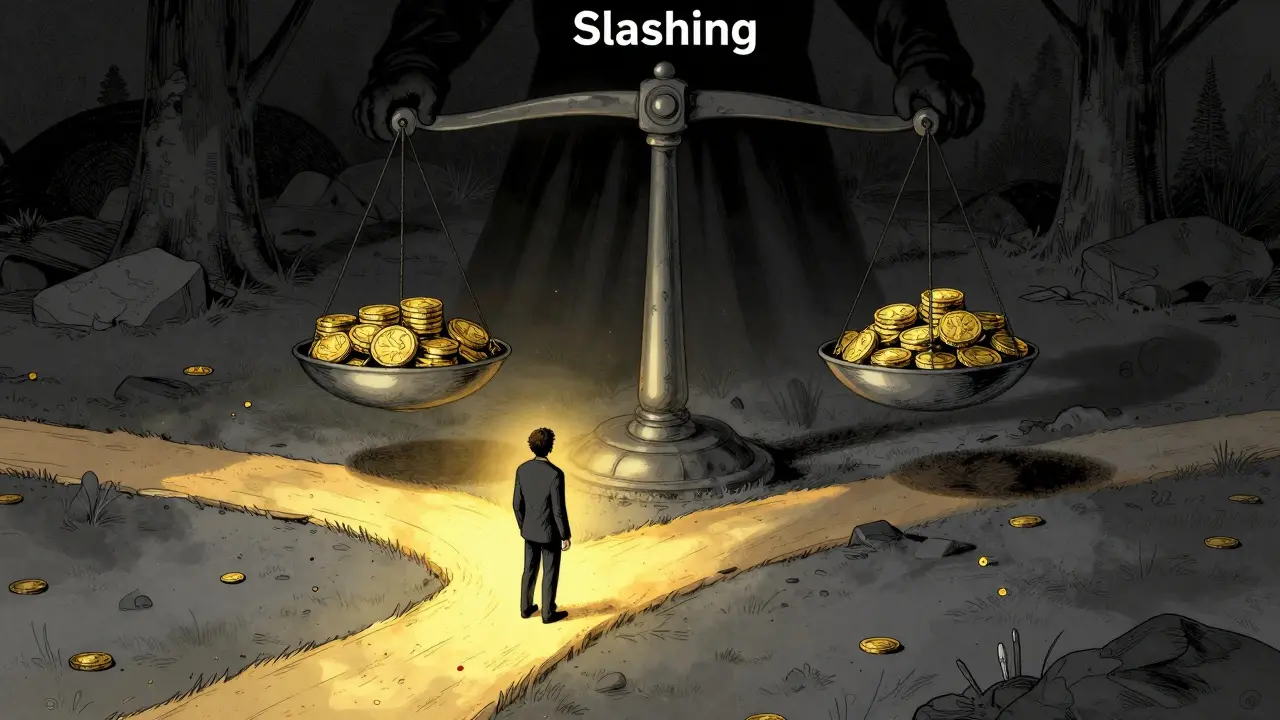
Imagine you’re a validator on a blockchain. You’ve locked up your coins to help secure the network. Now, the chain splits into two versions. Which one do you support? In a Proof of Work system like Bitcoin, the answer is simple: you pick one. Why? Because mining takes real electricity, real hardware, real money. You can’t split your rigs between both chains - it’d cut your profits in half. But in a pure Proof of Stake system? There’s no cost to validating on both. That’s the nothing at stake problem.
What Exactly Is the Nothing at Stake Problem?
The nothing at stake problem is a flaw in early Proof of Stake designs where validators have no reason not to support every possible fork of the blockchain. If a chain splits - say, because of a network delay or a bug - a validator can sign blocks on both sides. They get rewards from both chains. No penalty. No extra cost. Just more income. This sounds smart, right? Until you realize: if everyone does this, the blockchain never settles. No one commits to one version. The network gets stuck. Forks keep happening. Double-spends become easy. And without finality, the whole system loses trust. This wasn’t just a theoretical concern. In 2012, Peercoin - one of the first PoS blockchains - had no penalties for validating on multiple chains. Validators could safely bet on every fork. The result? A fragile network that couldn’t resolve conflicts. Vitalik Buterin pointed this out in his 2017 blog post, calling it a "fundamental vulnerability." He explained: if you’re a rational actor, and there’s no downside to supporting multiple chains, you’ll always do it.Why Proof of Work Doesn’t Have This Problem
Bitcoin’s Proof of Work avoids this because mining is expensive. Miners spend electricity, cooling, hardware, and time. You can’t duplicate your ASICs across two chains. If you try, you’re cutting your hash rate in half - and your rewards too. That’s a strong incentive to pick the chain with the most support. In PoW, the cost of mining acts as a natural filter. It forces miners to choose. In PoS, without extra rules, there’s no filter. Validators can copy-paste their validation across chains. They don’t burn energy. They don’t use more hardware. They just click "sign" on both sides. That’s why early PoS systems were seen as insecure. They didn’t just lack incentives - they had the opposite: perfect incentives to break consensus.The Solution: Slashing Conditions
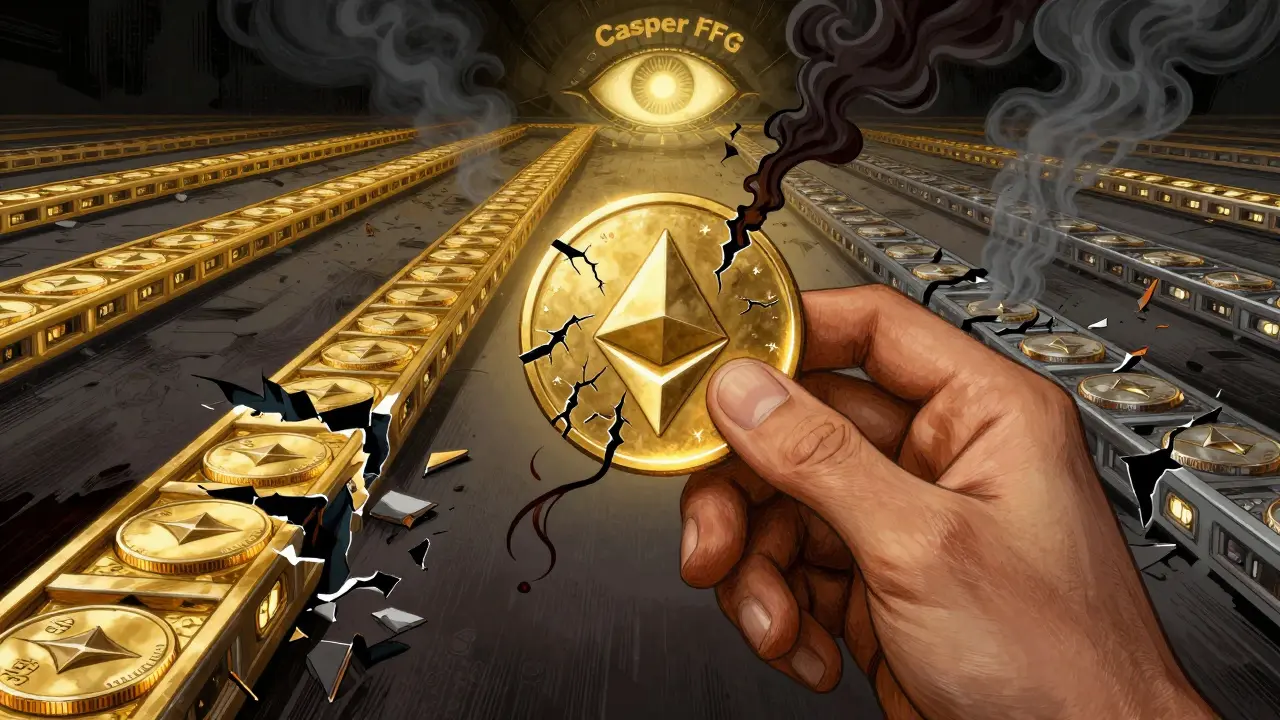
The fix? Make cheating expensive. The breakthrough came with slashing. Slashing means if a validator signs conflicting blocks - say, two blocks at the same height or votes that contradict their past ones - they lose part or all of their staked ETH. Ethereum’s Casper FFG protocol, introduced during "The Merge" in September 2022, uses slashing as its core defense. Here’s how it works:- If you sign two blocks at the same block number (equivocation), you lose at least 1 ETH.
- If you vote for a block that "surrounds" your previous vote (a technical violation), you lose up to your full 32 ETH stake.
- The penalty scales with how many others are slashed at the same time - punishing mass collusion.

How Ethereum Fixed It in Practice
Ethereum didn’t just theorize about slashing - they built it into every validator client. Validators now run two pieces of software: an execution client (like Geth) and a consensus client (like Prysm or Lighthouse). The consensus client includes slashing protection. That protection is automatic. It keeps a database of every block you’ve signed. If you try to sign a conflicting one, the software blocks you. You can’t even submit it. This prevents accidental slashing from misconfigured setups. Still, mistakes happen. In December 2022, over 2,300 validators were slashed during a network upgrade - not because they were malicious, but because their software wasn’t updated properly. That’s why tools like the Ethereum Staker Discord server exist: to help new validators avoid these traps. The result? Since The Merge, Ethereum has processed over 800 million blocks with no successful nothing-at-stake attacks. The system works.Other Blockchains and Their Approaches
Ethereum isn’t alone. Most major PoS chains now use slashing:- Cardano uses a similar model: validators who misbehave lose their stake.
- Cosmos uses "bonded stake" - if you act badly, your tokens get burned.
- Polkadot slashes both the validator and their nominators (those who stake with them).
Is the Problem Really Solved?
Some critics, like Charles Hoskinson of Cardano, argue that PoS is still vulnerable during extreme network partitions - when validators lose connectivity and can’t communicate. But Ethereum’s designers have already thought of this. They use checkpointing. Every 2-3 minutes, the network locks in a "finalized" block. Once finalized, it’s nearly impossible to revert. Even if a fork happens, the network ignores it if it doesn’t include the latest finalized checkpoint. A March 2023 MIT study analyzed 18 months of Ethereum data and found only 0.0003% of validators showed any sign of nothing-at-stake behavior - and all were due to software bugs, not intentional attacks. In short: the problem isn’t gone. But it’s been neutralized.What This Means for You
If you’re a staker, this matters. Your ETH isn’t just sitting there earning rewards - it’s actively securing the network. And if you misconfigure your validator, you could lose it. Here’s what you need to do:- Always use slashing protection software (built into most modern clients).
- Never run two validators with the same key.
- Keep your software updated - especially before upgrades.
- Use redundant infrastructure: backup power, internet, and servers.
What’s Next?
Ethereum’s next upgrades - like Verkle Trees and Single Secret Leader Election - aim to make the network even more efficient. Ironically, by reducing the cost of honest validation, they make the nothing-at-stake problem even less relevant. Why cheat if you can win fairly? The lesson? The nothing at stake problem was never about the technology. It was about incentives. And once you make cheating costly enough, rational actors choose honesty.What is the nothing at stake problem in PoS?
The nothing at stake problem is a flaw in early Proof of Stake systems where validators can safely validate on multiple blockchain forks at the same time because there’s no cost to doing so. Unlike Proof of Work, where miners must choose one chain due to high energy costs, PoS validators can sign blocks on all forks without penalty - leading to potential network instability and inability to reach consensus.
How does Ethereum solve the nothing at stake problem?
Ethereum solves it through slashing conditions. If a validator signs conflicting blocks - like two blocks at the same height or contradictory votes - they lose a portion of their staked ETH. Penalties start at 1 ETH and can reach the full 32 ETH stake for severe violations. This makes cheating more expensive than the reward, forcing validators to support only one chain.
Can you still get slashed on Ethereum?
Yes, but usually only due to misconfiguration - not malicious intent. If you run duplicate validators, use outdated software, or fail to enable slashing protection, you risk being slashed. Most modern validator clients like Prysm and Lighthouse include built-in protection to prevent this. Always update your software and use a reliable setup.
Is the nothing at stake problem unique to Ethereum?
No. It’s a universal flaw in any pure Proof of Stake system without penalties. But nearly all major PoS blockchains - including Cardano, Cosmos, and Polkadot - now use slashing mechanisms to prevent it. The problem was solved years ago in well-designed systems, and Ethereum’s implementation set the standard.
Why didn’t Bitcoin have this problem?
Bitcoin uses Proof of Work, not Proof of Stake. Miners spend real electricity and hardware resources to mine. Splitting those resources between two chains cuts their profits in half. That natural cost forces miners to pick one chain - eliminating the incentive to support forks. PoS lacks this cost, which is why it needed a new solution: slashing.
Do staking pools have a higher risk of causing nothing at stake?
Not really. Large staking pools like Lido and Coinbase have too much at stake - literally. They manage billions in ETH. A single slashing event could destroy trust and cause mass withdrawals. Their economic incentive is to be honest. In fact, they’re the most likely to follow best practices because their business depends on it.
Aman Kulshreshtha
March 21, 2026 AT 19:10so like... if you can validate on both forks and get paid twice, why wouldn't you? it's not greed, it's math. until they slapped slashing on it, PoS was basically a free money exploit. wild how something so simple broke everything.
Shelley Dunbrook
March 22, 2026 AT 05:20Interesting. And yet, we still have validators getting slashed because they didn’t update their software. The system works-until human error becomes the attack vector.
Lorna Gornik
March 22, 2026 AT 23:17slashing is wild tbh 😅 like imagine getting fined $5k for accidentally clicking "yes" on two blocks at once... yikes. glad my client blocks me before i mess up
Anna Lee
March 24, 2026 AT 21:47OMG YES! I was so confused at first why PoS was even a thing until I learned about slashing. Now it makes sense-like, you’re not just staking, you’re signing a contract with the chain. Don’t be that guy who gets slashed bc they didn’t read the manual 😅
vu phung
March 26, 2026 AT 10:19the real win here is that slashing turned rational actors into rational validators. no more free lunch. now you have to earn your rewards by being careful. it’s beautiful.
Kevion Daley
March 27, 2026 AT 17:15obviously the real solution is to just go back to PoW. at least then you’re paying for your mistakes in electricity bills. slashing is just crypto’s way of pretending it’s not a casino.
YANG YUE
March 28, 2026 AT 12:04the nothing-at-stake problem isn’t really a problem-it’s a mirror. it reflects how humans behave when incentives are misaligned. we don’t need more tech. we need better math. and we got it. slashing isn’t punishment. it’s a mirror held up to greed. and guess what? most people looked away. the ones who didn’t? they got rich.
Dominic Taylor
March 28, 2026 AT 13:25from a consensus theory standpoint, the elegance lies in the economic incommensurability: the cost of equivocation must exceed the marginal gain. Ethereum’s slashing mechanism achieves this via quadratic penalties and accountability clustering. The 2022 MIT study confirms the equilibrium is stable under Byzantine conditions with <1/3 adversarial stake.
Andrew Midwood
March 30, 2026 AT 10:04my validator got slashed once bc i tried to run two instances. turned out i forgot i’d already set one up on my backup pi. lesson learned: if you’re not using slashing protection, you’re just gambling with your ETH. no cap.
Jeannie LaCroix
March 30, 2026 AT 13:31so you’re telling me the entire future of finance hinges on not clicking "sign" twice? that’s it? that’s the whole thing? i feel like i just watched a 20-minute TED Talk about why you shouldn’t lick batteries.
Jenni Moss
April 1, 2026 AT 12:28You’re doing amazing work out there. Seriously. Staking isn’t passive income-it’s active heroism. Keep your software updated. Trust your client. You’re not just earning rewards-you’re keeping the whole system alive. I believe in you 💪❤️