
Imagine trying to run a bank that can’t look outside its own walls. It doesn’t know the stock market is crashing. It doesn’t know gold prices have doubled. It just sits there, blind to the real world. That was the fundamental problem with early blockchain networks. They were secure, yes, but they were isolated. This isolation created a massive bottleneck for decentralized finance (DeFi). How could you lend money against Bitcoin if the lending protocol didn’t know what Bitcoin was worth right now? The answer lies in a critical piece of infrastructure called price oracles.
Price oracles are the bridges that connect blockchains to external data sources. They feed real-world information-like asset prices, weather data, or sports scores-into smart contracts. Without them, most DeFi protocols simply wouldn’t function. But these bridges aren't just simple wires; they are complex systems riddled with security risks, technical trade-offs, and fierce competition. If an oracle fails, billions of dollars in user funds can vanish in seconds.
What Exactly Is a Price Oracle?
A price oracle is a mechanism or service that provides verified external data, specifically asset prices, to blockchain networks. Since blockchains like Ethereum are deterministic and closed systems, they cannot directly query APIs from centralized exchanges like Binance or Coinbase. An oracle acts as the trusted intermediary that fetches this data, verifies it, and writes it onto the blockchain where smart contracts can read it.
The concept became essential around 2017-2018 when DeFi started gaining traction. Before oracles, smart contracts could only interact with on-chain data. This limited their use cases to simple token swaps. With oracles, developers could build complex financial products like leveraged trading, insurance policies, and algorithmic stablecoins. For example, a lending protocol needs to know the exact value of your collateral (say, ETH) to determine if you need to add more funds or if your loan should be liquidated. The oracle provides that number.
However, not all oracles are created equal. Some pull data from a single source, while others aggregate dozens. Some update every second, while others update hourly. Understanding how they work is crucial because the choice of oracle often determines the security of the entire application relying on it.
How Price Oracles Actually Work
The process might sound simple-get the price, put it on-chain-but the execution involves several layers to prevent fraud and manipulation. Let’s break down the two most common architectures used today: Decentralized Oracle Networks (DONs) and On-Chain Aggregators.
- Data Collection: The oracle network queries multiple data sources. For Chainlink, this means hitting APIs from major centralized exchanges (CEXs) like Coinbase, Kraken, and Binance. For Uniswap’s oracle, the "data source" is the liquidity pool itself on the blockchain.
- Verification and Aggregation: Raw data is messy. One exchange might report a slightly different price than another due to latency or arbitrage. The oracle system aggregates these inputs. Chainlink uses a median calculation to ignore outliers. Uniswap calculates a Time-Weighted Average Price (TWAP) over a specific period to smooth out sudden spikes.
- On-Chain Submission: Once the final price is calculated, it is submitted to the blockchain. In Chainlink’s case, independent node operators stake their reputation (and sometimes crypto tokens) to submit the data. In Uniswap’s case, the data is already on-chain, so users or protocols simply read the historical observations stored by the pool.
This distinction is vital. Chainlink brings data from off-chain to on-chain. Uniswap derives price data from on-chain activity. Both methods have strengths and weaknesses, which we will explore next.

Major Players: Chainlink vs. Uniswap vs. Pyth
The oracle landscape is dominated by a few key players, each solving the problem differently. Choosing the right one depends on your needs: speed, security, or cost.
| Oracle Provider | Data Source Type | Key Mechanism | Primary Strength | Main Weakness |
|---|---|---|---|---|
| Chainlink | Off-chain (Centralized Exchanges) | Decentralized Node Network with Median Calculation | High security, tamper-proof, wide asset coverage (1,000+ assets) | Higher gas costs, slower updates during extreme congestion |
| Uniswap V3 Oracle | On-chain (Liquidity Pools) | Time-Weighted Average Price (TWAP) | Gas efficient, native to DEX, no external dependencies | Vulnerable to flash loan attacks in low-liquidity pools |
| Pyth Network | Off-chain (Institutional Publishers) | First-party data from banks and hedge funds | Ultra-low latency (sub-second), high frequency updates | Newer ecosystem, less battle-tested than Chainlink |
Chainlink is the industry standard for general-purpose data. Launched in 2017, it secures over $30 billion in DeFi value. Its multi-layered decentralization means no single entity controls the price feed. If one node goes offline or tries to cheat, the others override it. This makes it ideal for lending protocols like Aave or Compound where accuracy is paramount.
Uniswap’s Oracle is different. It doesn’t fetch data from the internet. Instead, it records the price of tokens in its liquidity pools at the beginning of every block. Developers use this history to calculate a TWAP. This is great for capital efficiency and avoids paying Chainlink fees, but it has a fatal flaw: if the pool has low liquidity, a bad actor can manipulate the price using a flash loan. We saw this in the Harvest Finance hack in 2020, where attackers stole $24 million by skewing Uniswap’s price feed.
Pyth Network represents the new wave of "high-frequency" oracles. Unlike Chainlink, which relies on third-party node operators, Pyth allows institutional publishers (like Jane Street or Jump Trading) to publish data directly. This results in incredibly fast updates, making it popular for perpetual futures and derivatives platforms that need real-time pricing.
The Dark Side: Oracle Manipulation Attacks
If oracles are the bridge between worlds, they are also the weakest link. Security researchers at Messari reported that 37% of all DeFi hacks between 2020 and 2023 involved some form of oracle manipulation. Why? Because exploiting code bugs is hard; manipulating market prices is relatively easy if you have enough capital.
There are two main types of attacks:
- Flash Loan Attacks: An attacker borrows millions of dollars instantly (without collateral), buys up all the available supply of a token in a low-liquidity pool, driving the price up artificially. The oracle reads this inflated price. The attacker then takes out a huge loan against their now "valuable" collateral, repays the flash loan, and walks away with the profit. This worked against Harvest Finance and later against other smaller protocols.
- Stale Data Exploits: During extreme market volatility, like the "Black Thursday" crash in March 2020, blockchain networks get congested. Oracles might fail to update prices for hours. If an oracle reports an old, higher price during a crash, borrowers can drain loans before the system realizes the collateral is worthless. MakerDAO lost $4 million in undercollateralized loans during this event because its oracle hadn’t updated the ETH price.
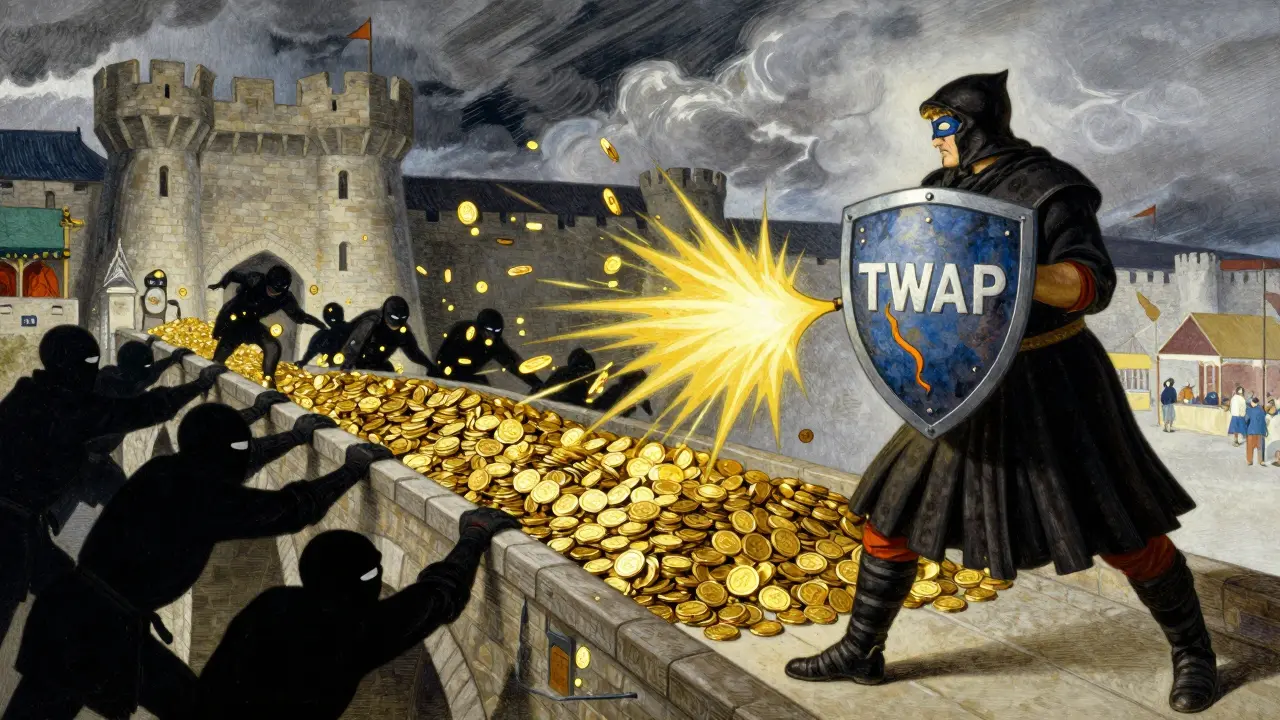
To mitigate this, experts recommend using Time-Weighted Average Prices (TWAPs) rather than spot prices. A TWAP averages the price over 10 minutes, 1 hour, or even 24 hours. This makes it much harder for an attacker to manipulate the average without holding expensive positions for a long time. However, TWAPs introduce latency, which isn’t suitable for high-frequency trading.
How to Choose the Right Oracle for Your Project
For developers building DeFi applications, choosing an oracle is a critical design decision. There is no "one size fits all." Here is a practical framework to help you decide:
- Assess the Criticality of the Data: Is this price used for liquidating user loans? If yes, security is everything. Use Chainlink or a similar decentralized network with deep decentralization. Do not use a single-source oracle.
- Check Liquidity Depth: Are you relying on an on-chain DEX oracle like Uniswap? Ensure the pool has significant depth. If the pool is thin, a small trade can swing the price wildly. Always implement circuit breakers that pause operations if the price moves too quickly.
- Consider Latency Needs: Do you need sub-second updates for a derivatives platform? Look into Pyth Network or API3. Do you just need daily settlement for a savings app? Chainlink’s default heartbeat is fine.
- Implement Redundancy: Never rely on a single oracle. Best practice involves using multiple feeds. For example, use Chainlink as the primary source and Uniswap TWAP as a fallback, or vice versa. If the two prices diverge significantly, trigger a halt.
Integration complexity varies. Chainlink requires integrating with their Solidity libraries and understanding concepts like "heartbeats" and "stale thresholds." Uniswap’s oracle is built into the V3 router, so it’s easier to access but requires you to write custom logic to calculate the TWAP correctly.
The Future of Oracles in 2026 and Beyond
As we move through 2026, the oracle landscape is evolving rapidly. The days of simple price feeds are ending. We are seeing the rise of "hybrid" models and cross-chain interoperability.
One major trend is Cross-Chain Interoperability Protocol (CCIP), launched by Chainlink in late 2023. This allows price data to be securely transferred between different blockchains (e.g., from Ethereum to Solana) without needing separate oracles on each chain. This reduces redundancy and improves consistency across the multi-chain ecosystem.
Another shift is toward institutional-grade data. With regulations like the EU’s MiCA (Markets in Crypto-Assets) requiring verifiable price sources for stablecoins, projects are moving away from anonymous nodes toward identifiable, licensed data providers. Pyth Network leads here, offering direct feeds from traditional finance institutions.
Security is also becoming more proactive. New oracle designs include "implicit verification," where the network mathematically proves that the data was derived correctly without trusting the node operators blindly. While theoretical limitations remain-as noted by OpenZeppelin-the gap is closing. By 2027, analysts predict oracle services will generate over $1.2 billion annually, reflecting their status as critical, revenue-generating infrastructure rather than just a utility.
For users, this means safer DeFi experiences. For developers, it means more tools but also higher responsibility. The oracle is no longer just a plugin; it’s the foundation of trust in decentralized finance.
What is the difference between a centralized and decentralized oracle?
A centralized oracle relies on a single entity or API to provide data, creating a single point of failure. If that server goes down or is hacked, the data is compromised. A decentralized oracle, like Chainlink, uses a network of independent nodes to gather and verify data from multiple sources. This eliminates single points of failure and makes manipulation significantly harder and more expensive.
Why did the Harvest Finance hack happen?
The Harvest Finance hack occurred because the protocol relied on Uniswap’s spot price oracle for a low-liquidity pool. Attackers used a flash loan to buy a large portion of the token supply, artificially inflating the price. The oracle read this manipulated price, allowing the attackers to borrow far more than their collateral was actually worth. This highlighted the danger of using on-chain spot prices for critical financial decisions.
Is Chainlink safe from manipulation?
Chainlink is highly resistant to manipulation due to its decentralized node structure and median aggregation method. To manipulate a Chainlink feed, an attacker would need to compromise a majority of the independent node operators simultaneously, which is economically unfeasible. However, no system is 100% immune, especially during extreme network congestion where data updates may stall.
What is a TWAP oracle?
TWAP stands for Time-Weighted Average Price. Instead of taking the current price at a single moment (spot price), a TWAP oracle calculates the average price over a set period, such as 10 minutes or 1 hour. This smoothing effect prevents short-term price spikes or crashes from triggering erroneous smart contract actions, making it safer for lending and borrowing protocols.
Which oracle is best for high-frequency trading?
For high-frequency trading and derivatives, Pyth Network is currently considered superior due to its sub-second update intervals and direct institutional data feeds. Traditional oracles like Chainlink may have latencies of several seconds to minutes, which is too slow for rapid arbitrage or leverage trading strategies.