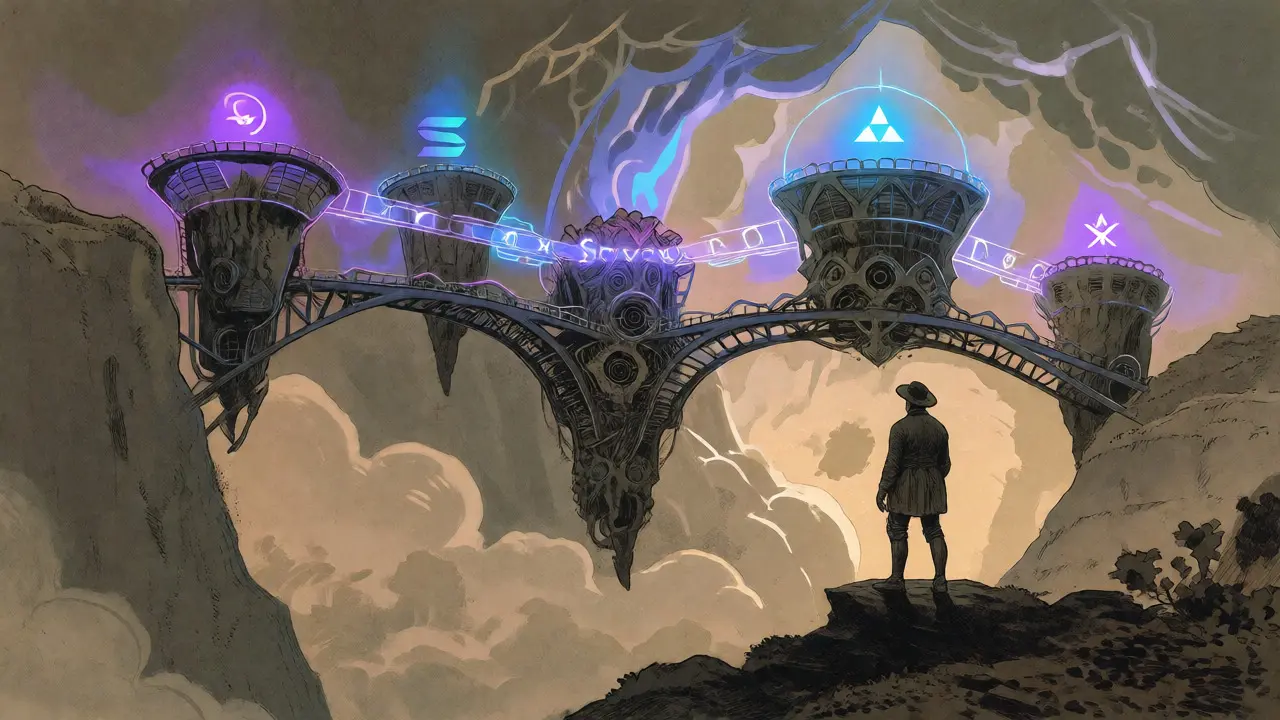
Most people hunting for free crypto expect a simple "airdrop" button to appear on their dashboard. But when you look into Monsoon Finance, you quickly realize it doesn't play by those rules. It launched its Token Generation Event (TGE) back in September 2021, not with a viral marketing campaign giving away millions of tokens to anyone who signed up, but with a structured distribution model focused on utility and privacy. If you're here because you heard about an MCASH airdrop and are wondering if you missed out or what the current status is, you need to understand that Monsoon Finance operates differently. It uses a mechanism called "Anonymity Mining" rather than traditional handouts.
What Is Monsoon Finance?
Monsoon Finance is a cross-chain privacy protocol designed to bring transactional privacy to smart contract blockchains like Solana, Moonbeam, BSC, Polygon, and Fantom. Think of it as a bridge that lets you move assets between different chains while keeping your activity private. The project raised $2.29 million across six funding rounds before launching, which signals serious backing, but also means the token economics were carefully controlled from day one. Unlike meme coins that flood the market with supply, Monsoon’s approach was tighter, focusing on long-term sustainability over short-term hype.
The core technology relies on zkSNARKs (Zero-Knowledge Succinct Non-Interactive Arguments of Knowledge). In plain English, this allows users to prove they have enough funds to make a transaction without revealing who they are or how much they’re spending. This is crucial for institutional players and privacy-conscious individuals who don’t want their entire financial history broadcasted on a public ledger.
The Truth About the "Airdrop" Mechanism
Here is where most confusion starts. There wasn’t a single, massive "airdrop" event where everyone got free money. Instead, Monsoon Finance implemented a multi-stage distribution strategy. Early supporters participated in seed, private, and public sales. These weren't free; they were investments. The total supply of MCASH is capped at 100 million tokens. At launch, only about 2.1 million tokens were circulating, creating scarcity but also limiting immediate liquidity.
So, how do regular users get tokens today? Through Anonymity Mining. This is the real "airdrop" equivalent for new users. You earn MCASH by actively using the protocol’s privacy features. Every time you shield a transaction or use their cross-chain privacy bridge, you accumulate rewards. It’s a usage-based system, meaning the more you engage with the tech, the more governance tokens you hold. This aligns incentives: holders are actual users, not just speculators waiting to dump.
Token Economics and Allocation Breakdown
Understanding where the tokens went helps explain why the price behaves the way it does. The allocation was heavily weighted toward early backers and the team, with smaller slices for public access. Here is a snapshot of the initial structure:
| Category | Amount (MCASH) | Percentage | Notes |
|---|---|---|---|
| Private & Pre-Sale | 6,970,000 | 6.97% | Higher entry prices, longer vesting |
| Public Sale | 875,000 | 0.88% | Limited availability |
| TGE Release | 50% of allocated | N/A | Immediate unlock for some tiers |
| Vesting Schedule | Remaining | N/A | Monthly unlocks over 3-4 months |
This tight circulation meant that while the Fully Diluted Valuation (FDV) looked high at $20 million, the actual market cap at launch was around $445,500. For investors, this distinction matters. Low circulating supply can lead to high volatility, which we saw clearly in the months following the TGE.

Investment Rounds and ROI Reality Check
If you’re evaluating whether to jump in now, look at the historical performance of the funding rounds. The Seed round raised $500,000 at $0.08 per token. At its peak, this delivered an impressive 4.29x return. However, markets change. As of late 2026, the token has faced significant downward pressure, with many early rounds showing returns in the negative territory relative to their all-time highs. The Private round, priced at $0.153, and the IDO/IEO rounds at $0.200, both saw peak ROIs of around 1.72x before correcting.
Why the decline? Limited liquidity. BeInCrypto and other data providers have noted insufficient trading volume for reliable predictions. On major exchanges like Binance, daily volumes often hover near zero. This isn't necessarily a sign of failure, but it indicates that the token is currently illiquid. For a trader, this means wide spreads and difficulty exiting large positions without moving the price. For a holder, it means patience is required until organic demand from privacy usage picks up.
How to Earn MCASH Today: Anonymity Mining
Forget waiting for a random airdrop claim link. To get MCASH now, you need to interact with the protocol. Here’s the practical path:
- Connect your wallet: Ensure you have a compatible wallet for one of the supported chains (Solana, Polygon, etc.).
- Deposit Assets: Move stablecoins or native tokens into the Monsoon privacy pool.
- Execute Private Transactions: Use the shield function to hide your balance and transactions.
- Claim Rewards: Accumulate MCASH through the Anonymity Mining algorithm based on the duration and volume of your private holdings.
This process requires a bit more technical know-how than clicking a "claim" button. You need to understand gas fees across different chains and how zero-knowledge proofs work under the hood. But for those willing to learn, it offers a direct way to acquire governance rights without buying on the open market.

Market Performance and Current Status
As of October 2026, MCASH trades around $0.000295. The recent 24-hour increase of 4.13% shows slight momentum, but the overall trend remains challenging. The 90-day performance shows a decline of roughly 13.75%. While shorter timeframes show modest gains, the broader picture reflects the general cooling of the privacy coin sector post-2021 bull run.
Monsoon Finance ranks low in market capitalization comparisons (#9309 range), placing it firmly in the micro-cap category. This offers high risk and high potential reward. If the narrative shifts back toward privacy-driven by regulatory scrutiny on transparent blockchains-projects with solid tech like Monsoon could see renewed interest. However, without aggressive marketing or new exchange listings, growth will likely remain slow and driven by utility rather than speculation.
Risks and Considerations
Before diving in, consider these factors:
- Liquidity Risk: With low trading volume, selling large amounts may be difficult.
- Complexity Barrier: Privacy tech is harder to adopt than standard DeFi lending or swapping.
- Competition: Established players like Zcash and newer entrants in the zk-rollup space compete for the same user base.
- No Traditional Airdrops: Don't expect surprise drops. Value comes from usage.
Monsoon Finance isn't for everyone. It suits users who genuinely value privacy and are willing to navigate the learning curve of cross-chain interactions. If you're looking for quick flips, this might feel stagnant. If you believe in the necessity of private finance on public chains, the current low valuation might present an accumulation opportunity.
Was there a traditional airdrop for Monsoon Finance?
No, Monsoon Finance did not conduct a traditional mass airdrop. Tokens were distributed primarily through seed, private, and public sales, along with specific partner programs like BullPerks. Current acquisition happens via Anonymity Mining or purchasing on exchanges.
How can I earn MCASH tokens now?
You can earn MCASH through "Anonymity Mining." This involves depositing assets into the protocol and using its privacy features. The more you use the service, the more governance tokens you accrue as rewards.
Which blockchains support Monsoon Finance?
Monsoon Finance supports multiple chains including Solana, Moonbeam, BSC, Polygon, and Fantom. This cross-chain capability allows users to maintain privacy while moving assets between different ecosystems.
Is MCASH a good investment in 2026?
It depends on your risk tolerance. MCASH is a micro-cap asset with low liquidity. It has strong technical foundations in zkSNARKs but faces competition and adoption challenges. It's better suited for long-term believers in privacy tech than short-term traders.
What is the total supply of MCASH?
The total maximum supply of MCASH is capped at 100 million tokens. This fixed supply helps prevent inflationary dilution, though circulating supply varies based on vesting schedules and market activity.