
Imagine handing over your diploma to a potential employer. Now imagine that diploma is a piece of paper from 1998, slightly yellowed at the edges. The employer has to call your university, wait on hold for twenty minutes, and hope the registrar’s office actually picks up. This is the current reality for millions of professionals. But what if that process took three seconds? What if you could prove you earned that degree without calling anyone, sending emails, or worrying about whether the document is fake?
This is exactly what professional credentials on blockchain are solving. We are moving away from static pieces of paper toward dynamic, cryptographically secured digital records. By August 2026, this isn't just a futuristic concept anymore; it's a practical tool used by universities, corporations, and governments to verify skills instantly. If you are looking to protect your career history or streamline your hiring process, understanding how these systems work is no longer optional-it is essential.
How Blockchain Verifies Your Skills Without Intermediaries
To understand why this matters, we need to look under the hood. Traditional credentialing relies on a central authority. Your university holds the record. If their server goes down, or if they go out of business, or if a clerk makes a typo, your proof of education becomes difficult to access. It creates a single point of failure.
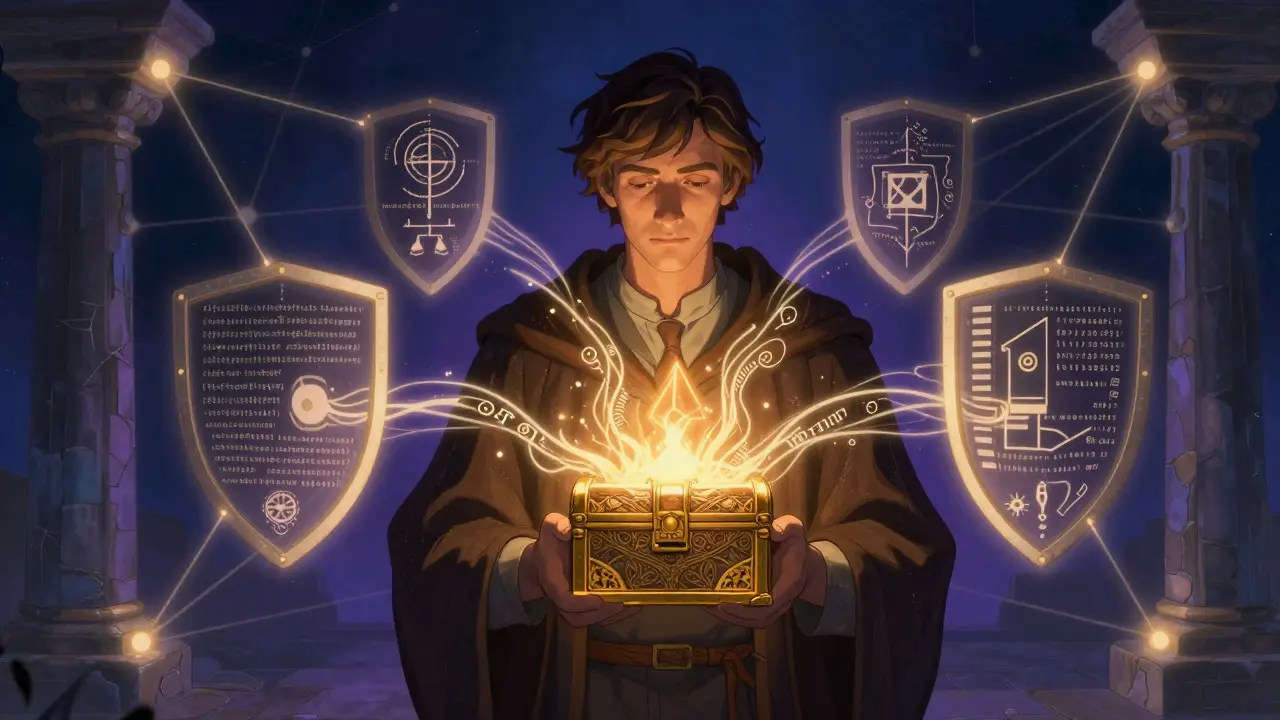
Blockchain technology changes this by distributing the record across a network of computers. When an issuer-like a university or a training provider-creates a credential, they don't just send you a PDF. They create a digitally signed document containing specific claims about your identity and achievements. This document is then hashed (turned into a unique string of characters) and stored on the blockchain ledger.
Here is the key part: the actual sensitive data usually doesn't live on the public blockchain. Instead, a cryptographic fingerprint does. Think of it like a notary stamp. You keep the original document in your personal digital wallet. When an employer wants to verify it, they check the fingerprint against the blockchain. If the fingerprint matches, the document hasn't been tampered with since the moment it was issued. No phone calls. No waiting. Just instant, mathematical proof.
The Technical Backbone: DIDs and Zero-Knowledge Proofs
You might be wondering, "Doesn't putting my education on a public ledger expose my private data?" That is a valid concern. Early blockchain experiments struggled with privacy. Today, however, two specific technologies solve this problem: Decentralized Identifiers (DIDs) and Zero-Knowledge Proofs (ZKPs).
Decentralized Identifiers (DIDs) allow you to control your own identity online without relying on a social media platform or a government database. Instead of logging in with Facebook or Google, you use a DID. This identifier is linked to your public key but doesn't reveal who you are until you choose to share that information. It gives you ownership of your digital presence.
Then there are Zero-Knowledge Proofs (ZKPs). This sounds complex, but the concept is simple. A ZKP allows you to prove you know something without revealing what that thing is. For example, you can prove you are over 18 years old without showing your birthdate. In the context of credentials, you can prove you have a certain certification without necessarily exposing every detail of your academic history to a third party. You control exactly what gets shared and with whom.
| Feature | Traditional Paper/PDF | Blockchain-Based Credential |
|---|---|---|
| Verification Time | Days to weeks (requires human intervention) | Seconds (automated cryptographic check) |
| Fraud Risk | High (easy to forge documents) | Negligible (tamper-proof ledger) |
| Data Ownership | Held by the institution | Held by the individual (in digital wallet) |
| Portability | Low (hard to transfer between systems) | High (works across platforms via standards) |
| Privacy Control | None (must show full document) | Granular (share only necessary proofs) |
Real-World Adoption: From Universities to Refugees
This technology is already being tested in high-stakes environments. Some of the most prominent examples come from higher education. Institutions like MIT, UT Austin, and the University of Nicosia have moved beyond prototypes to issuing digital diplomas using blockchain technology. These aren't just NFTs for collectors; they are functional records that students can carry throughout their careers.
Perhaps the most compelling use case, however, lies in humanitarian aid. Refugee organizations have shown significant interest in providing blockchain credentials to learners moving between countries. Imagine a student fleeing a conflict zone. They lose their home, their bank accounts, and often their physical school records. With a blockchain credential stored in a smartphone app, they can still prove their qualifications to employers or universities in a new country. The record survives even if the issuing institution is destroyed. This portability saves lives and preserves economic potential.
In the corporate world, companies are using these systems for internal training. Instead of a generic "completed training" email, employees receive verifiable badges for specific skills, such as compliance certifications or specialized software proficiency. Platforms like Credly, Accredible, and Concentric Sky have built ecosystems where these badges work across different systems, allowing workers to collect credentials from multiple sources into one unified profile.
Specialized Certifications: The CBDA Example
As the financial sector embraces digital assets, specific professional credentials have emerged to bridge the knowledge gap. One notable example is the Certificate in Blockchain and Digital Assets (CBDA). Offered by the Digital Assets Council of Financial Professionals (DACFP) in collaboration with the New York Institute of Finance, this certification was updated as of March 2025 to reflect the latest regulatory landscape.
The CBDA is designed for financial professionals who need to guide clients through cryptocurrency investments, security measures, and regulatory considerations. It signifies expertise in a rapidly evolving field. By earning this credential, professionals demonstrate they possess the risk management strategies and technical knowledge required to navigate the digital assets space safely. This shows how blockchain isn't just storing credentials; it's becoming the subject matter of the credentials themselves.

Benefits for Employers and Job Seekers
For job seekers, the biggest benefit is control. You are no longer at the mercy of a university's administrative office. You can share your achievements instantly during an interview. You can build a portfolio of micro-credentials-smaller certifications for specific skills earned through hackathons, internships, or online courses-that complement your main degree. This creates a more nuanced picture of your abilities than a simple GPA ever could.
For employers, the value proposition is efficiency and trust. Screening resumes is time-consuming and risky. Fake degrees and exaggerated work histories are common problems. With blockchain credentials, HR departments can verify a candidate's background with a single click. This reduces administrative burdens and costs while ensuring that the people they hire actually have the skills they claim. It levels the playing field, rewarding genuine competence over polished lies.
Challenges and Future Outlook
Despite the benefits, hurdles remain. Interoperability is still a work in progress. While standards exist, not all platforms talk to each other seamlessly yet. There is also the question of adoption inertia. Many institutions are slow to change legacy systems. Furthermore, users need to manage their digital wallets securely. If you lose access to your private keys, you could theoretically lose access to your credentials, though recovery mechanisms are improving.
Looking ahead, the trend is clear. As more industries-from healthcare managing personal health data to construction verifying safety licenses-adopt these systems, the ecosystem will become more robust. The combination of open badges and blockchain enables a future where lifelong learning is continuously recognized. Every course, every workshop, and every project can add a verified layer to your professional identity. We are moving toward a world where your reputation is portable, permanent, and entirely yours.
Are blockchain credentials legally binding?
Yes, in many jurisdictions, digital signatures and blockchain records are legally recognized as equivalent to paper documents. However, the specific legal status depends on local regulations. Organizations like the UN and various national governments are actively working to standardize the legal acceptance of these digital records to ensure global interoperability.
What happens if the blockchain network shuts down?
Blockchain networks are decentralized, meaning they don't rely on a single server. Even if some nodes go offline, the network remains operational. Additionally, because the credential itself is often stored in your personal digital wallet, you retain possession of the data. The blockchain serves as the verification layer, not the sole storage location for the content.
Do I need to pay to issue a blockchain credential?
It varies by platform. Some issuers absorb the cost as part of their service to graduates or employees. Others may charge a small fee for the transaction (gas fees) or for the issuance of the digital badge. Generally, the cost is significantly lower than the administrative overhead of printing and mailing physical certificates and handling manual verification requests.
Can employers see my entire history when I share one credential?
Not necessarily. Thanks to privacy-preserving technologies like Zero-Knowledge Proofs, you can often share proof of a specific qualification without revealing your entire educational history. You have granular control over what data is exposed to the verifier, ensuring you only share what is relevant to the job application.
Which platforms are leading the market for blockchain credentials?
Several platforms are currently dominant, including Credly, Accredible, and Concentric Sky. These platforms provide the infrastructure for issuers to create credentials and for recipients to store and share them. They adhere to open standards, which helps ensure that credentials issued on one platform can be verified across others, promoting a unified ecosystem.
Don Fizy
August 4, 2026 AT 08:47Hey everyone! This is such a huge shift for HR departments. I've been seeing this in tech companies for a bit now, but having it go mainstream means no more waiting weeks for background checks on basic degrees. It's gonna save so much headache for recruiters and candidates alike. Hope you all get your digital wallets sorted soon! 😊
Dominic Greco
August 5, 2026 AT 10:20Don't believe the hype. They want to put your life on a ledger so they can track every move you make. Once that data is out there, who really owns it? The university? The government? Or some shadowy corp mining crypto? Wake up sheeple 🐑👁️
Candice Cornett
August 6, 2026 AT 21:56it's just another way to control people. paper diplomas were fine. now we need 'verification' because trust is dead. typical.
Lance Jantz
August 8, 2026 AT 15:30Oh, Candice, how quaintly Luddite of you. To cling to the parchment of the past is to ignore the crystalline structure of truth that blockchain offers. We are not merely verifying degrees; we are curating the very essence of one's intellectual provenance. It is a symphony of cryptographic validation, my dear, and you are humming off-key in the dark. One must embrace the digital ether to truly understand the soul of modern meritocracy.
Kat Bennett
August 10, 2026 AT 11:02I think there is a lot of potential here especially for people who have had to move around a lot or who took non-traditional paths through their education. It feels like it could level the playing field a bit if implemented correctly without too many hurdles for the average person trying to keep up with all the new tech requirements which can be daunting at first glance but ultimately rewarding.
Sean Rowland
August 12, 2026 AT 09:08The semantic implications of decentralized identity protocols necessitate a rigorous examination of the ontological status of the credential itself. Are we merely tokenizing epistemological certainty? The jargon surrounding DIDs often obscures the fundamental lack of interoperability standards that currently plague the ecosystem. One must question whether the 'immutable' nature of the ledger serves the individual or the institution's desire for perpetual surveillance of academic output.
Pernelia Wahkan
August 12, 2026 AT 19:06I'm curious about the zero-knowledge proofs mentioned. Can you elaborate on how exactly an employer verifies a skill set without seeing the underlying data? It sounds like magic but I suspect there's a specific cryptographic handshake involved that isn't fully explained in the article. Also, what happens if the issuing university goes bankrupt before the credential is even issued? Does the hash still hold weight?
Sus Sawyer
August 13, 2026 AT 13:30Great questions Pernelia! The ZKP basically lets you prove you meet a criteria (like 'has degree') without showing the degree itself. It's like proving you're over 21 without showing your birth date. As for the uni going bust, the hash is already on the chain so the proof exists independent of the issuer's current status. Pretty cool stuff right? 🚀
Ryan Robinson
August 14, 2026 AT 15:49i mean its nice but i worry about losing my private keys. if i lose my wallet do i lose my degree? seems risky to me honestly.
Ethan Yuwono
August 14, 2026 AT 23:21the fear of loss is natural. yet we must consider that recovery mechanisms are evolving. perhaps the true value lies not in the immutability but in the portability of our achievements across borders and systems. a thought to ponder.
Earl Kott65
August 15, 2026 AT 16:01Oh wow, look at us playing with fire 🔥. One day you'll wake up and realize your 'portable reputation' is just a digital leash. But sure, keep clicking those buttons and trusting the algorithms. Maybe next year they'll verify your dreams too 😂
Phil Babb
August 17, 2026 AT 12:59Let's face facts!!! This technology is NOT just a trend! It is the FUTURE of global hiring!! Especially for refugees and displaced workers who have lost everything!! Imagine being able to prove your skills when your home country has fallen apart!! That is POWER!! We need to push for adoption NOW!! Stop hesitating!! #BlockchainForGood #HiringRevolution