
Imagine trying to send a message to a friend, but every single word you type has to go through a central post office. If that post office loses your letter, gets hacked, or decides it doesn't like what you wrote, your communication stops dead. That’s the client-server model in a nutshell. Now, imagine instead that you hand your message directly to your friend, and they copy it for everyone else in the room who wants to see it. No middleman, no single point of failure. This is the essence of Peer-to-Peer (P2P) networking. It sounds simple, maybe even chaotic. So why did Bitcoin and Ethereum choose this messy, distributed approach over the neat, organized structure of traditional web apps? The answer isn't just about tech preference; it's about survival, trust, and the fundamental promise of decentralization.
The Core Difference: Who Holds the Power?
To understand why blockchain chose P2P, you first need to grasp what makes these two architectures different at their core. In a standard Client-Server architecture, there is a clear hierarchy. Servers are the bosses. They store data, process requests, and deliver content. Clients are the employees. They ask for things, wait for answers, and display them. Think of logging into Netflix. Your phone (client) asks Netflix’s massive server farm (server) for the next episode. If those servers go down, you get an error code. You can’t watch anything until the boss fixes the issue.
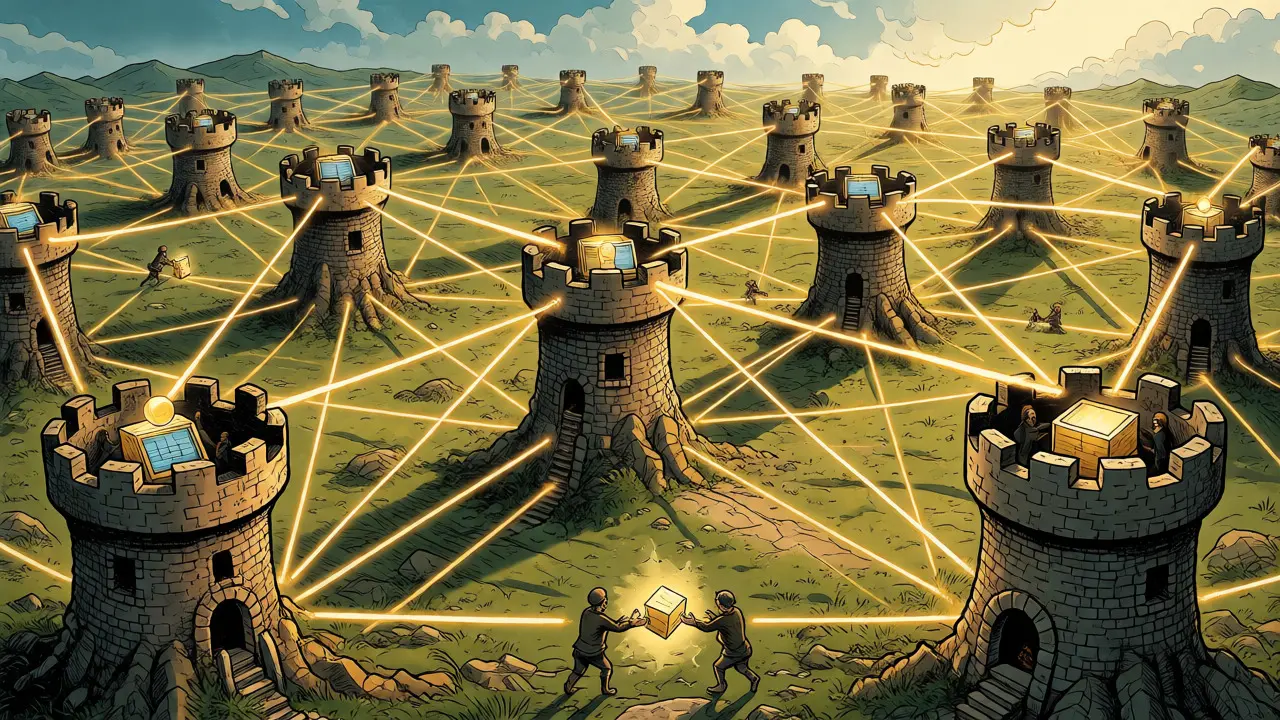
P2P networks flip this script entirely. There are no bosses here. Every computer in the network, known as a node or peer, acts as both a client and a server. When you download a file via BitTorrent, you aren't pulling it from one source; you're grabbing pieces from hundreds of other users who already have parts of that file. Each peer contributes bandwidth, storage, and processing power. This creates a system where authority is distributed rather than concentrated. For most web applications, this lack of central control is a bug. But for blockchain, it’s the entire feature set.
Why Centralized Servers Fail the Trust Test
You might wonder, "If client-server models are so efficient and stable, why abandon them?" The problem with centralized systems is that they require you to trust the entity running the server. When you use a bank, you trust them not to double-spend your money. When you use Facebook, you trust them not to censor your posts arbitrarily. This trust comes with risks. A single server failure can take down a service globally. More importantly, a single point of control means a single point of censorship or corruption.
Blockchain was born out of distrust in these centralized intermediaries. Satoshi Nakamoto didn't just want a digital currency; he wanted a system that didn't rely on trusting a third party. If Bitcoin ran on a client-server model, who would run the server? Would it be a company? A government? If that entity got hacked, went bankrupt, or changed the rules overnight, the whole system collapses. By using a P2P architecture, Bitcoin eliminates the need to trust any single participant. Instead, you trust the math and the network consensus. No one owns the Bitcoin network, which means no one can shut it down.
How Blockchain Uses P2P to Secure Data
In a traditional database, if I change my balance from $100 to $1000, the server updates its record, and that’s it. In a Blockchain, that transaction must be broadcast to every peer in the network. Each node maintains a complete copy of the ledger. This redundancy is expensive and slow compared to a centralized database, but it provides something crucial: immutability.
Because thousands of nodes hold identical copies of the history, changing a past transaction requires altering the data on more than half of all participating computers simultaneously. This is computationally impractical. If a hacker tries to rewrite history on one node, the rest of the network rejects it because their records don't match. This consensus mechanism relies entirely on the P2P structure. Without peers constantly verifying and sharing state, there is no way to agree on the truth without a central referee.
| Feature | Client-Server Model | P2P Blockchain Model |
|---|---|---|
| Control Point | Centralized Server | Distributed Nodes |
| Data Storage | Single Source of Truth | Replicated Across All Peers |
| Failure Impact | Total System Outage | Graceful Degradation |
| Censorship Resistance | Low (Admin can block) | High (No single admin) |
| Scalability Strategy | Add more powerful servers | Add more nodes (with trade-offs) |
The Cost of Decentralization: Speed vs. Security
Let’s be honest: P2P networks are slower. When you send an email, it hits a server and moves fast. When you send a Bitcoin transaction, it has to propagate through thousands of nodes, waiting for miners or validators to package it into a block. This latency is the price paid for security. In a client-server world, speed is king. In a blockchain world, integrity is king.
This architectural choice also impacts scalability. Adding more users to a client-server app usually just means upgrading the server hardware. In a P2P network, adding more nodes increases resilience but can actually slow down the propagation of new blocks because messages have to travel further across the globe. This is why we see the rise of Layer-2 solutions like the Lightning Network. These protocols build faster, cheaper channels on top of the base P2P layer, allowing micro-transactions to happen off-chain while still settling back to the secure, decentralized main chain periodically.
Beyond Crypto: Real-World P2P Applications
While Bitcoin popularized P2P for finance, the architecture powers many other technologies. File-sharing protocols like BitTorrent were early adopters, proving that millions of devices could coordinate without a central directory. Today, this same logic applies to decentralized storage projects like Filecoin or IPFS (InterPlanetary File System). These systems break files into chunks and distribute them across the network, much like how blockchain distributes transaction data.
Even social media is starting to look at P2P alternatives. Platforms like Mastodon use a federated model, which is a hybrid cousin of P2P, where independent servers talk to each other. While not pure P2P, it shares the goal of removing the single corporate gatekeeper. As internet users become more aware of data privacy and platform dependency, the appeal of architectures that don't rely on a single company’s servers continues to grow.

Security Risks Unique to P2P Networks
It’s not all sunshine and rainbows in the P2P world. Because anyone can join the network, bad actors can try to exploit the system. One common threat is the Sybil attack, where a single attacker spins up thousands of fake nodes to dominate the network’s voting power. Another is the Eclipse attack, where an adversary surrounds a target node with malicious peers, isolating it from the rest of the honest network.
Blockchain protocols mitigate these risks through economic incentives and cryptographic proofs. For instance, Proof-of-Work requires miners to spend real energy, making it expensive to launch a Sybil attack. Proof-of-Stake requires validators to lock up capital, meaning attacking the network puts their own money at risk. These mechanisms turn the vulnerability of open participation into a strength by aligning self-interest with network health.
Looking Ahead: Will P2P Dominate Web3?
As we move deeper into 2026, the debate between centralized efficiency and decentralized resilience remains active. Cloud computing giants offer incredible speed and ease of use, but they come with subscription costs and regulatory vulnerabilities. Blockchain’s P2P foundation offers a counter-narrative: ownership and permanence. While P2P may never replace client-server for everything-your video streaming service probably won’t switch to P2P anytime soon-it has carved out a permanent niche for value transfer, identity management, and immutable record-keeping.
The future likely holds a hybrid approach. We will continue to see centralized front-ends interacting with decentralized back-ends. Users will enjoy the speed of traditional interfaces while relying on P2P networks for the underlying truth. Understanding this distinction helps you navigate the tech landscape, whether you’re investing in crypto, building dApps, or just curious about how the internet is evolving.
Is P2P always better than client-server?
No. Client-server is superior for applications requiring high speed, low latency, and easy administration, such as online gaming or traditional web browsing. P2P is better suited for applications requiring censorship resistance, high availability, and trustless verification, such as cryptocurrencies and decentralized file storage.
Why is P2P considered more secure for blockchain?
P2P removes the single point of failure. In a client-server model, hacking the central server compromises the entire system. In a P2P blockchain, an attacker would need to compromise the majority of nodes simultaneously to alter the ledger, which is exponentially harder and more expensive due to cryptographic consensus mechanisms.
Can P2P networks handle high transaction volumes?
Traditionally, P2P networks struggle with throughput compared to centralized databases. However, modern blockchain innovations like sharding, Layer-2 rollups, and optimized gossip protocols allow major networks like Ethereum and Solana to process thousands of transactions per second while maintaining decentralization.
What is a Sybil attack in a P2P network?
A Sybil attack occurs when a single user creates multiple fake identities (nodes) to gain disproportionate influence over the network. Blockchains prevent this by requiring proof of work (energy expenditure) or proof of stake (capital lock-up), making it costly to create many fake nodes.
Do all blockchains use pure P2P architecture?
Most public blockchains use a P2P model for transaction propagation and block validation. Some enterprise blockchains use permissioned networks that resemble hybrid models, combining P2P elements with controlled access layers, though they often sacrifice some degree of decentralization for performance and compliance.