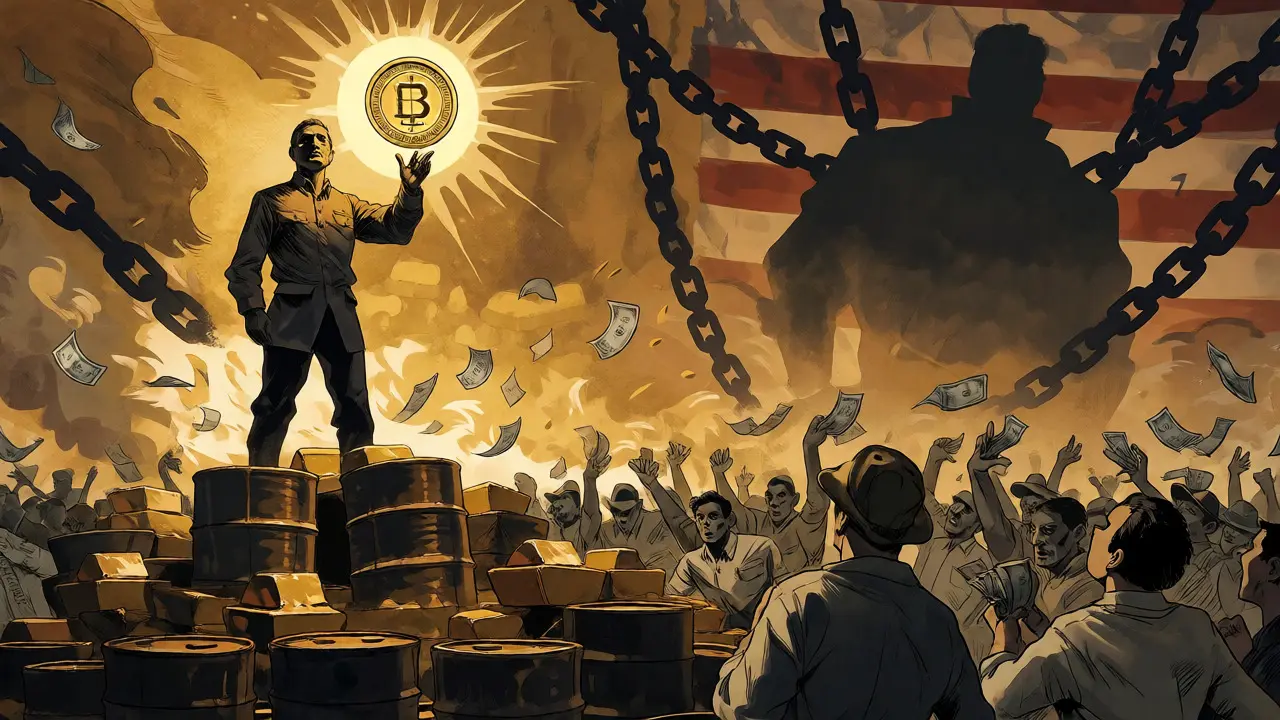
Imagine trying to buy a cup of coffee with a currency that the government says is worth $60, but no one on the street will take. That’s the reality for many Venezuelans dealing with the Petro, a sovereign cryptocurrency launched by President Nicolás Maduro in 2018. The idea was bold: back digital tokens with oil, gold, and diamonds to bypass international sanctions and stabilize an economy crushed by hyperinflation. But does it work? If you’re looking at Venezuela’s financial landscape, you’ll find the Petro isn’t just a tech experiment-it’s a political tool wrapped in blockchain code, struggling against both market skepticism and heavy-handed regulation.
The Birth of a State-Backed Token
Nicolás Maduro announced the Petro in December 2017, framing it as a lifeline for a country drowning in debt. By decreeing its creation through Presidential Decree 3196, the government aimed to create "new forms of international financing." The pitch was simple: instead of relying on the U.S. dollar or traditional banks, Venezuela would issue 100 million tokens, each valued at roughly $60, backed by physical reserves like oil and gold. This wasn’t just about convenience; it was about survival. With foreign debt hitting $140 billion and the bolívar losing value daily, the Petro was meant to be a shield against economic collapse.
But here’s the catch: unlike Bitcoin, which anyone can mine and trade freely, the Petro runs on a federated blockchain. This means verification isn’t decentralized among thousands of anonymous nodes. Instead, a specific group controls the ledger. In this case, that group answers to the Venezuelan state. For crypto purists, this defeats the purpose. Why use a blockchain if the government holds all the keys? It turns out, the primary goal wasn’t technological innovation-it was regulatory control and sanction evasion.
Who Controls the Petro?
Regulation in Venezuela’s crypto space falls under SUPCACVEN, the Superintendence of Crypto Assets and Related Activities. Created alongside the Petro, this body manages everything from miner registries to exchange operations. Think of them as the central bank for digital assets, but with broader powers. They decide who gets to mine, how exchanges operate, and even collect fees on transactions. This centralized authority contrasts sharply with the "trustless" nature of most cryptocurrencies.
To boost adoption, the government established four Petro Zones in March 2018. These include Margarita Island, Los Roques Archipelago, Paraguaná peninsula, and the Ureña-San Antonio border area. The incentive? Tax breaks. Companies operating in these zones could import mining equipment duty-free for two years. The logic was sound: make it cheap to mine, and people will use the token. Yet, reports on actual mining activity in these zones remain sparse. Did the tax incentives spark a mining boom, or did they just benefit a few connected insiders? The data is murky, suggesting limited organic growth.

Market Skepticism and the VIBE Leak
If you thought the government believed its own hype, think again. A leaked document from VIBE, the government’s crypto advisory group, revealed a starkly different view. VIBE recommended selling $2.3 billion worth of Petros in private offerings at discounts up to 60%. That’s right-the advisors suggested slashing the price by more than half to attract buyers. This move signaled deep doubts about the official $60 valuation. If the token were truly backed by solid reserves, why sell it so cheap?
This lack of confidence trickled down to the general public. While the government mandated Petro payments for certain services-like airplane fuel and government documents by January 2020-ordinary citizens largely ignored it. Most Venezuelans turned to established cryptocurrencies like Bitcoin or stablecoins like USDT to protect their savings. Why trust a volatile, government-controlled token when Bitcoin has a proven track record of preserving value during inflation? The Petro became a symbol of forced compliance rather than voluntary adoption.
Sanctions and International Isolation
You can’t talk about the Petro without mentioning U.S. sanctions. Washington viewed the cryptocurrency not as a financial innovation, but as a way for the Maduro regime to dodge restrictions on Venezuelan debt. Congressional measures, including S.37, sought to codify bans on trading Venezuelan crypto assets. This isolation hurt the Petro’s liquidity. Unlike Ethereum or Solana, you won’t find the Petro listed on major global exchanges like Coinbase or Binance with significant volume. Without open market trading, its price remains theoretical, dictated by government decree rather than supply and demand.
The opposition-controlled National Assembly declared the Petro illegal in March 2018, arguing it was an unauthorized debt issuance. This created a legal paradox: the executive branch enforced its use, while the legislative branch rejected its legitimacy. For businesses and individuals, navigating this uncertainty was risky. Do you accept a payment method that half the government considers invalid? Most chose to avoid the headache entirely, sticking to dollars or established cryptos.

Petro vs. Traditional Crypto: A Comparison
To understand where the Petro fits, compare it to the giants of the industry. Here’s how it stacks up:
| Feature | Petro (PTR) | Bitcoin (BTC) | Ethereum (ETH) |
|---|---|---|---|
| Backing | Oil, Gold, Diamonds | None (Proof of Work) | None (Utility/Smart Contracts) |
| Control | Federated (State-Controlled) | Decentralized | Decentralized |
| Primary Use Case | Sanction Evasion/Gov Services | Store of Value | Smart Contracts/DApps |
| Exchange Listings | Limited/Local | Global/Major | Global/Major |
| Volatility Source | Political/Economic Policy | Market Sentiment/Adoption | Network Activity/Upgrades |
The table highlights a critical difference: decentralization. Bitcoin and Ethereum thrive because no single entity controls them. The Petro relies on state stability, which has been anything but stable. When the government changes policy or faces new sanctions, the Petro’s value fluctuates wildly based on political news, not technical merit.
Current Status and Future Outlook
As of 2025, the Petro remains a niche instrument. It hasn’t replaced the bolívar, nor has it become a preferred medium for international trade. Its main success lies in forcing some level of digital literacy among government workers and those accessing state services. However, for the average Venezuelan, it’s still a mystery or a nuisance. The Treasury of Cryptoassets, a state-owned company handling issuance and custody, continues to manage the token, but transparency remains low.
Will the Petro survive? It depends less on blockchain technology and more on geopolitics. If U.S. sanctions ease, the Petro might gain traction as a settlement layer for oil deals. If political instability continues, it risks becoming another failed monetary experiment. For now, it serves as a cautionary tale: you can mint a coin, but you can’t force people to believe in it.
What backs the Petro cryptocurrency?
The Petro is officially backed by Venezuela's natural resources, specifically reserves of oil, gasoline, gold, and diamonds. The government claims this asset backing provides intrinsic value, though independent audits are rare.
Is the Petro widely used in Venezuela?
No, widespread adoption is minimal. While mandatory for certain government services and aviation fuel, most citizens prefer USD, Bitcoin, or stablecoins for daily transactions due to greater trust and liquidity.
Why did the U.S. sanction the Petro?
The U.S. government viewed the Petro as a mechanism for the Maduro administration to circumvent financial sanctions on Venezuelan debt and access international capital markets without complying with existing restrictions.
Can I buy Petro on major exchanges like Coinbase?
Generally, no. The Petro lacks significant listings on major global exchanges. Trading is mostly confined to local Venezuelan platforms or over-the-counter deals, limiting its accessibility for international investors.
What are Petro Zones?
Petro Zones are designated areas in Venezuela, such as Margarita Island and the Colombian border region, where companies receive tax incentives, like duty-free imports of mining equipment, to encourage cryptocurrency mining and usage.