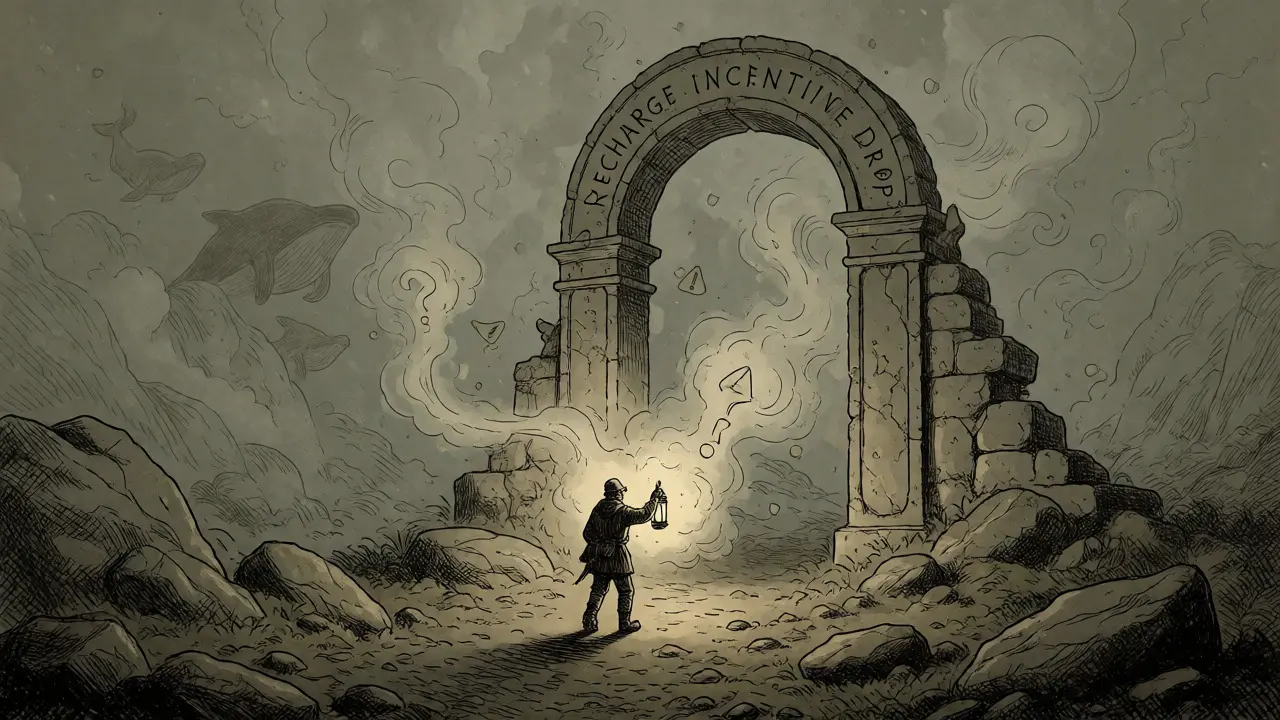
You clicked on this because you saw the name "Recharge Incentive Drop" somewhere-maybe in a Telegram group, a Discord channel, or a shady ad-and now you're wondering if it's real. Here is the hard truth: as of November 2026, there are no verified, authoritative records for an official project with this exact name. No major exchange lists it. No reputable data aggregator like CoinGecko or Messari tracks it. The phrase "by Unknown details" in your search query isn't just a placeholder; it is likely the actual state of affairs. This specific airdrop is either extremely new, poorly branded, or a scam waiting to happen.
But don't close the tab yet. Understanding why this information is missing is actually more valuable than finding a fake whitepaper. It teaches you how to spot the difference between a legitimate opportunity and a wallet-drainer. Let's break down what we know about the current airdrop landscape, why "unknown" projects are risky, and how you can protect yourself while hunting for free tokens.
The Mystery of the Recharge Incentive Drop
When a crypto project launches an airdrop, they usually shout it from the rooftops. They want users. They want volume. They want social proof. If a project called Recharge Incentive Drop is a potential token distribution event that currently lacks verifiable public documentation exists, why is it silent? Usually, silence means one of three things.
First, it might be a private beta test. Some protocols distribute small amounts of tokens to testers before announcing the main event. These distributions rarely have flashy names until the mainnet launch. Second, it could be a misnamed reference. Maybe you heard "Recharge" but the project is actually called "Recycle," "Renew," or something similar. Crypto names often get garbled in translation or rumor mills. Third, and most likely, it is a low-effort scam. Scammers love generic terms like "Incentive," "Drop," and "Reward" because they sound official but mean nothing without a contract address behind them.
Without a smart contract address (the long string of letters and numbers starting with 0x for Ethereum-based tokens), you cannot verify anything. If someone asks you to connect your wallet to claim the "Recharge Incentive Drop" but doesn't provide a verifiable contract on Etherscan or Solscan, treat it with extreme suspicion.
Why Details Are Missing: A Reality Check
In the crypto world, information asymmetry is the norm. But for a legitimate airdrop, key details should be public. Think about the big ones: Arbitrum, Optimism, Uniswap. Before the tokens hit wallets, everyone knew the snapshot date, the eligibility criteria, and the token allocation. For the Recharge Incentive Drop, the absence of these details is a red flag.
Here is what you would typically expect to see for a valid airdrop:
- Official Website: A domain that looks professional and links to social media.
- Social Media Presence: Active Twitter/X accounts with engagement from other credible influencers, not just bots.
- Contract Address: A verified smart contract code visible on block explorers.
- Team Information: Even if pseudonymous, doxxed teams or known backers add credibility.
If you search for "Recharge Incentive Drop" and find only spammy blogs or AI-generated articles repeating each other, that is a bad sign. Legitimate projects have organic discussion. People ask questions, complain about gas fees, or celebrate wins. If the comments section is empty or filled with "Great project!" from accounts created yesterday, run.

How Modern Crypto Airdrops Actually Work
To understand if this drop is worth your time, you need to know how the game has changed. Gone are the days when you just held a coin and got free money. Today, airdrops are complex incentive mechanisms designed to bootstrap network usage.
| Airdrop Type | Requirement | Risk Level | Typical Reward |
|---|---|---|---|
| Task-Based | Social media follows, retweets, joining Discords | Low (Time only) | Small ($10-$50) |
| Interaction-Based | Swapping tokens, bridging assets, using dApps | Medium (Gas fees + Smart Contract risk) | Medium-High ($100-$1000+) |
| Staking-Based | Locking funds in a protocol for liquidity | High (Capital lock-up + Market volatility) | Variable (Yield + Token bonus) |
| Retroactive | Historical usage before a snapshot date | Low (Already happened) | High (Unpredictable) |
The "Recharge" name suggests a utility-focused token, perhaps related to energy, gaming, or payment infrastructure. If it falls into the Interaction-Based category, you might need to spend real money on gas fees to qualify. If it is Task-Based, you are trading time for potentially negligible returns. Always calculate the cost-benefit ratio. Spending $20 in gas fees to potentially earn $15 in tokens is a losing strategy unless you believe the token will appreciate significantly.
Red Flags to Watch Out For
Since the details are unknown, assume the worst-case scenario: it is a phishing attempt. Scammers exploit the fear of missing out (FOMO). They create urgency. "Claim within 24 hours!" is a classic tactic. Real airdrops rarely have such tight, arbitrary deadlines for claiming once the distribution starts.
Watch out for these specific traps:
- The "Connect Wallet" Trap: Never connect your main hardware wallet (like Ledger or Trezor) to an unknown site. Use a fresh, empty browser wallet. If the site asks for your seed phrase, it is 100% a scam. No legitimate airdrop ever needs your seed phrase.
- Pump-and-Dump Schemes: Some projects issue millions of tokens to insiders, list them on a minor exchange, hype them up, and then dump their holdings on retail investors. If the token supply is massive and the circulating supply is tiny, beware.
- Hidden Fees: Does the claim process require you to send ETH or SOL first? That is unusual for a pure airdrop. Sometimes scammers charge a "gas fee" that goes straight to their pocket.
Remember the lesson from past failures. Not every airdrop ends in riches. Many end in worthless tokens that crash 90% within weeks of listing. The excitement of free money often blinds us to the lack of fundamental value.
Due Diligence Checklist
Before you click any button related to the Recharge Incentive Drop, run through this checklist. If you fail even one item, proceed with caution or skip entirely.
- Is there a GitHub repository? Look for active code commits. Dead repos mean dead projects.
- Who is auditing the contracts? Look for audits from firms like CertiK, Hacken, or Trail of Bits. No audit? Higher risk.
- Check the tokenomics. How many tokens are locked for the team? If the team unlocks 100% of their tokens immediately, they have no incentive to hold. Vesting schedules matter.
- Search for scam reports. Use sites like ScamAdviser or check Reddit threads specifically for "Recharge Incentive Drop." Look for recent complaints.
If you live in Wellington or anywhere else, remember that local regulations vary, but the global nature of crypto means you are responsible for your own security. There is no customer support hotline for a lost seed phrase.
What To Do Next
So, where does this leave you? If you cannot find solid evidence of the Recharge Incentive Drop's legitimacy, the best move is patience. Wait for a verified announcement from a trusted source. Don't let FOMO drive your decisions.
If you still want to investigate, set up a burner wallet. Transfer a small amount of native currency (ETH, BNB, SOL) to it. Try interacting with the project's website using this burner wallet. If everything looks normal and the community grows over the next few weeks, you might consider participating. But keep your expectations low. Treat it as a lottery ticket, not an investment.
The crypto market moves fast. New narratives emerge weekly. While you wait for clarity on this specific drop, look at established Layer 2 networks or emerging DeFi protocols that have transparent roadmaps. Those offer better odds than chasing ghosts.
Is the Recharge Incentive Drop a confirmed scam?
It is not necessarily a scam, but it is unverified. The lack of official documentation, social media presence, and contract addresses makes it high-risk. It could be a very early-stage project or a poorly marketed one, but caution is strongly advised.
Where can I find official details for this airdrop?
Currently, there are no widely recognized official channels. You should check established aggregators like CoinMarketCap, CoinGecko, or specialized airdrop trackers like DappRadar. If it doesn't appear there, it may not exist publicly yet.
Do I need to pay gas fees to claim an airdrop?
Usually, yes, you pay gas fees to claim tokens on-chain. However, some projects use "claimless" distributions where tokens are sent directly to eligible wallets. Be wary of sites asking for large upfront payments beyond standard network gas fees.
What is the safest way to participate in unknown airdrops?
Use a separate, fresh wallet containing only a small amount of funds. Never share your seed phrase. Verify the contract address on a block explorer before interacting. Start with minimal capital to test the waters.
Why is the creator listed as "Unknown"?
Many crypto projects start anonymously to decentralize governance or avoid regulatory scrutiny initially. However, successful projects usually reveal their team or backers over time. Permanent anonymity combined with no marketing is a warning sign.