When you want to trade crypto without a middleman, SushiSwap V3 (Core) is one of the few decentralized exchanges that actually feels like it’s built for real users-not just developers. Launched in 2023, this platform isn’t just another Uniswap clone. It’s got its own rhythm, its own rewards, and a few serious trade-offs you need to understand before you connect your wallet.
How SushiSwap V3 Works (Without the Jargon)
SushiSwap V3 (Core) runs on Ethereum and uses something called an Automated Market Maker, or AMM. That means there’s no order book. Instead, trades happen directly against pools of crypto locked in smart contracts. You swap ETH for USDC? That’s pulled from a pool where other people have deposited those tokens. Simple, right? But here’s where it gets interesting.
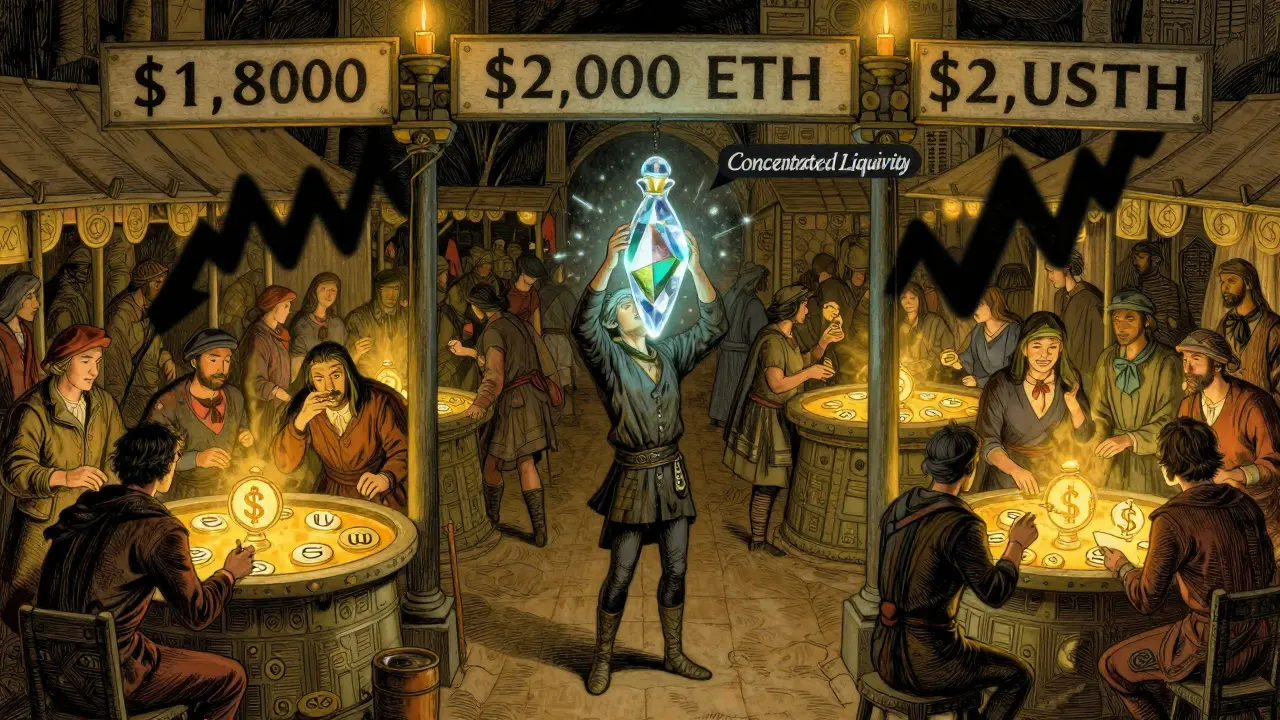
Unlike older versions, V3 uses concentrated liquidity. Instead of spreading your tokens across every price range, you pick a narrow band-say, between $1,800 and $2,000 for ETH. If the price stays in that zone, you earn way more fees. But if it moves outside? You stop earning until it comes back. Think of it like setting up a mini-shop that only opens when customers walk by. Smart? Yes. Easy? Not always.
This feature lets liquidity providers earn 2-3x more than on V2, but it also means you’re playing a game of price prediction. If you guess wrong, you end up holding one token while the price moves away. It’s like options trading, but without a broker to help you.
The Reward System: More Than Just Trading Fees
Here’s what sets SushiSwap apart: it doesn’t just give you trading fees. It gives you a slice of the pie twice.
Every time someone trades on SushiSwap, 0.3% of the fee is collected. Of that:
- 0.25% goes directly to liquidity providers
- 0.05% goes to people who stake xSUSHI
That second part is huge. If you hold SUSHI tokens and convert them to xSUSHI via the SushiBar, you earn a share of those 0.05% fees every single day. It’s passive income from trading activity-not just from staking your tokens. And it’s not theoretical. As of October 2025, the platform had over $69 billion in cumulative trading volume. That’s real money flowing through the system.
There’s also the Onsen Program, which boosts rewards for new tokens. If you add liquidity to a fresh pair like $WIF or $PEPE, you can earn extra SUSHI tokens on top of trading fees. This keeps new projects coming to the platform-and gives early adopters a real edge.
What You Can’t Do on SushiSwap
Let’s be clear: SushiSwap V3 isn’t a full-service exchange. You won’t find margin trading. No leverage. No stop-losses. No fiat on-ramps beyond basic bank transfers and Apple Pay (which are handled through third-party partners, not the core platform). If you’re used to trading on Binance or Coinbase, you’ll feel the lack of tools.
And while it supports six wallets-MetaMask, WalletConnect, Coinbase Wallet, Phantom, Argent, and Rainbow-you’re still stuck with Ethereum gas fees. A simple swap can cost $3-$15 depending on network congestion. For small trades under $100, that’s a killer. That’s why many users now use the Polygon version of SushiSwap, which cuts fees to pennies and still lets you trade the same tokens.

SushiSwap vs Uniswap: The Real Difference
People always compare SushiSwap to Uniswap. Here’s the breakdown:
| Feature | SushiSwap V3 | Uniswap v4 |
|---|---|---|
| Fee split to stakers | Yes (0.05%) | No |
| Concentrated liquidity | Yes | Yes |
| Onsen reward program | Yes | No |
| Limit orders | Yes (since July 2025) | Yes (since 2024) |
| Dollar Cost Averaging (DCA) | Yes (since July 2025) | No |
| TVL (Total Value Locked) | $3.99B | $11.2B |
| Supported tokens | 3 coins, 5 pairs | Over 2,000 |
Uniswap has more liquidity, more tokens, and more users. But SushiSwap gives you extra ways to earn. If you’re holding SUSHI, you’re not just a user-you’re a stakeholder. And that changes how you think about the platform.
The Hidden Costs: Gas, Complexity, and Risk
Here’s the truth most reviews skip: SushiSwap V3 is powerful, but it’s not beginner-friendly. The interface looks clean, but the options are deep. Concentrated liquidity? You need to understand ticks, price ranges, and impermanent loss. The DCA tool? It’s great for long-term buyers-but if you set it wrong, you could end up buying more of a coin that keeps falling.
And then there’s gas. Ethereum fees can turn a $20 trade into a $25 loss. That’s why most active traders use Polygon. The Polygon version of SushiSwap works the same way, but with near-zero fees and faster confirmations. You can even bridge your tokens over with a few clicks. It’s not a different platform-it’s the same one, just cheaper.
Security? There’s no insurance. No KYC. No customer support team. If you send crypto to the wrong address, or if a smart contract glitch happens? You lose it. That’s the nature of DeFi. SushiSwap doesn’t hide that. But it also doesn’t warn you enough. No demo account. No sandbox. You’re in the deep end from day one.

Who Is This For?
SushiSwap V3 isn’t for everyone. If you’re just swapping ETH for USDT once a month? Use Coinbase. It’s easier, safer, and you won’t sweat the gas fees.
But if you’re:
- Already holding SUSHI or xSUSHI
- Willing to learn how concentrated liquidity works
- Looking for extra rewards beyond trading fees
- Trading on Polygon to avoid Ethereum fees
- Interested in supporting new DeFi projects with Onsen rewards
Then this is one of the best places to be. The recent addition of Limit Orders and DCA in July 2025 proves the team isn’t resting. They’re building tools that match what centralized exchanges offer-just without the middleman.
The Bottom Line
SushiSwap V3 (Core) is a high-efficiency, high-reward platform for those who know what they’re doing. It’s not the biggest, and it’s not the easiest. But it’s one of the few decentralized exchanges that actually rewards its community-not just its users.
The $3.99 billion in TVL and $69 billion in volume aren’t just numbers. They’re proof that people are choosing it over bigger names because of the way it shares value. If you’re serious about DeFi, and you’re ready to learn, SushiSwap V3 is worth your time. Just don’t expect hand-holding. You’re on your own here-and that’s the point.
Is SushiSwap V3 safe to use?
SushiSwap is a decentralized platform, so there’s no central authority to protect your funds. All transactions happen through smart contracts, which are open-source and audited, but bugs or exploits can still happen. There’s no insurance or recovery option if you send funds to the wrong address or if a contract fails. Use trusted wallets like MetaMask or WalletConnect, and never invest more than you can afford to lose.
Can I trade fiat currency on SushiSwap?
SushiSwap doesn’t handle fiat directly. But it integrates with third-party services like MoonPay and Transak that let you buy crypto using bank transfers or Apple Pay. These services convert your fiat into ETH or USDC, which you then use on SushiSwap. You’ll pay extra fees for this service, but it’s the only way to get in without buying crypto elsewhere first.
Why does SushiSwap have so few trading pairs?
As of late 2025, SushiSwap V3 (Core) only supports 3 coins across 5 pairs because it prioritizes deep liquidity over quantity. Instead of spreading thin across hundreds of tokens, it focuses on ETH, USDC, and DAI-the most stable and heavily traded assets. This keeps slippage low and fees predictable. Other tokens are available on the Polygon version, but the Core Ethereum version stays lean to maintain efficiency.
How do I earn from xSUSHI staking?
You convert your SUSHI tokens to xSUSHI using the SushiBar interface. This locks your tokens and gives you a proportional share of the 0.05% trading fee cut. You earn daily, and your xSUSHI balance grows over time. There’s no fixed APY-it depends on how much trading happens on the platform. In late 2025, users saw annual returns of 5-12% from this alone, depending on volume.
Should I use Ethereum or Polygon for SushiSwap?
For most users, Polygon is the better choice. Fees are 100x lower, and transactions confirm in seconds. The Polygon version supports the same tokens, rewards, and features as the Ethereum Core version. Only use Ethereum if you’re doing large trades ($5,000+) where gas fees become a smaller percentage of your total cost. For everyday use, Polygon wins.
What’s Next?
The next big move for SushiSwap is likely deeper integration with Layer 2 networks like Arbitrum and zkSync. With Ethereum fees still unpredictable, the platform can’t afford to rely on one chain. If they pull off seamless cross-chain liquidity, they could become the first truly multichain DeFi powerhouse.
For now, SushiSwap V3 is a niche tool for those who want more control, more rewards, and less reliance on centralized exchanges. It’s not perfect. But it’s one of the few places in crypto where the users actually get paid for helping the system work.
Gaurav Mathur
February 12, 2026 AT 18:58Jeremy Lim
February 13, 2026 AT 00:15John Doyle
February 14, 2026 AT 22:23kelvin joseph-kanyin
February 15, 2026 AT 22:59Grace Mugambi
February 17, 2026 AT 19:33Crystal McCoun
February 17, 2026 AT 19:38Beth Trittschuh
February 18, 2026 AT 14:31Benjamin Andrew
February 19, 2026 AT 03:27Donna Patters
February 19, 2026 AT 13:10Michelle Cochran
February 21, 2026 AT 10:02Peggi shabaaz
February 22, 2026 AT 03:10Holly Perkins
February 23, 2026 AT 23:47