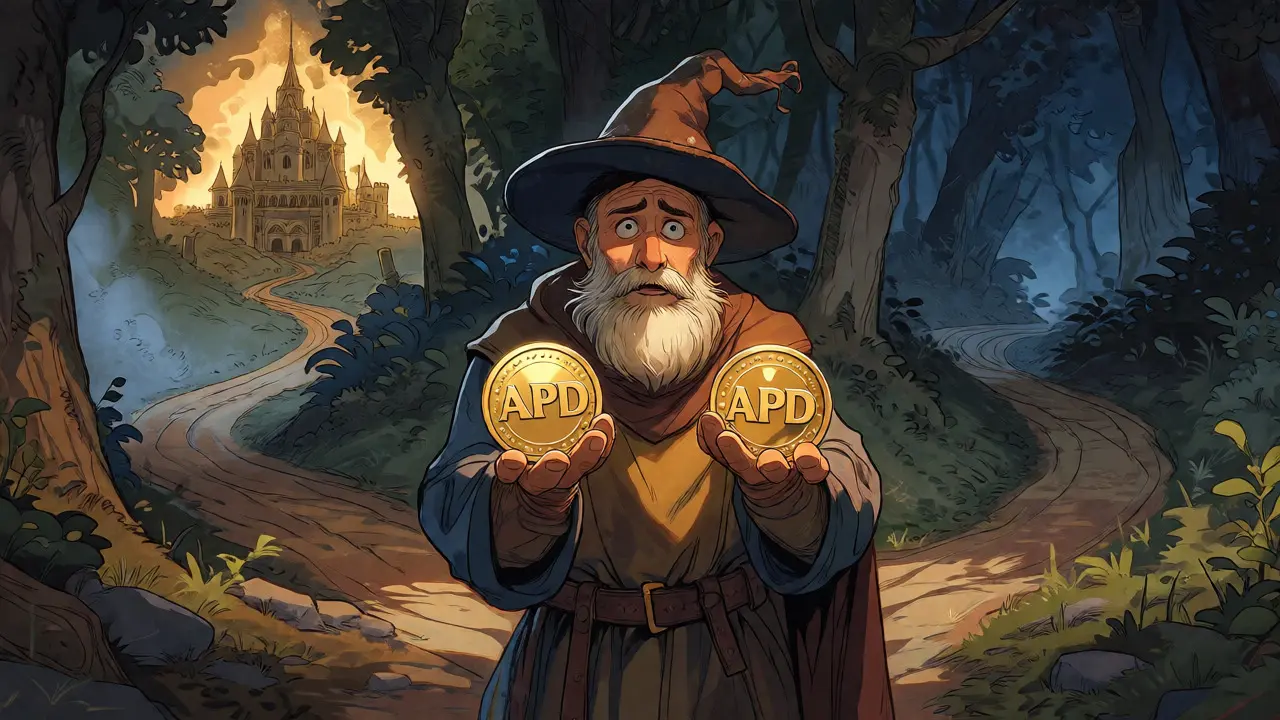
You search for APD, and you get two completely different answers. One says it's a governance token on BNB Chain with billions in supply. The other claims it's a launchpad token on Solana or Ethereum with a tiny market cap. This isn't just bad luck; it's a classic case of ticker symbol collision that traps retail investors. If you are trying to figure out what you are actually buying, you need to know that "APD" currently refers to at least two distinct projects: APDAO and Aptopad. They share the same three-letter code but operate on different blockchains, have vastly different supplies, and serve entirely different purposes.
The Core Identity Crisis: APDAO vs. Aptopad
Let's cut through the noise. When most major data aggregators like Coinbase or LBank mention APD today, they are referring to the native governance token of APDAO. This project positions itself as a decentralized autonomous organization focused on value transfer, incentive distribution, and community voting. It operates primarily on the BNB Smart Chain (BEP20 standard). The contract address typically starts with 0x, confirming its compatibility with EVM-compatible chains rather than Solana, despite some confusing listings on platforms like CoinSwitch.
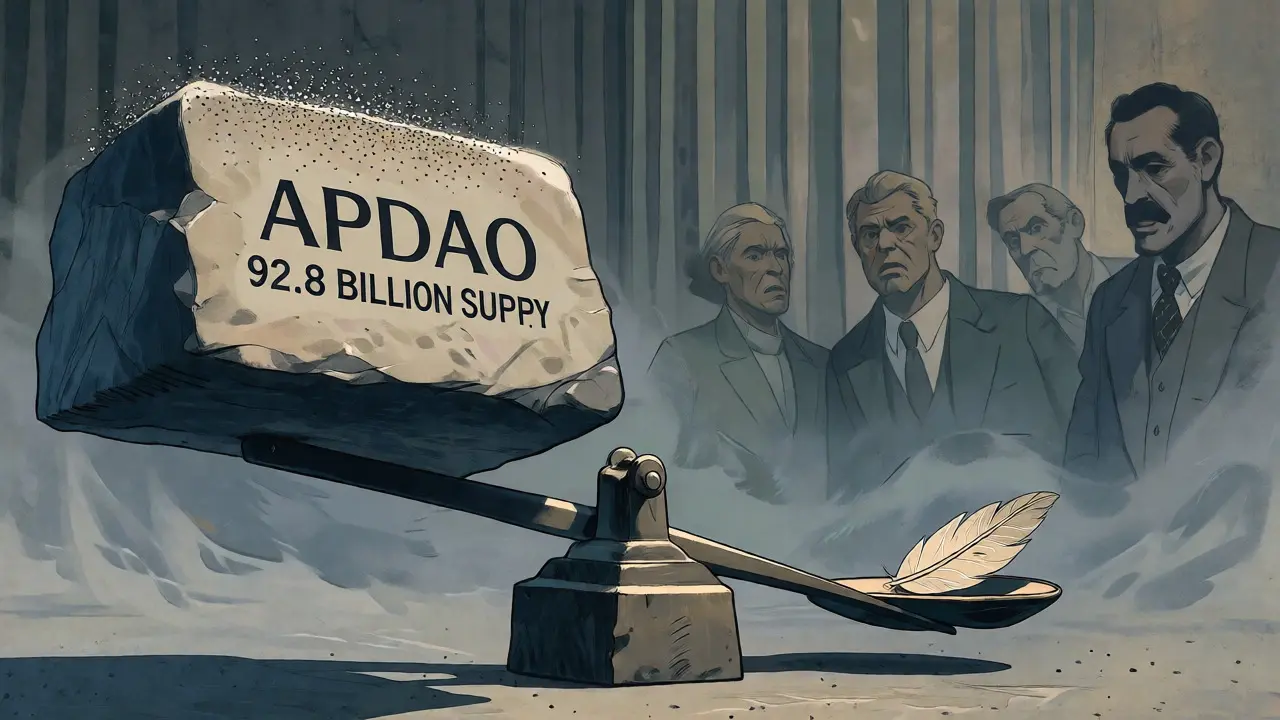
On the flip side, there is Aptopad, which also uses the APD ticker. Aptopad is a decentralized launchpad designed to help project owners attract liquidity before launching their tokens. Its token has a maximum supply of only 100 million, compared to APDAO's massive 92.8 billion total supply. The price difference is staggering: while APDAO might trade around $0.04 to $0.23 depending on the exchange and time, Aptopad's APD trades in fractions of a cent, often below $0.0001. If you buy the wrong one, your portfolio performance will look nothing like the charts you studied.
| Feature | APDAO (APD) | Aptopad (APD) |
|---|---|---|
| Primary Function | Governance & Community Voting | Launchpad Utility & Liquidity |
| Blockchain | BNB Smart Chain (BEP20) | Ethereum / Multi-chain (varies by listing) |
| Total Supply | 92,800,000,000 | 100,000,000 |
| Circulating Supply | Reported as 0 (High Anomaly) | Low / Limited Visibility |
| Approx. Price Range | $0.04 - $0.25 | <$0.0001 |
| Daily Volume | $2M - $23M (Volatile) | <$1,000 (Very Low) |
Why the Data Doesn't Add Up
Here is where things get weird. If you look at Binance's data for APD, you see a fully diluted market cap of over $4 billion, yet the circulating supply is listed as zero. How can you trade something with zero circulation? Platforms report daily trading volumes ranging from $2.44 million to $23.6 million across 16 markets. This discrepancy suggests either a lack of transparency in tokenomics reporting or significant off-chain activity that hasn't been properly indexed. For a beginner, this is a red flag. A healthy governance token usually has a clear, verifiable circulating supply so users can gauge how much influence their vote holds relative to the whole.
Analysts have pointed out that tokens with zero reported circulating supply but high trading volume often fall into a "high-risk category." CryptoRank.io data from late 2025 indicated that such projects had a 92% failure rate within twelve months. The logic is simple: if the team or insiders hold nearly all the supply, they can manipulate the price with minimal capital. You might see a 23% profit spike in four hours, as one trader noted on Binance Square, but that volatility is usually followed by a sharp decline. In fact, APD saw a 40.79% drop over seven days following such pumps, erasing gains quickly.
Technical Specifications and Blockchain Reality
Don't trust the headline; check the contract. Some sources claim APD runs on Solana because of "high-speed transactions," but the contract addresses starting with 0x prove otherwise. These are hexadecimal addresses typical of Ethereum Virtual Machine (EVM) chains like BNB Chain or Ethereum mainnet. Solana addresses are alphanumeric strings, not hex codes. This error likely stems from lazy copy-pasting in aggregator databases.
For APDAO, the technical backbone is the BNB Chain ecosystem. This means transaction fees are low, and compatibility with wallets like MetaMask or Trust Wallet is straightforward. However, the documentation quality is poor. A quick GitHub search reveals zero official repositories for APDAO, which is unusual for a project claiming to be a transparent DAO. Without open-source code, you cannot verify how the governance voting mechanism actually works. Are votes weighted by holding period? Is there a quorum requirement? The website linked in some reports, alphapartner.vip, offers minimal technical detail, leaving investors to rely on social sentiment rather than code audits.
Market Performance and Volatility Risks
If you are looking for stability, APD is not it. As of October 2025, the price hovered around $0.0437, down more than 80% from its all-time high of $0.25. The trend is consistently downward, with declines of 62% over 30 days and 52% over 90 days. This isn't just market correction; it looks like a sustained bleed. Compare this to established governance tokens like Uniswap (UNI) or MakerDAO (MKR), which maintain higher daily volumes ($85M-$142M) and more predictable price action due to deeper liquidity pools.
Aptopad's APD fares no better in terms of growth potential. With a daily volume of just $432, it lacks the liquidity to support large trades. If you try to sell a moderate amount, you might crash the price yourself. This illiquidity makes it suitable only for micro-speculation, not serious investment. The user experience reflects this frustration. Trustpilot reviews for platforms listing these tokens average 2.1 stars, with complaints about "impossible to determine which APD token I'm buying" and unresponsive support teams when tokens seemingly disappear from portfolios.

How to Buy APD Safely (If You Must)
Before you click "buy," follow this checklist to avoid buying the wrong asset:
- Verify the Contract Address: Go to a blockchain explorer like BscScan or Etherscan. Copy the contract address provided by the exchange and paste it into the explorer. Check the token name and symbol. Does it say "APDAO" or "Aptopad"?
- Check the Supply: Look at the total supply. If it's near 92.8 billion, it's likely APDAO. If it's 100 million, it's Aptopad. Do not guess based on price alone, as prices fluctuate.
- Avoid "Solana" Listings: If an exchange lists APD as a Solana SPL token, double-check the contract. Given the prevalence of BEP20 contracts, a Solana listing might be a wrapped version or an error. Stick to the native chain if possible.
- Limited Exchange Exposure: Note that Binance explicitly states APD is "not listed on Binance for trading and services." You will likely find it on smaller exchanges like LBank, HTX, or via decentralized exchanges (DEXs) on BNB Chain. Be aware that smaller exchanges carry higher custodial risk.
The Future Outlook: Will It Survive?
As of late 2025, APDAO has no public roadmap. There are no announced partnerships with major enterprises, and the community size is fragmented. Telegram groups show low activity, averaging 12 messages a day among 3,000 members. Twitter sentiment is 78% negative regarding the ticker confusion. Without a clear utility beyond vague "governance" promises, the token relies heavily on speculative hype.
The regulatory environment adds another layer of risk. The combination of zero circulating supply, high insider concentration, and active trading could trigger scrutiny under securities laws like the Howey Test in the US. If regulators decide the token was sold as an investment contract without proper registration, delistings from compliant exchanges could accelerate the price decline. For now, APD remains a niche, high-risk asset best suited for traders who understand the specific contract they are holding, not long-term holders seeking safe growth.
Is APD the same as AlphaPartner?
Not exactly. While some data providers link APD to AlphaPartner.vip, the primary recognized entity for the APD ticker in recent reports is APDAO. AlphaPartner appears to be a related platform or marketing site, but the token's core identity is tied to the APDAO governance structure on BNB Chain. Always verify the contract address to confirm the specific issuer.
Why does APD have zero circulating supply?
This is a common data reporting anomaly in newer or less transparent crypto projects. It may indicate that the majority of tokens are locked in vesting contracts, held by the foundation, or that the data feeders haven't updated the circulating metrics correctly. Despite the "zero" label, millions of dollars in volume are traded daily, suggesting tokens are moving between wallets.
Can I stake APD for rewards?
Currently, there is no widely documented staking mechanism for APD comparable to major protocols like ETH or SOL. The token is primarily positioned for governance voting. Any staking opportunities would likely be found on specific third-party yield platforms rather than native protocol features, adding counterparty risk.
Which blockchain is APD on?
The primary APD token associated with APDAO is on the BNB Smart Chain (BEP20). Another token with the same ticker, Aptopad, may exist on Ethereum or other EVM chains. It is not natively on Solana, despite some incorrect listings. Always check the contract address prefix (0x...) to confirm it is an EVM-compatible chain.
Is APD listed on Binance?
No. As of October 2025, Binance explicitly notes that APD is not listed for trading and services. You will need to use alternative centralized exchanges like LBank or HTX, or decentralized exchanges on the BNB Chain network to acquire it.