
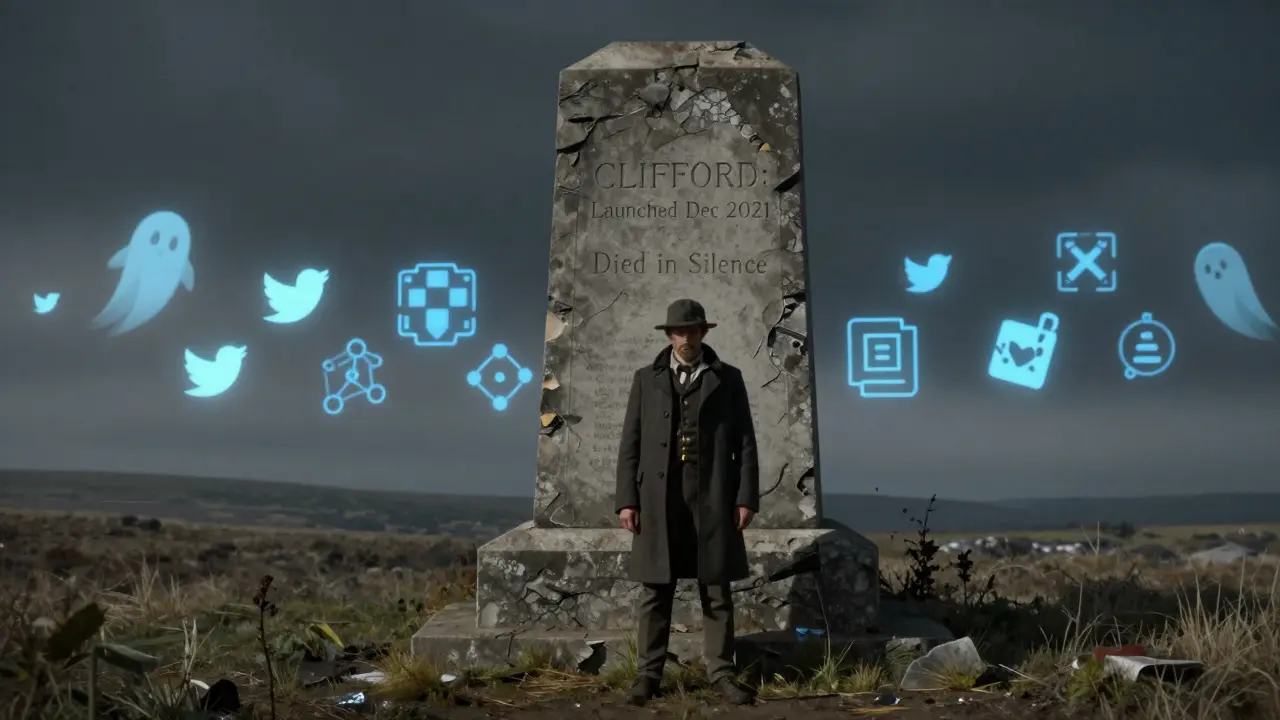
Clifford (CLIFFORD) isn't a cryptocurrency you can buy, trade, or stake today. It’s not even really alive. If you’re wondering what Clifford is, the short answer is: it’s a defunct meme coin that launched in December 2021 and vanished almost immediately. No one’s trading it. No one’s holding it. And no one’s talking about it. Despite being listed on a few exchanges, every major metric points to the same conclusion - Clifford is dead.
It was supposed to be a deflationary meme token
Clifford, sometimes called Clifford Inu (CLIFF), was pitched as a deflationary token built on Ethereum. Its creators claimed it had smart contract features designed to reduce supply over time - meaning tokens would be permanently burned with every trade. The idea was simple: make scarcity work for holders. They also promised locked liquidity, meaning the money in the trading pool couldn’t be pulled out, and a marketing tax that funded community growth.
It sounded like a lot of other meme coins from 2021 - Dogecoin’s little cousin, trying to look serious with fancy tech terms. But unlike Dogecoin or even Shiba Inu, Clifford never got off the ground. There was no viral moment. No influencer hype. No community rallying behind it. Just a whitepaper, a contract address, and silence.
Confusing data across platforms
One of the first red flags is how wildly different the numbers are depending on where you look.
- Binance says Clifford (CLIFFORD) has a max supply of 1 billion tokens, priced at $0.000092, with a market cap of around $92,000.
- CoinMarketCap says the max supply is 1 trillion tokens, with zero in circulation and a price so low it’s practically invisible - $0.00000003.
- Crypto.com says the price is $0.00006759 but adds a bold warning: “CLIFFORD is not tradable yet.”
- CoinSwitch claims it’s built on Solana, which directly contradicts Coinbase’s claim that it’s on Ethereum.
This isn’t just inconsistent - it’s chaotic. When even the basic facts like blockchain, supply, and price don’t match across platforms, you’re not dealing with a real project. You’re dealing with data ghosts.
No trading. No liquidity. No activity.
Here’s the kicker: every exchange that lists Clifford reports $0 in 24-hour trading volume. Zero. Not $100. Not $10. Zero. CoinMarketCap says circulating supply is 0. Binance says it’s “Not listed.” Crypto.com says it’s not tradable. Even the one exchange that claims to support it - Uphold - shows no actual trades ever happened.
If no one’s buying or selling, the token has no value. Not even speculative value. It’s just a string of code sitting on a blockchain, collecting dust.

Where’s the community?
Successful crypto projects live and die by their communities. Clifford has none.
- No dedicated subreddit. Not even one post in r/CryptoCurrency.
- The official Twitter account @clifftoken has 347 followers - and hasn’t tweeted since 2022.
- No Telegram group. No Discord server. No GitHub commits. No developer updates.
- No reviews on Trustpilot, CryptoSlate, or any crypto review site.
There’s no fanbase. No memes. No inside jokes. No people arguing about whether to HODL or sell. Just silence.
It’s not just inactive - it’s abandoned
The project’s website, clifftoken.io, is gone. The domain either redirects to nothing or shows an error. No documentation. No whitepaper download. No contact info. If you tried to reach out today, you’d have nowhere to go.
Even the staking feature - the one thing that made Clifford sound slightly more legitimate - doesn’t exist anymore. You can’t stake what you can’t buy. And you can’t buy what isn’t circulating.
Why did it fail?
Clifford didn’t fail because it was a bad idea. It failed because it was nothing.
It launched in late 2021, during the peak of the meme coin frenzy. Thousands of tokens dropped that year. Most died within months. But Clifford didn’t even last that long. It didn’t get listed on major exchanges. It didn’t get media coverage. No one wrote about it on CoinDesk, Cointelegraph, or The Block. No analysts from Messari or Delphi Digital ever looked at it.
According to Blockworks Research, over 98% of meme coins launched in 2021 failed to gain traction. Clifford wasn’t just one of them - it was one of the quietest. It didn’t even make it to the “failed” category. It just… disappeared.
What’s the current status?
As of February 2026, Clifford (CLIFFORD) remains listed on a handful of obscure platforms, but it’s functionally dead. The price swings you see - like Crypto.com reporting a 21.68% daily change - aren’t real market movements. They’re likely just one or two people manually trading tiny amounts over the counter, probably testing the contract or trying to scrape data.
There’s no roadmap. No team update. No new feature. No rebranding. No revival attempt. It’s a fossil.
Is it worth investing in?
No. Not even close.
If you’re thinking about buying Clifford because you saw a price on a website - don’t. You can’t actually buy it. Even if you could, the token has no liquidity, no backing, no community, and no future. It’s not a gamble. It’s a trap.
There are thousands of dead tokens like this. They’re the digital equivalent of abandoned shopping malls - the signs are still up, but no one’s inside.
What can you learn from Clifford?
Clifford is a lesson in how not to build a cryptocurrency.
- Don’t rely on buzzwords like “deflationary” or “locked liquidity” without real execution.
- Don’t launch without a community - no amount of smart contracts can replace human trust.
- Don’t assume listing on a few exchanges equals legitimacy - if no one trades it, it’s meaningless.
- And above all - if you can’t find a single person talking about it, it probably doesn’t exist.
Clifford didn’t fail because it was too ambitious. It failed because it was too empty.
Is Clifford (CLIFFORD) still being traded anywhere?
No. All major exchanges list Clifford with $0 trading volume and 0 circulating supply. Even platforms that claim to list it, like Binance and Crypto.com, explicitly state it’s not tradable. Any price you see is either outdated, speculative, or from a non-functional over-the-counter transaction.
Can I stake Clifford tokens?
No. While the original whitepaper mentioned staking through smart contracts, there’s no active staking platform, no wallet integration, and no way to access the contract. With zero tokens in circulation and no liquidity, staking is technically impossible.
Is Clifford built on Ethereum or Solana?
There’s no clear answer. Coinbase and CoinMarketCap list it as an Ethereum token. CoinSwitch claims it’s on Solana. This contradiction is a sign the project was poorly documented from the start. Multiple contract addresses exist across platforms, suggesting either a scam, a clone, or a complete lack of technical coordination.
Why do different sites show different prices and supplies for Clifford?
Because the token has no real market activity. The prices and supply numbers you see are either pulled from abandoned data, calculated from non-functional contracts, or manually entered by users. There’s no live trading to anchor these values, so every site guesses differently.
Was Clifford ever listed on Binance or Coinbase?
Binance lists it as “Not listed,” meaning it’s not available for trading. Coinbase mentions it in its research as a deflationary token but doesn’t offer it for purchase. Neither exchange supports active trading, and neither has updated the listing since 2022.
Is there a chance Clifford will come back?
Unlikely. There’s been zero developer activity, no community engagement, and no communication since 2022. The website is gone. The social media accounts are silent. Without any team, funding, or roadmap, a revival is impossible. It’s a dead project.
Should I buy Clifford if I see it listed on a small exchange?
Absolutely not. Even if you can technically buy it, there’s no way to sell it later. The liquidity is nonexistent. You’d be buying a digital file with no value, no market, and no future. It’s not an investment - it’s a loss waiting to happen.
Freddie Palmer
February 8, 2026 AT 00:45Interesting breakdown-seriously, this is one of the clearest takedowns of a dead token I’ve seen in a while.
The data discrepancies alone should be a red flag for anyone even remotely serious about crypto.
Why does CoinMarketCap list a trillion-supply token with zero circulation? Why does CoinSwitch claim Solana? This isn’t incompetence-it’s negligence, or worse.
I’ve seen abandoned coins before, but Clifford is a ghost story with a whitepaper.
And the fact that no one’s even tried to revive it? No rebrand, no migration, no “we’re back” tweet? That’s not a failure. That’s an obituary.
Also, the “deflationary” claim? With zero trades? You can’t burn what doesn’t exist.
This is what happens when you treat crypto like a PowerPoint slide, not a community.
Thanks for documenting this. Someone needs to archive these ghosts before they’re mistaken for opportunities.
Sharon Lois
February 8, 2026 AT 14:14Of course it’s dead.
Did you see who launched it?
Some guy in a Discord server with a .xyz domain and a Canva whitepaper.
They didn’t even bother to fake a team.
And now? The exchanges are still listing it because their bots auto-pull data from abandoned contracts.
It’s not a coin-it’s a data glitch.
They’re using it to pump other scams.
Every price you see? Fake volume.
Every ‘trader’? A bot.
This is how they launder money now.
They build a dead token, list it everywhere, then use the ‘liquidity’ as cover for real trades.
Clifford? Just a decoy.
Jesse Pasichnyk
February 9, 2026 AT 09:20Man, I saw this token on a meme page and thought it was funny.
Clifford the big red dog? Come on.
But then I checked the charts.
Zero volume.
No one talking.
Website gone.
It’s not even a joke anymore.
It’s a graveyard.
Don’t touch it.
Just delete it from your watchlist.
It’s not worth your time.
Jordan Axtell
February 10, 2026 AT 15:55You know what’s worse than a dead coin?
Someone still trying to sell it to you.
I got a DM last week: ‘CLIFFORD is undervalued! Buy now before the rebound!’
Bro, the contract doesn’t even have a transfer function.
I checked.
It’s locked.
Like, permanently.
And yet, people are still buying it on obscure DEXs.
They think they’re getting a bargain.
They’re not.
They’re just feeding the ghost.
I’ve seen this movie before.
The ghost always wins.
And the buyer? They’re just another data point in the graveyard.
James Harris
February 11, 2026 AT 09:02Look, I’ve been in crypto since 2017.
I’ve lost money.
I’ve gained money.
I’ve seen projects rise and crash.
But Clifford?
It never even got to rise.
It was a whisper in a hurricane.
And that’s the real lesson here.
Crypto isn’t about tech.
It’s about people.
No community? No heartbeat.
No one to cheer? No reason to live.
Clifford didn’t fail because of code.
It failed because no one cared.
And that’s sadder than any rug pull.
Don’t chase dead coins.
Chase people.
Chase passion.
That’s what lasts.
Alex Garnett
February 12, 2026 AT 08:49Clifford is the perfect metaphor for the entire crypto space.
It had all the trappings of legitimacy: whitepaper, contract, exchange listings.
But beneath it? Nothing.
No substance.
No accountability.
No vision.
Just a hollow shell built on hype and borrowed credibility.
And yet-
People still chase it.
They still believe.
They still buy.
Because they refuse to accept that some things are simply… empty.
Clifford isn’t dead.
It’s a mirror.
And we’re all staring into it.
Ryan Chandler
February 13, 2026 AT 19:04CLIFFORD.
Just… wow.
I read this entire thing and I felt something.
Not anger.
Not sadness.
Not even irony.
Just… awe.
Awe at how perfectly it represents the absurdity of crypto.
A token that never lived.
A project that never tried.
A community that never formed.
And yet-it’s still listed.
Still tracked.
Still… there.
Like a tombstone in a field no one visits.
It’s beautiful.
In the most tragic way possible.
Ajay Singh
February 13, 2026 AT 21:05Shruti Sharma
February 14, 2026 AT 11:04Brittany Novak
February 15, 2026 AT 20:26Clifford was never real.
It was a honeypot.
Designed to trap retail investors who don’t check contract addresses.
Every listing? Fake.
Every price? Manipulated.
Every ‘volume’? Wash trading from a single wallet.
And now?
It’s being used to validate other scams.
When someone says ‘it’s listed on Binance,’ they point to Clifford.
It’s a Trojan horse for trust.
They don’t need to pump it.
They just need it to exist.
So people believe.
And they get careless.
Clifford isn’t dead.
It’s a weapon.
Joshua Herder
February 16, 2026 AT 05:27Let me tell you something about Clifford.
It’s not just a dead coin.
It’s a philosophical statement.
It’s what happens when you remove intention from innovation.
When you build something because you can, not because you should.
When you assume that blockchain = value.
When you think that a contract address is a legacy.
Clifford didn’t fail because of bad code.
It failed because it was conceived in a vacuum.
No passion.
No pain.
No purpose.
It was born from a spreadsheet.
Not a dream.
And that’s why it died before it ever lived.
It’s not a lesson in crypto.
It’s a lesson in humanity.
What are we building?
And why?
Clifford doesn’t answer that.
It just… sits there.
Waiting.
For someone to ask.
Udit Pandey
February 16, 2026 AT 21:50As an Indian investor, I must say this is a textbook example of how not to approach decentralized finance.
Clifford’s collapse is not merely technical-it is moral.
When a project lacks transparency, accountability, and community, it ceases to be financial innovation.
It becomes exploitation.
And yet, we still see retail investors chasing such tokens in India, lured by false promises of ‘next Shiba Inu.’
There is no merit in speculation without substance.
There is no honor in gambling on ghosts.
The global crypto community must enforce ethical standards-not just technical ones.
Clifford is not an anomaly.
It is a symptom.
And we must treat the disease before more die.