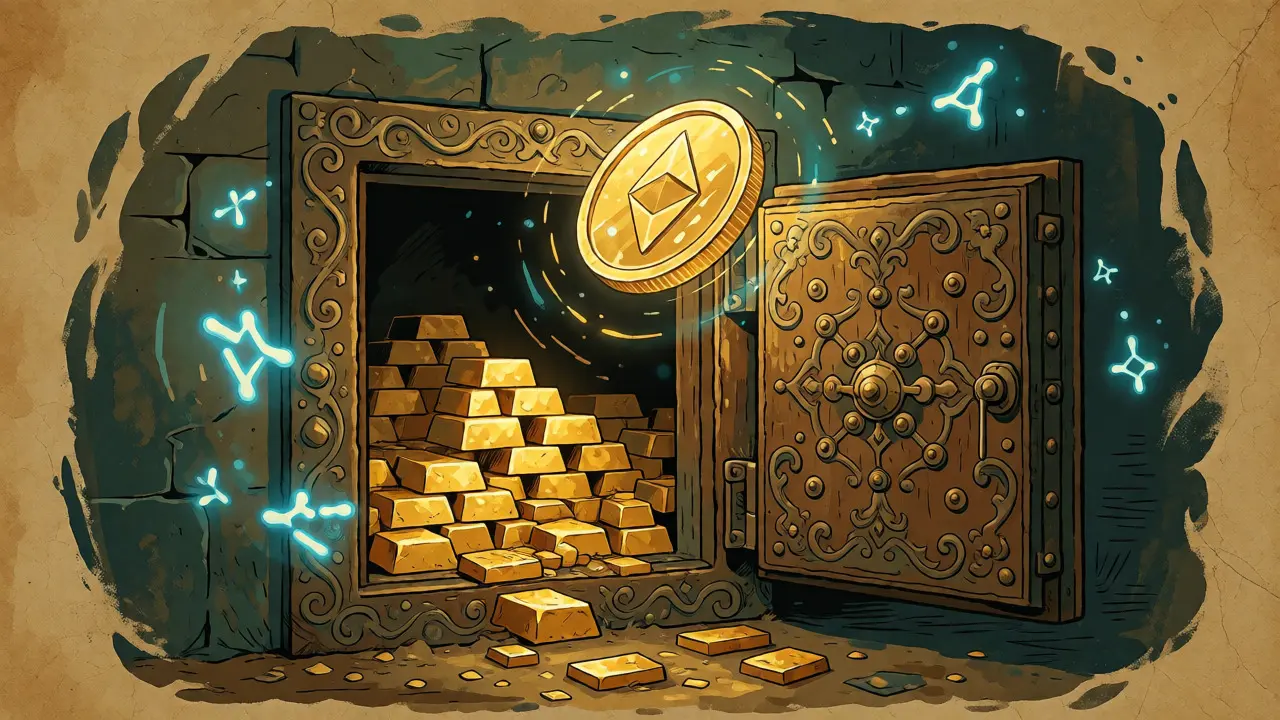
Imagine buying a digital token that promises to be backed by real physical gold. Sounds solid, right? That is the pitch behind Goldgr, a cryptocurrency trading under the ticker GOLDGR. It launched in 2025 on the Ethereum blockchain, positioning itself as a bridge between traditional precious metals and modern crypto convenience. The core promise is simple: one GOLDGR token equals one gram of physical gold stored in a vault.
But here is the catch. While the concept is attractive, the reality for investors as of October 2026 is far more complex. Is it a safe haven asset or a high-risk speculative play? This article breaks down exactly what Goldgr is, how its technology works, who is actually running it, and why you need to look closely at the data before putting your money into it.
The Core Concept: Digital Gold on Ethereum
Goldgr operates as an ERC-20 token on the Ethereum network. Unlike Bitcoin, which has no underlying physical asset, Goldgr claims to derive its value from tangible bullion. The project’s website, gold.game, describes a platform where users can buy, sell, and exchange raw gold, bars, and coins using this digital token.
The idea is to solve two problems at once. First, it offers the stability often associated with gold during market volatility. Second, it provides the speed and accessibility of blockchain transactions. You don’t need to ship heavy metal bars across borders; you just send tokens. The platform advertises features like real-time pricing, low transaction fees, and secure digital wallets. However, these are marketing claims. Until you see independent proof, treat them as promises rather than guarantees.
Tokenomics: Supply Issues and Holder Concentration
If you dig into the numbers, things get messy quickly. There is a significant contradiction in the reported supply data that every potential investor should understand. On-chain data from Etherscan shows a maximum total supply of 10 billion GOLDGR tokens. Yet, other major data aggregators like Bitget and CoinMarketCap list a maximum supply of only 100 million. Why the discrepancy? The reason isn’t clearly documented in public sources.
Even more concerning is the distribution. As of late 2026, only about 117,663 tokens were reported in circulation. But who holds the rest? A snapshot from Etherscan reveals that a single address labeled "TrustSwap Team Finance Lock" holds over 99.99% of the displayed supply. This extreme concentration creates massive risk. If the entity controlling that locked amount decides to release tokens or manipulate the price, the market could swing wildly. With such a small circulating supply, liquidity is thin, meaning large trades can drastically move the price against you.
| Feature | Goldgr (GOLDGR) | PAX Gold (PAXG) | Tether Gold (XAUt) |
|---|---|---|---|
| Launch Year | 2025 | 2019 | 2020 |
| Blockchain | Ethereum | Ethereum | Ethereum |
| Audit Status | No submitted audit | Regular audits | Regular audits |
| Custodian Transparency | Undisclosed | Paxos Trust Company | Tether Treasury |
| Liquidity | Very Low | High | High |
Who Is Behind Goldgr?
This is perhaps the biggest red flag for institutional investors and cautious individuals alike. Who created Goldgr? According to multiple exchanges and data providers, including HTX, the founding team remains undisclosed. There are no named founders, directors, or legal entities publicly identified in the whitepaper or official communications.
In the crypto world, anonymity isn’t always bad-Bitcoin’s creator Satoshi Nakamoto is famously unknown. But for a project claiming to hold physical assets in custody, knowing who is legally responsible matters. If the vault burns down or the custodian goes bankrupt, who do you sue? Without a named company or jurisdiction of incorporation, accountability is murky. You are essentially trusting an anonymous group to manage real-world logistics based on code alone.
Technology and Security Risks
Technically, GOLDGR is a standard ERC-20 token. Its contract address is 0x957E0fDfbd1c2F97648318B2f057E327996EC367. It uses basic functions like transfer, approve, and balanceOf. Nothing fancy there. But security checks reveal a critical gap: Etherscan displays "No Contract Security Audit Submitted."
This doesn’t prove the contract is malicious, but it means no third-party security firm has publicly verified the code for vulnerabilities. In a space where smart contract hacks are common, skipping a public audit is a significant oversight. Furthermore, the ABI (Application Binary Interface) shows ownership functions exist. Unless the developers have renounced ownership-which we can’t confirm from current data-they retain control. They could potentially mint new tokens or change parameters if the code allows it.
Market Performance and Liquidity
As of October 25, 2026, GOLDGR traded around $128.50. At first glance, that seems stable compared to volatile altcoins. But look closer at the volume. Data shows daily trading volumes hovering around $1,000 to $1,500 across all markets. For a token with a nominal market cap of roughly $15 million, this liquidity is dangerously low.
Low liquidity means slippage. If you try to sell $10,000 worth of GOLDGR, you might crash the price because there aren’t enough buyers on the other side. Most trading happens on decentralized exchanges like PancakeSwap, specifically in pools paired with XAUt (Tether Gold) or WETH. These pools are tiny. Relying on a single DEX pool for exit liquidity is risky. If that pool dries up, selling becomes difficult without accepting a steep discount.
Verifying the "Gold Backing" Claim
The entire value proposition rests on the claim that each token is backed by one gram of gold. But how do you know this is true? Established competitors like PAX Gold publish monthly attestations from accounting firms confirming their reserves. Goldgr’s materials mention insured vaults and compliance procedures, but they lack specific details.
There is no published list of bar serial numbers, no named insurance provider, and no recent third-party reserve report available in the reviewed public sources. The term "compliance" is used broadly, but without identifying the regulator or license number, it’s hard to verify. Until Goldgr releases an independent audit proving the physical gold exists and is legally tied to the tokens, the backing remains a trust-based assumption.
Should You Invest in Goldgr?
Deciding whether to invest depends on your risk tolerance. If you are looking for a diversified portfolio hedge similar to ETFs or established tokens like PAXG, Goldgr might feel too experimental. The lack of transparency regarding the team, combined with extreme holder concentration and unverified reserves, places it in the high-risk category.
However, if you are a speculator comfortable with early-stage projects and believe in the narrative of tokenized commodities, you might watch it closely. Just be aware that the upside potential comes with the possibility of losing most of your capital due to illiquidity or governance issues. Always verify the contract address manually when adding tokens to your wallet to avoid scams mimicking the name.
Frequently Asked Questions
Is Goldgr (GOLDGR) really backed by physical gold?
The project claims each token is backed by one gram of physical gold. However, as of October 2026, there is no independently verified public audit or reserve report confirming this. Unlike competitors like PAX Gold, Goldgr does not currently publish detailed attestation reports naming the custodian or insurer.
Who founded Goldgr?
The founders of Goldgr remain undisclosed. Public sources, including exchange listings and the project's own documentation, do not name the individuals or the legal entity responsible for the project's creation and management.
Where can I buy GOLDGR tokens?
GOLDGR is primarily traded on decentralized exchanges (DEXs) within the Ethereum ecosystem, such as PancakeSwap. Users need an Ethereum-compatible wallet and ETH to pay for gas fees. Liquidity is low, so check pool depth before trading.
What are the main risks of investing in Goldgr?
Key risks include extreme holder concentration (over 99% held by one locked address), lack of a public smart contract audit, undisclosed team identity, contradictory supply data, and very low trading liquidity which can lead to high price impact.
How does Goldgr compare to Tether Gold (XAUt)?
Tether Gold is an established product with regular audits and deep liquidity. Goldgr is newer (launched 2025), lacks public audits, has significantly lower liquidity, and does not disclose its operational team or custodians, making it a higher-risk alternative.