
Most people know Bitcoin and Ethereum, but few understand why blockchain transactions slow down when more people join the network. This bottleneck is the biggest hurdle for global adoption of decentralized finance. QuarkChain is a decentralized platform specifically engineered to address scalability and performance limitations inherent in traditional blockchain networks. Also known as QKC Network, it was first launched in 2018 to solve the critical issue of low transaction throughput in the blockchain sector. If you have ever waited too long for a crypto transfer to confirm, you already know why this project exists.
The Problem with Traditional Blockchains
To understand QuarkChain, you first need to grasp the concept known as the blockchain trilemma. This idea suggests that a blockchain system generally has to sacrifice one aspect among three choices: decentralization, security, or scalability. Most established networks pick two and lose the third. For example, Bitcoin secures the network well but processes very few transactions per second. Ethereum improved flexibility with smart contracts but struggled with congestion fees.
When thousands of users try to send payments simultaneously, the network backs up. Miners cannot validate everything fast enough. This creates high fees and slow confirmation times. QuarkChain aims to fix this by changing the underlying architecture rather than just tweaking the same old structure.
How the Two-Layer Architecture Works
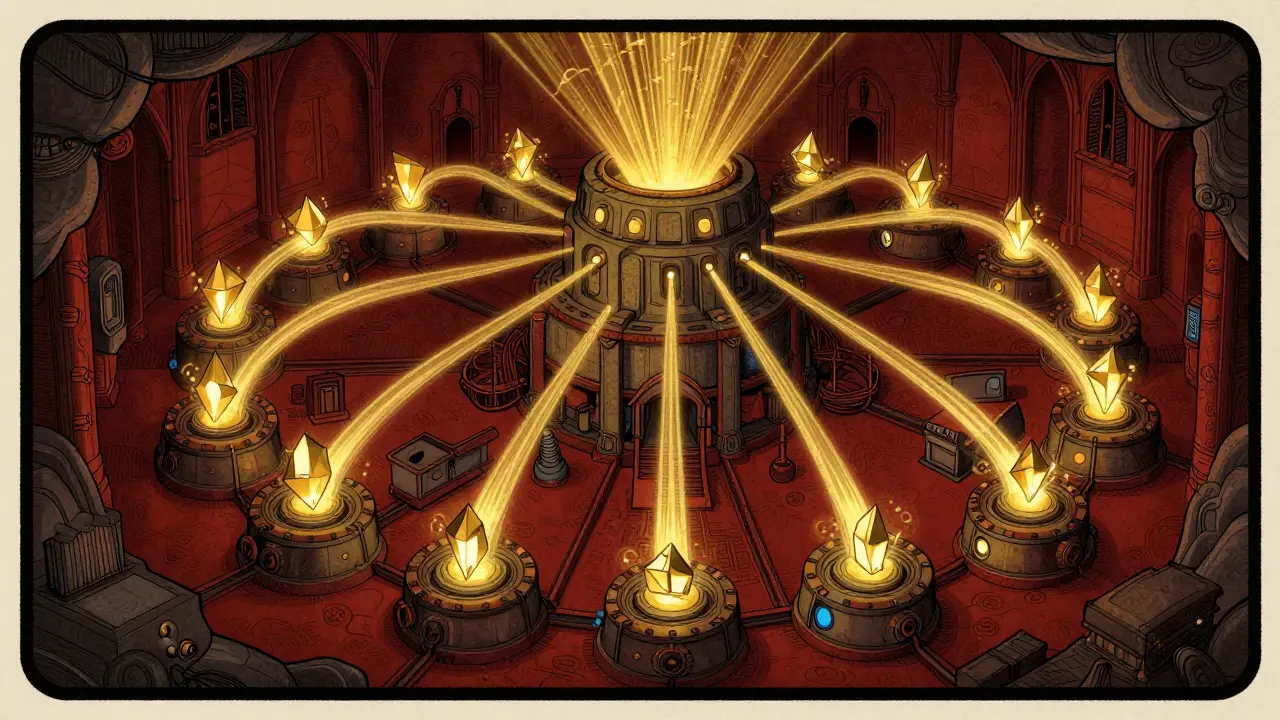
Sharding is a scaling technique where the entire database is split into shards so each node stores less and validates fewer transactions. Also known as Network Partitioning, it allows multiple transactions to happen in parallel. Imagine a supermarket checkout line. In a standard blockchain, you have one cashier serving everyone. In QuarkChain, you open ten separate lanes at once.
The system uses a unique two-layered design. The first layer contains multiple shards, which are essentially smaller blockchains running side-by-side. Each shard processes a subset of transactions independently. This means the network doesn't have to wait for one massive ledger to update before the next user can act. The second layer consists of the root chain. This part is responsible for confirming all blocks from the sharded chains without processing transactions itself.
This separation is crucial for security. While shards handle the speed work, the root chain acts as the judge ensuring no shard cheats. It validates the proofs sent up from the shards. Because these layers operate together, the network achieves a processing capacity exceeding 100,000 transactions per second (TPS). This throughput is designed to handle enterprise-grade applications where speed is non-negotiable.
Understanding Cross-Shard Transactions
Many sharding solutions only allow transactions to happen within the same shard. If you are on Shard A and want to send money to someone on Shard B, traditional systems get stuck. You cannot talk across lanes easily. QuarkChain distinguishes itself by enabling cross-shard transactions directly.
This feature allows the throughput to scale linearly as the number of shards increases. As more nodes join and more shards open up, the total capacity grows without breaking security. Developers building apps on this network don't need to worry about users being stuck in different "islands" of the network. The protocol handles the routing automatically. This flexibility supports complex DeFi applications where liquidity needs to move freely between different pools or contracts located on different shards.
The QKC Token Utility and Economics
QKC Token is the native utility token for the QuarkChain network, functioning as the unit of exchange between participants and required for paying transaction fees. Also known as QuarkChain Coin, it exists in both native form on the blockchain and as an ERC-20 token. Unlike some tokens that exist purely for speculation, QKC has built-in mechanics to maintain network stability. It serves as gas for transactions, similar to how ETH is used on Ethereum. Every time you deploy a smart contract or send funds, a small amount of QKC is consumed as a fee.
The token also plays a role in staking. Users who hold QKC in the network can lock their coins to help secure the blockchain. In return, they earn rewards based on network participation and duration held. This incentivizes people to keep their tokens in the ecosystem rather than selling them immediately on exchanges. During the initial phase, QKC was structured as an ERC-20 token on the Ethereum testnet, compatible with popular wallets like Trezor. Now, users can swap between the wrapped version and the native blockchain version seamlessly.
Performance Comparison with Competitors
If you look at raw numbers, the difference becomes obvious. Traditional networks often struggle under load. Here is a comparison of theoretical maximum throughput across major platforms:
| Coin | Avg TPS (Transactions Per Second) | Average Cost | Consensus Type |
|---|---|---|---|
| Bitcoin | 4-7 | High | Proof of Work |
| Ethereum | 15-45 | Moderate to High | Proof of Stake |
| QuarkChain | 100,000+ | Low | DPOS / PoW Hybrid |
While Ethereum has been upgrading with Layer 2 solutions, QuarkChain handles this volume at the base layer through sharding. However, higher speed comes with trade-offs. Security validation requires robust communication between shards. Some analysts note that while the theoretical limit is impressive, real-world conditions might yield lower performance due to coordination overhead. Still, benchmarks consistently show a massive advantage over single-chain designs.
Developer Experience and EVM Compatibility
One of the biggest barriers for new blockchains is developer adoption. If a network speaks a different programming language, developers have to rewrite everything from scratch. QuarkChain avoids this friction by being EVM-compatible. The Ethereum Virtual Machine (EVM) allows smart contracts written for Ethereum to run on QuarkChain with minimal changes.
This lowers the barrier for Ethereum developers to migrate applications. Teams don't need to learn entirely new coding frameworks. Case studies suggest developers transition from Ethereum to QuarkChain in approximately two to three weeks. They become proficient with specific implementations of cross-shard logic fairly quickly. The official documentation provides comprehensive technical specifications, assuming prior knowledge of blockchain basics. Tools like MetaMask can interact with the network once configured correctly, making wallet integration smoother for the average user.
Market Position and Real World Adoption
Tech specs are great, but adoption proves value. QuarkChain has established strategic partnerships to bridge the gap between theory and practice. Projects like TokenInsight use the chain for data analytics, ensuring transparency in market data. Industrial services companies such as Morpheus Labs utilize the infrastructure for heavy-duty IoT tracking.
Even gaming applications find a home here. PlayTable and other gaming protocols need high-speed micro-transactions to function properly. Standard payment delays ruin user experience in games. QuarkChain solves this latency issue. Despite having a smaller ecosystem compared to giants like Solana, the growth in sectors like high-frequency trading shows promising signs. Strategic alliances help build trust with enterprise clients who require reliability over hype.

Governance and Community Control
Decentralized networks rely on governance models to decide on upgrades. QuarkChain implements a decentralized governance model allowing token holders to vote on proposals and protocol changes. Participation rates averaging approximately 12.7% of circulating supply indicates active engagement, though it varies based on proposal importance. This ensures the community, not a central company, dictates the road ahead. Decisions might range from adjusting gas fees to modifying consensus parameters.
Dr. Qi Zhou, the founder with a Ph.D. in Electrical Engineering from Georgia Tech, initially guided the vision. His background at Google informs the focus on distributed systems. While the founder set the path, the network increasingly relies on the community votes to steer development directions. This balance helps avoid centralized points of failure in decision-making processes.
Risks and Challenges to Consider
No investment is without risk. Market sentiment on social media platforms shows moderate engagement. With around 45,000 followers on X (formerly Twitter) as of late 2023, the community is growing but smaller than major competitors. Price volatility has also been noted. One week in November 2023 saw a significant value fluctuation attributed to broader market conditions. Investors must remember that crypto assets remain highly speculative.
Technical challenges persist regarding security maintenance across numerous shards. Maintaining synchronization without vulnerabilities is mathematically complex. There is also the chicken-and-egg problem common to new platforms. Applications need users to grow, but users stay away until applications improve. This cycle slows initial growth compared to already saturated networks.
Setting Up Your First Wallet
If you plan to store QKC, you need the right tools. The network supports both web-based interfaces and software wallets. Setting up a dedicated QuarkChain wallet requires configuring the RPC endpoint correctly. Non-technical users sometimes find custom configurations tricky initially. Using hardware wallets like Trezor bridges the security gap effectively.
Ensure you verify the contract addresses before swapping. Because QKC exists as an ERC-20 token externally, always double-check you are interacting with the official bridge contract to prevent scams. Once transferred to the native chain, you gain access to faster speeds and staking features.
Is QuarkChain safe to invest in?
All cryptocurrency investments carry risk. QuarkChain uses advanced encryption and a multi-node architecture. However, price volatility is common in this sector. Always do your own research.
How does sharding help QuarkChain?
Sharding splits the workload across multiple sub-chains. This allows parallel processing, drastically increasing the number of transactions the network can handle per second.
Can I use my existing Ethereum wallet for QKC?
Yes, but QKC needs to be bridged. The external version is an ERC-20 token compatible with Ethereum wallets, while native QKC requires a dedicated QuarkChain client or wallet support.
Who founded QuarkChain?
The project was founded by Dr. Qi Zhou, a former Google engineer with a PhD in Electrical Engineering from Georgia Institute of Technology. He launched the project in 2017.
What is the maximum speed of QuarkChain?
Technical benchmarks indicate a processing capacity exceeding 100,000 transactions per second, significantly higher than most traditional blockchains.
Final Thoughts on Future Growth
The landscape of blockchain infrastructure is shifting rapidly. Platforms that can process payments instantly without losing security will likely capture the enterprise market. QuarkChain's approach tackles the scalability issue at the foundation level. Whether it surpasses competitors depends on developer retention and continued partnership expansion. Monitoring the roadmap reveals ongoing efforts to refine cross-shard efficiency. Keep an eye on the mainnet updates to gauge progress toward mainstream utility.
Raymond K
March 28, 2026 AT 17:18It reelly makes sense when yiu think bout teh bottleneck issue with current blockchains. I have always felt slow confirmation times kill the vibe for new adopters. Seeing a solution that actually tackles sharding at the base layer is super exciting for the future. The way they split the workload reminds me of how cloud servers handle traffic loads efficiently. Most projects promise scalability but never deliver without losing decentralization. This architecture seems to find a sweet spot that others missed completely.
Jamie Riddell
March 29, 2026 AT 15:04i agree with you raymond about the bottleneck point being the biggest hurdle for everyone we are trying to solve security while keeping speed up which is hard but looks promising here
Lisa Walton
March 30, 2026 AT 19:59Another whitepaper solution that will probably flop when real liquidity dries up.
Shubham Maurya
March 31, 2026 AT 14:14I dont think so 👀🤔 history shows scaling solutions always struggle eventually 🛑📉 but hey maybe this time it works 💸🚀 who knows man 😜👌
Michael Nadeau
April 1, 2026 AT 09:21Sharding fundamentally alters the trust assumptions we usually accept in distributed ledgers. When we consider the theoretical maximum throughput compared to the current standards the gap becomes undeniable for enterprise needs. Traditional chains prioritize security above all else often sacrificing any notion of practical utility for mass payments. QuarkChain attempts to balance these competing goals through architectural separation rather than layer two hacks. The root chain serves as a final arbiter ensuring that individual shards do not deviate from consensus rules. Miners on shards process transactions locally while the root validates proofs asynchronously. This division of labor allows linear scaling as more resources join the network ecosystem. Users benefit from lower fees because congestion is distributed across many independent processing lanes simultaneously. Developers gain flexibility by migrating existing smart contracts without rewriting complex logic entirely. Compatibility with the Ethereum Virtual Machine removes significant friction barriers for migration from established platforms. Security validation requires robust cross-shard communication protocols that prevent atomicity failures during transfers. While no system is perfect this approach mathematically addresses the trilemma better than single chain designs. Network stability depends on the incentive structures embedded within the staking mechanisms described earlier. Economic sustainability is maintained by burning gas fees to regulate token supply against inflationary pressures. Ultimately the success hinges on whether real applications deploy on top of this infrastructure soon enough.
Markus Church
April 3, 2026 AT 06:38The technical specifications regarding the root chain validation mechanism appear sound upon initial review. Maintaining synchronization across numerous shards presents a significant engineering challenge that requires rigorous testing before widespread deployment. Your analysis of the economic model provides valuable context for potential investors considering allocation strategies. The comparison with competitors highlights distinct advantages in transaction throughput metrics specifically.
Callis MacEwan
April 5, 2026 AT 02:55Looking at the TPS claims versus actual net latency reveals critical bottlenecks in cross-shard routing logic. We need to examine the DPOS/PoW hybrid consensus implementation details closer to verify security assertions made in the documentation. Sybil attack resistance on individual shards remains a concern despite the root chain oversight layer architecture proposed here.
Alex Kuzmenko
April 6, 2026 AT 10:53i thnik the sybil part is handled pretty well with the bonding mechanics described in section four of the paper. its nice they addressdd the coordination overhead stuff becuase thats where most shard chains fail badly. hopeing to see some live data sooen to test those theories though
Zackary Hogeboom
April 6, 2026 AT 10:55This could really change how we view DeFi infrastructure moving forward honestly. The EVM compatibility alone opens up so many doors for teams building on Ethereum currently. Imagine moving your dapp and instantly getting hundred thousand TPS support without changing code. That kind of upgrade path is rare in the industry right now and super attractive for devs. Community governance also feels more genuine here compared to centralised foundations elsewhere. Excited to see what apps launch next quarter using this backend technology stack.
Disha Patil
April 7, 2026 AT 05:14people are to excited for tech that isnt fully tested yet and it hurts when they lose money i wish they would wait until stable releases. why do everyone rush in to buy tokens before mainnet is even proven reliable for daily use cases. i feel worried about my friends investing too much capital here prematurely.
Tiffany Selchow
April 8, 2026 AT 21:57Only losers chase hype cycles like this while smart money sits on Bitcoin forever.
Katrina Tate
April 9, 2026 AT 08:25Predictable narrative shift every few months whenever a new scaling solution emerges to capture weak investor capital.
Chris R
April 9, 2026 AT 21:21We must remain focused on the long term value proposition of true decentralized infrastructure improvements. Progress takes patience and the team seems dedicated to solving real bottlenecks rather than marketing gimmicks. Many projects fail due to lack of developer tools but the EVM support here bridges that gap effectively. Supporting innovation in this sector benefits the entire digital economy eventually.
Raymond K
April 10, 2026 AT 09:44u are right chris sometimes it takes time to prove things work for real adoption. i beleive in the team vision and the tech fundamentals look solid enough for me to watch closely. hopefully more partners come onboard to show it scales under load without breaking.