
For years, launching a token in the United States felt like walking through a minefield blindfolded. One day you were building a community; the next, you were staring down a cease-and-desist letter from regulators who claimed your utility token was actually an unregistered security. But if you are reading this in May 2026, that era of ambiguity is largely behind us. The regulatory landscape has shifted dramatically over the last twelve months, moving from aggressive enforcement to structured clarity.
The core issue remains the same: does your digital asset qualify as a security? If it does, you must register it under federal laws designed to protect investors. If it doesn’t, you might fall under different rules entirely. This guide breaks down exactly what changed in 2025 and 2026, how to determine where your project fits, and what specific steps you need to take to stay compliant without stifling innovation.
Understanding the New Regulatory Framework
The foundation of U.S. crypto regulation still rests on two pillars: the Securities Act of 1933 and the Securities Exchange Act of 1934. These laws weren’t written for blockchain, but they apply whenever someone sells an "investment contract." That phrase comes from the Howey Test, a legal standard established in 1946. It asks four questions: Is there an investment of money? Is it in a common enterprise? Do profits come from the efforts of others? And is there an expectation of profit?
In the past, the U.S. Securities and Exchange Commission (SEC) used this test broadly, often labeling almost any new token as a security. However, starting in early 2025, the agency’s approach softened significantly. Under Acting Chairman Mark T. Uyeda and later Chair Atkins, the SEC formed a dedicated Crypto Task Force. Their goal wasn’t to shut down projects, but to create clear rules for those that *are* securities while letting others operate freely.
This shift means you no longer have to guess. The SEC now distinguishes between traditional equity or debt securities issued by companies working with crypto, and "subject crypto assets"-tokens offered as part of an investment contract. If your token falls into the latter category, registration is mandatory. If it functions purely as a commodity or utility, you may not need SEC registration at all.
Key Developments in 2025 and 2026
To understand your obligations today, you need to look at three major developments that reshaped the industry recently:
- The April 2025 Disclosure Guidance: On April 10, 2025, the SEC’s Division of Corporation Finance released definitive guidance. They stated clearly that disclosures in registration statements must protect investors and facilitate capital formation. Crucially, they emphasized that language should be plain and understandable, avoiding unnecessary technical jargon. This means your prospectus can’t hide behind complex blockchain terminology.
- The July 2025 ETF Guidelines: For those looking to list products on exchanges, the SEC published comprehensive guidance on Crypto Asset Exchange-Traded Products. This clarified requirements for risk factors, custody arrangements, and financial statements. It signaled that institutional adoption was welcome, provided the paperwork was clean.
- The September 2025 Joint Statement: Perhaps the biggest surprise was the cooperation between the SEC and the Commodity Futures Trading Commission (CFTC). In a rare show of unity, both agencies confirmed that registered exchanges can list spot crypto assets, including leveraged products, without violating federal law. This removed a massive barrier for trading platforms and gave issuers more confidence in secondary market liquidity.
These moves indicate a maturing market. Regulators are no longer trying to ban crypto; they are trying to fit it into existing frameworks. For you, this means compliance is more predictable, but also more rigorous. You can’t rely on loopholes anymore because the loopholes are being closed with clear definitions.
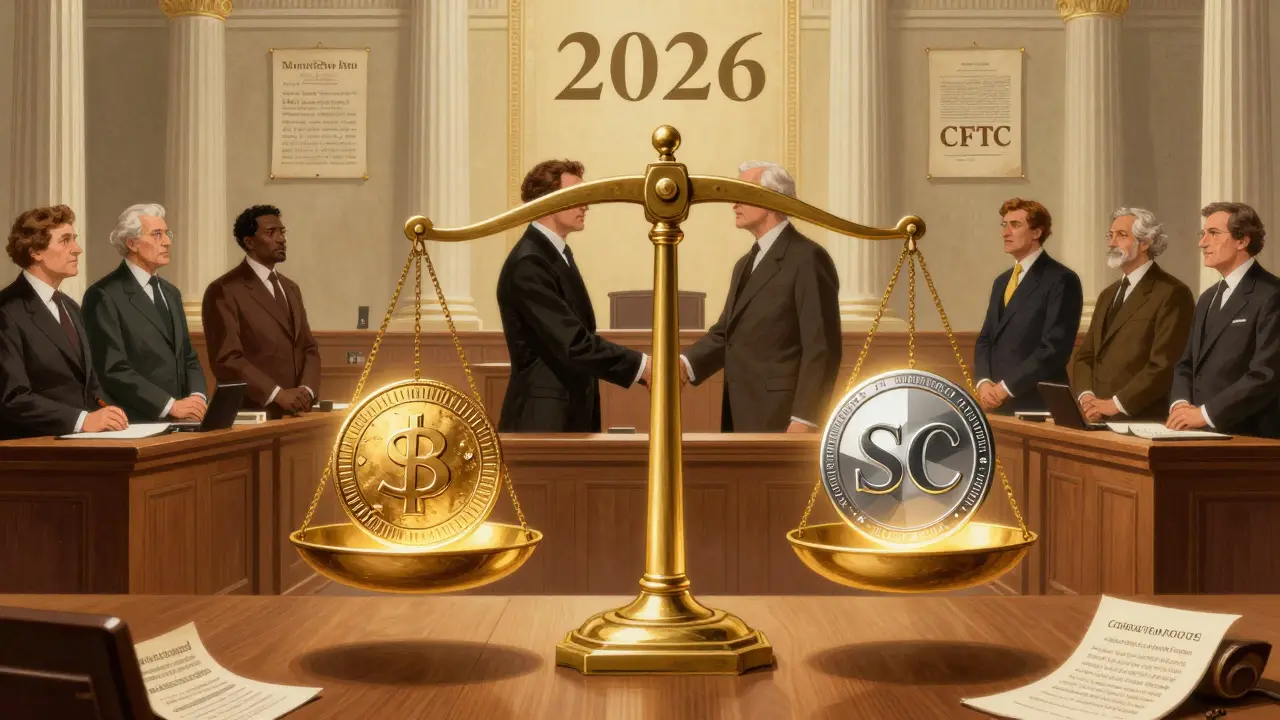
Determining if Your Token is a Security
Before you file a single form, you must answer one question: Is my token a security? The SEC’s recent stance suggests that most decentralized tokens, like Bitcoin, are not securities. Chair Atkins has explicitly stated that many crypto assets should not be governed by securities laws. Instead, they are commodities under CFTC jurisdiction.
However, if your token represents ownership in a company, promises fixed returns, or relies heavily on a central team’s development efforts to generate value, it likely triggers the Howey Test. Here is a practical checklist to help you decide:
- Centralization Level: Is the network fully decentralized? If a small group controls upgrades, treasury funds, or voting rights, the SEC will view it as a common enterprise reliant on their efforts.
- Profit Expectation: Are buyers primarily motivated by speculative gains rather than using the token for access to services? If yes, it leans toward a security.
- Marketing Language: Did you use words like "investment," "returns," or "passive income" in your whitepaper? This creates a paper trail that supports a security classification.
- Utility Function: Does the token have immediate, real-world utility? Can users spend it right now? Pure utility reduces the likelihood of being classified as a security.
If you find yourself answering "yes" to the first three points, you are likely dealing with a security. Don’t panic-this just means you follow a specific path. If you answer "no," you might fall under CFTC oversight instead, which has its own set of rules but generally less stringent disclosure requirements for initial offerings.
Registration Process and Disclosure Requirements
If your token is a security, you must register it. The process involves filing a registration statement with the SEC, typically using Form S-1 for public offerings or Form D for private exemptions. The content of these filings is critical. Based on the 2025 guidance, here is what you must include:
| Section | Required Content | Why It Matters |
|---|---|---|
| Prospectus Summary | A high-level overview of the project, token economics, and use of funds. | Investors need to grasp the basics without reading hundreds of pages. |
| Risk Factors | Specific risks related to blockchain technology, smart contract vulnerabilities, and regulatory changes. | Protects the issuer from liability by ensuring informed consent. |
| Business Description | Details on the team, technology stack, and competitive advantage. | Proves the viability of the underlying enterprise. |
| Custody and Security | How tokens are stored, who holds the keys, and insurance coverage. | Addresses the unique security risks of digital assets. |
| Financial Statements | Audited financials if applicable, or detailed projections for early-stage projects. | Ensures transparency regarding fund usage. |
Note that the SEC rejected overly technical explanations in 2025. If you describe your consensus mechanism, do it in plain English. Imagine explaining it to a grandmother who knows nothing about code. If she understands how her money is protected, your disclosure is good enough. If she’s confused, rewrite it.

Navigating the CLARITY Act and Jurisdictional Split
A significant development affecting registration is the proposed CLARITY Act. While still pending legislative action as of mid-2026, its principles have already influenced regulatory behavior. The Act aims to statutorily classify decentralized tokens like Bitcoin and Ethereum as commodities. This removes them from SEC Rule 204A-1 reporting requirements, which previously forced Registered Investment Advisers (RIAs) to report every digital asset holding as a potential security.
This creates a bifurcated system:
- Security Tokens: Remain under SEC jurisdiction. Issuers must register, disclose, and comply with ongoing reporting. Investors get strong protections, but issuers face higher costs.
- Commodity Tokens: Fall under CFTC oversight. Less prescriptive disclosure for initial sales, but stricter rules for trading venues and derivatives. RIAs managing these assets may need to register as Commodity Trading Advisors instead.
For startups, this distinction is vital. If you want to avoid SEC registration, you must design your token to function as a commodity or utility from day one. Decentralize governance early. Ensure the network operates independently of your team. If you retain control, the SEC will argue that investors are relying on your efforts, keeping you in the security bucket.
Practical Steps for Compliance
So, what should you do right now? First, conduct a thorough internal audit of your tokenomics and marketing materials. Remove any language promising returns. Second, engage legal counsel specializing in digital assets. General corporate lawyers often miss the nuances of the Howey Test in a blockchain context.
If you proceed with registration, prepare for a lengthy review process. The SEC’s Crypto Task Force is reviewing applications, but they are meticulous. Expect comments asking for clearer risk disclosures or better explanations of custody solutions. Respond promptly and thoroughly. Delays are common, but they are part of the price of legitimacy.
Finally, consider your custody strategy. The SEC acknowledges self-custody rights but demands robust oversight. If you offer custodial services, you must demonstrate institutional-grade security. If you encourage self-custody, you must educate users on the risks of losing private keys. Either way, document everything.
Do I need to register my ICO if it’s private?
Not necessarily. Private offerings can use exemptions like Regulation D (Rule 506(b) or 506(c)). However, you must still ensure that your token qualifies for the exemption and that you only sell to accredited investors or satisfy other specific conditions. Even with an exemption, you must file a Form D with the SEC within 15 days of the first sale.
What is the difference between a security token and a utility token?
A security token represents an investment contract where buyers expect profits from the efforts of others. A utility token provides access to a product or service and derives value from its usage. The line can be blurry, so the structure of your network and marketing claims determine the classification.
How does the CLARITY Act affect my business?
If passed, the CLARITY Act would classify many decentralized tokens as commodities, removing them from SEC registration requirements. This would lower compliance costs for projects that are truly decentralized. Until then, regulators are applying its spirit informally, favoring decentralization.
Can I trade my unregistered tokens on an exchange?
Generally, no. Exchanges listed on national securities exchanges must comply with SEC rules. Listing unregistered securities can lead to severe penalties for both the issuer and the exchange. The September 2025 Joint Statement allows spot trading of certain crypto assets, but they must still meet legal definitions of non-securities or be properly registered.
What happens if I fail to register when required?
The SEC can seek injunctions, fines, and disgorgement of profits. Investors may also sue for rescission, demanding their money back. In extreme cases, criminal charges could be brought against executives. Compliance is not optional if your token meets the definition of a security.