Crypto Risk Calculator: Egypt's Law 194 Impact
Your Crypto Exposure Assessment
Based on Egypt's Law 194 (2020) ban and reported cases from CBE enforcement
Risk Assessment Summary
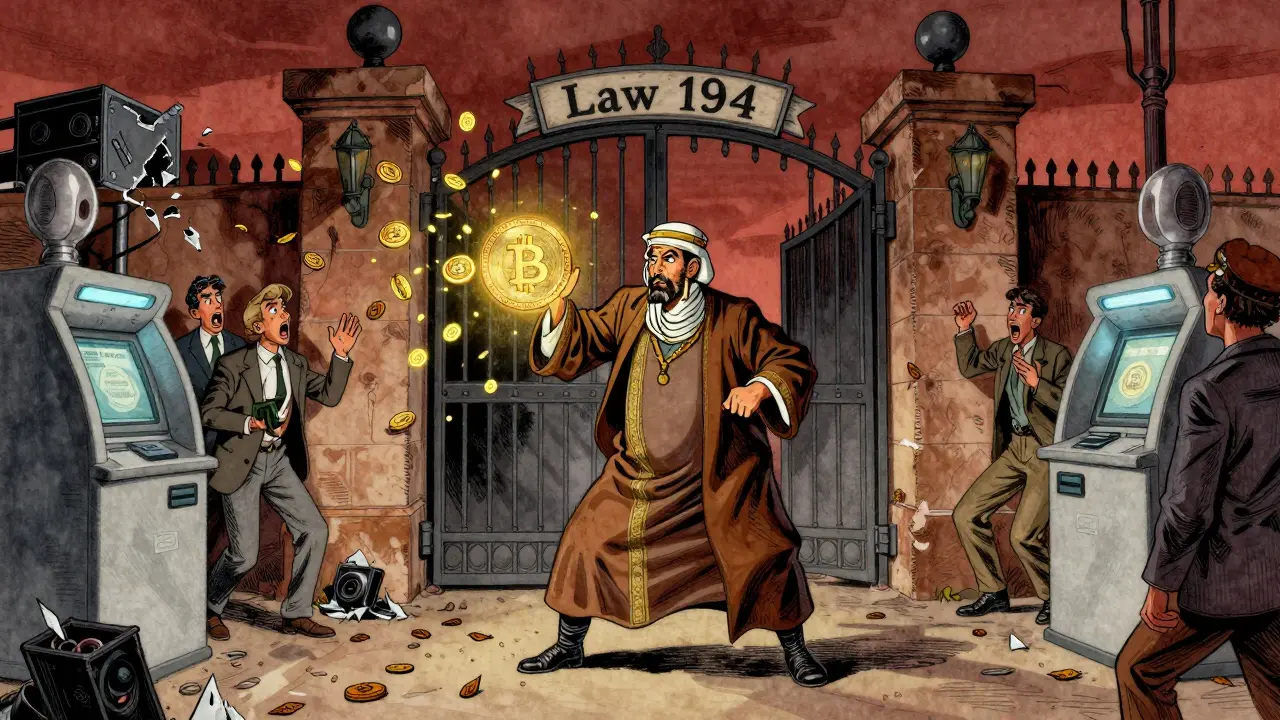
On September 16, 2020, Egypt didn’t just update its banking laws-it shut the door on cryptocurrency for millions of its citizens. Law No. 194 of 2020, officially called the Central Bank and Banking Sector Law, didn’t just regulate digital assets. It banned them. Completely. And that ban still stands today, with no signs of changing anytime soon.
What Law 194 of 2020 Actually Says
At first glance, Law 194 looks like a routine banking reform. It’s 241 articles long, replacing an older law from 2003. But hidden in Article 204 is the real punch: no one in Egypt can issue, trade, or promote cryptocurrencies without prior approval from the Central Bank of Egypt (CBE). And here’s the catch-no one has ever received that approval.
This isn’t a gray area. It’s a total ban. That means exchanges like Binance and Coinbase can’t operate legally. Mining rigs? Illegal. ICOs? Banned. Even running a YouTube channel explaining Bitcoin? Technically, that’s promotion-and it’s prohibited unless the CBE says otherwise. And they haven’t.
The law doesn’t just target big players. It hits everyday users too. If you bought Ethereum in 2019 and still hold it, you can’t sell it legally in Egypt. You can’t convert it to Egyptian pounds through a bank. You can’t even use it to pay for services from local businesses without risking legal trouble.
Why Did Egypt Do This?
The CBE says it’s about protecting people. Their official warnings claim cryptocurrencies are too volatile, lack legal protection, and could cause financial chaos. They point to price swings, scams, and money laundering risks. But the real reasons run deeper.
Egypt’s economy has been under pressure. The Egyptian pound lost nearly half its value between 2016 and 2023. Capital flight-people moving money out of the country-was a major concern. Cryptocurrencies made it easier for people to bypass strict currency controls. Estimates from CBE internal reports suggest Egyptians were moving around $200 million a year into crypto before the ban. That’s money the government couldn’t track, control, or tax.
There’s also the issue of sovereignty. Egypt’s central bank doesn’t want a digital currency-any digital currency-to compete with the Egyptian pound. If people start using Bitcoin or USDT as their real money, the CBE loses control over interest rates, inflation, and monetary policy. That’s not just an economic problem-it’s a political one.
Who Got Hurt?
The ban didn’t just stop trading. It froze lives.
Thousands of Egyptians who bought crypto before 2020 suddenly found their accounts locked. Binance and Coinbase blocked Egyptian users. Bank accounts linked to crypto wallets were frozen. Some people lost access to hundreds of thousands of dollars in assets. The Facebook group ‘Egypt Crypto Victims’ documented over 427 cases involving $8.7 million in trapped funds.
Startups didn’t survive. A 2022 survey found 78% of Egypt’s blockchain entrepreneurs packed up and moved to Dubai or Singapore. That’s $150 million in lost investment, talent, and innovation gone overnight. Egypt had one of the fastest-growing fintech scenes in Africa. By 2022, fintech investment had dropped 63%-from $485 million to just $178 million.
Even regular users suffered. A YouGov poll in February 2023 showed 68% of Egyptians supported the ban-but only 22% could explain what Law 194 actually said. Most people weren’t voting for policy. They were scared of scams. And the government used that fear to justify a sweeping crackdown.

The Enforcement Machine
The ban isn’t just on paper. It’s enforced.
Starting in 2020, the CBE issued four official warnings, each one tightening the screws. Circular 4/2022 told banks to block all transactions to known crypto platforms. Banks complied. Peer-to-peer trading volume dropped 92% by the end of 2022.
Financial institutions now have to use monitoring systems to detect crypto activity. Small banks had 18 months to comply. Big banks had six. The CBE spent EGP 120 million ($3.8 million) in 2022 on blockchain analysis tools-but admitted in their annual report that they still struggle to track decentralized finance apps.
And then there’s the legal risk. Article 205 lets the CBE refer violations to prosecutors. No one knows the exact penalties-no fines are published. But people have been prosecuted under both Law 194 and Egypt’s 2018 Anti-Money Laundering Law. There are 47 known cases of dual charges, meaning someone could face jail time for simply sending Bitcoin to a friend.
The Contradiction
Here’s the strangest part: while Egypt bans crypto, it’s building blockchain.
In November 2022, the Ministry of Communications launched a national blockchain strategy. They’re testing blockchain for land registry, supply chains, and government records. The goal? Transparency, efficiency, and digital transformation.
But you can’t use blockchain without crypto. At least not in the way most developers understand it. Blockchain and cryptocurrency are separate technologies-but they’re deeply linked. Egypt wants the tech without the currency. It’s like wanting a car engine but banning gasoline.
Dr. Hanaa El Shenawy called it “Egypt’s Digital Policy Schizophrenia.” And she’s right. The government wants to be a tech leader-but only if it controls every byte.

What’s Happening Now?
As of 2025, the ban is still absolute. But cracks are forming.
Chainalysis estimates that 3.2 million Egyptians-about 3.2% of the population-are still using crypto. They’re using VPNs, peer-to-peer apps, and cash trades to bypass the ban. Annual transaction volume? Around $1.1 billion.
Parliamentary committees have quietly started reviewing possible changes. There’s talk of allowing institutional trading-banks or big investors buying crypto under strict rules. But no formal proposal has been introduced.
And then there’s the IMF. Egypt is negotiating an $8 billion bailout. The IMF’s July 2023 report explicitly called out Egypt’s “regulatory barriers to fintech innovation” as a problem. They want modernization. Crypto bans don’t fit that picture.
Fitch Ratings predicts Egypt will move toward a “controlled sandbox” by 2026-where crypto is allowed under tight supervision. The World Bank, meanwhile, says the ban will stay because “monetary sovereignty concerns” are too high, especially with the pound still weak.
What This Means for You
If you’re in Egypt: don’t assume you’re safe just because you’re not trading openly. Your bank might still flag your account. Your phone might get blocked. Your assets could vanish without warning.
If you’re outside Egypt: don’t assume Egypt’s ban is like China’s. China banned crypto trading but kept mining. Egypt banned everything-including mining, promotion, and even educational content. It’s one of the strictest bans in the world, alongside Algeria and Iraq.
If you’re an investor or developer: Egypt’s market is frozen. The talent is gone. The startups have moved. The government’s message is clear: no innovation without permission. And permission isn’t coming anytime soon.
The real question isn’t whether crypto will return to Egypt. It’s whether Egypt will change before it’s left behind.
How People Are Still Using Crypto
Despite the ban, crypto hasn’t disappeared. It’s gone underground.
People use P2P platforms like Paxful and LocalBitcoins, trading cash for Bitcoin in person or through mobile money. Others use Telegram bots to swap stablecoins like USDT. Some buy crypto on foreign exchanges and withdraw to wallets, then use those wallets to pay for services from freelancers abroad.
But it’s risky. One user on Reddit described how his account was frozen after he sent $500 to a friend who used it to pay for web hosting. The bank flagged it as “unauthorized foreign transaction.” He lost access to his entire savings.
VPN use has spiked. Internet providers report a 300% increase in traffic to crypto-related sites since 2021. But the government is cracking down on those too. In 2023, several popular VPN services were blocked by court order.
There’s no legal way out. Only ways to hide.
Ian Norton
December 15, 2025 AT 08:49Let’s be real-this isn’t about financial stability. It’s about control. Egypt’s regime fears losing grip on capital flows, plain and simple. They’d rather keep millions trapped in a failing currency than risk losing their monopoly. The fact they’re building blockchain for government records while banning crypto? That’s not hypocrisy-it’s authoritarianism with a tech veneer.
Rakesh Bhamu
December 15, 2025 AT 08:52Interesting read. I’ve seen similar patterns in India-when the government gets scared of decentralized tech, they ban instead of regulate. But here’s the thing: banning crypto doesn’t stop people from using it. It just pushes it underground. The real solution is education and smart regulation-not censorship. Egypt’s losing talent and innovation because of fear, not foresight.
Hari Sarasan
December 16, 2025 AT 10:43One must acknowledge the systemic peril inherent in the proliferation of unregulated digital asset ecosystems. The Central Bank of Egypt, in its prudent stewardship of national monetary sovereignty, has enacted a prophylactic measure of unparalleled necessity. To permit crypto is to invite macroeconomic destabilization, capital hemorrhage, and the erosion of fiduciary integrity. The $200M annual outflow? A hemorrhage. The 78% exodus of fintech entrepreneurs? A brain drain precipitated by regulatory negligence elsewhere. This is not repression-it is statecraft.
Lynne Kuper
December 17, 2025 AT 17:01So let me get this straight-you ban Bitcoin but you’re okay with blockchain for land registries? That’s like banning gasoline but letting people keep their engines. 😏
Also, 68% of Egyptians support the ban… but only 22% know what it says? Classic. Fear + ignorance = policy. Bravo, Egypt. You’ve turned financial regulation into a sitcom.
Madison Surface
December 17, 2025 AT 19:44I just want to say how heartbreaking this is. Imagine being someone who saved up for years to buy ETH or BTC, then one day your bank freezes everything and you can’t even talk about it without risking jail. These aren’t criminals-they’re people trying to build wealth in a broken system. And now they’re punished for outsmarting a failing economy. The government’s solution? More control. Not more opportunity. It’s so sad.
Tiffany M
December 19, 2025 AT 08:48OMG I can’t believe this is real?! Like, they banned crypto but they’re using blockchain?? That’s like banning water but letting people use hoses. I mean, come on!! Who wrote this law?? A 1980s bureaucrat with a fax machine?? And the fact that people are still using it via Telegram and cash trades?? That’s the most American thing ever-people just find a way. The government is fighting the future and losing. Hard.
Eunice Chook
December 19, 2025 AT 21:38Control is the only truth. Currency is power. Power is centralized. Decentralization is chaos. You can’t have both. Egypt chose order. The rest of the world will follow. Or collapse.
Lois Glavin
December 20, 2025 AT 01:19I feel bad for the people stuck with their crypto. I get why the government’s scared-money’s a mess over there. But banning it just makes life harder for regular folks. Maybe they should’ve let people use it safely instead of making it a crime. Just saying.
Abhishek Bansal
December 20, 2025 AT 17:56Wait, so Egypt bans crypto but lets people use VPNs? Then they block VPNs? Then people use Tor? Then they block Tor? Then they ban Tor? When do they just give up and say ‘fine, use crypto’? This is like a toddler throwing a tantrum because someone ate the last cookie. Also, I’ve seen more innovation in a Reddit thread than in Egypt’s entire fintech sector since 2020. Just saying.
Bridget Suhr
December 21, 2025 AT 07:50ok so i just read this whole thing and i’m shook. like, imagine having your life savings locked up because the bank says so? and they’re building blockchain but not letting you use crypto? that’s like having a car with no gas. also i think the imf is right-this is holding egypt back. but also… i’m not even sure what i’m saying anymore. lol