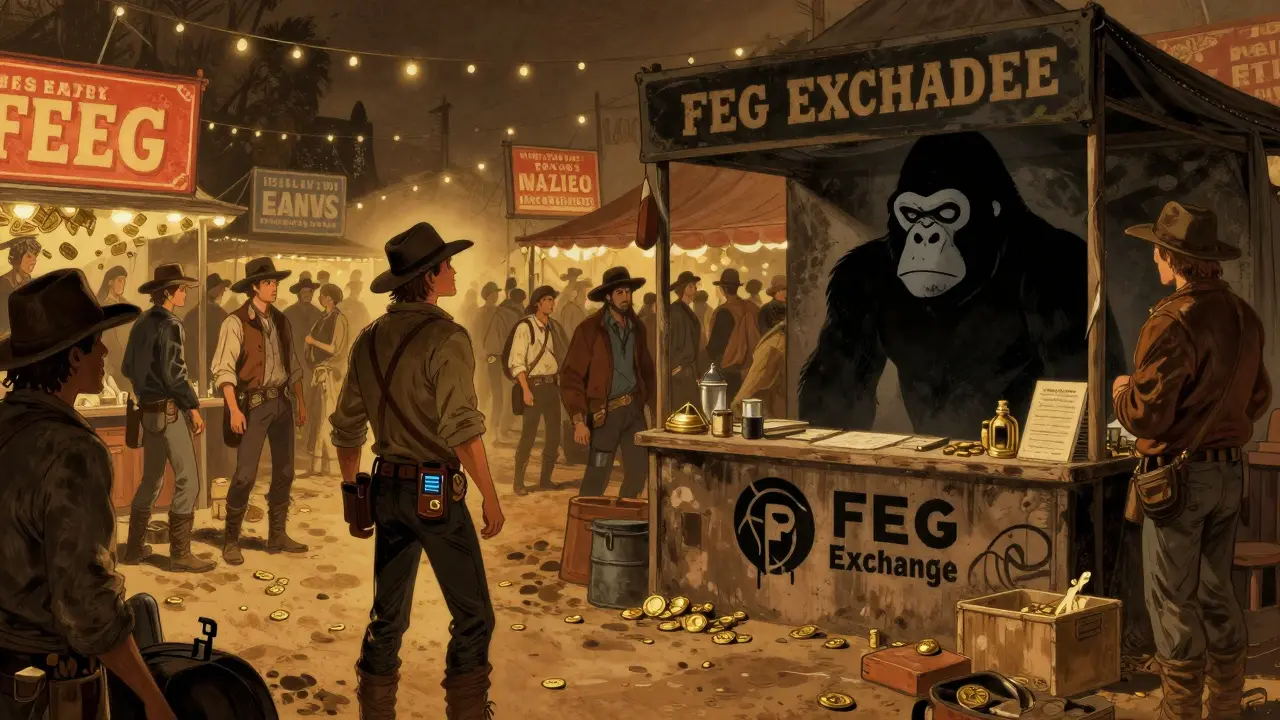
Remember when crypto felt like a gold rush? You just needed a wallet and a dream. Today, the landscape is cluttered with thousands of platforms promising easy profits, unique ecosystems, and 'revolutionary' tech. One name that pops up in niche communities is FEG Exchange, a decentralized platform tied to the controversial FEG Token. But here is the hard truth: while big names like Uniswap or Coinbase dominate the headlines, smaller exchanges like FEG operate in the shadows, often lacking transparency. Before you connect your wallet, you need to know if this platform is a hidden gem or a risky trap.
This review cuts through the marketing hype. We will look at how FEG Exchange actually works, whether its security claims hold water, and if it makes sense to trade here in 2026. I have dug into the code audits, user complaints, and tokenomics so you don't have to risk your savings on guesswork.
What Exactly Is FEG Exchange?
FEG Exchange is a non-custodial decentralized exchange (DEX) built primarily on the Ethereum and Binance Smart Chain networks. Launched in January 2021, it started as part of a meme-token ecosystem centered around the 'Feed Every Gorilla' philosophy-a quirky branding strategy aimed at funding primate conservation efforts. While the charity angle sounds noble, the business model is purely financial.
Unlike centralized exchanges where a company holds your funds, FEG Exchange is non-custodial. This means you never send your coins to them. Instead, you interact directly with smart contracts. If those contracts are buggy or malicious, there is no customer support line to call. Your money is gone.
The platform serves three main functions:
- Token Swapping: Trading FEG tokens against other assets like USDT or BTC.
- Liquidity Provision: Adding funds to pools to earn fees (though this is limited).
- Staking: Locking up tokens to earn rewards from transaction taxes.
It operates on two chains: Ethereum (ERC-20) and Binance Smart Chain (BEP-20). They claim to have a bridge between these two, which is useful if you want to move assets without using third-party bridges. However, most activity happens on BSC because Ethereum gas fees can eat up small trades entirely.
How Does It Work? The Mechanics of Trading
Using FEG Exchange requires a Web3 wallet like MetaMask or Trust Wallet. Once connected, the interface looks similar to any other DEX. You select a token pair, enter an amount, and swap. Simple enough, right? Not quite. The devil is in the details.
The core mechanic driving FEG Exchange is its transaction tax. Here is how it breaks down:
- Standard Tax: Most transactions incur a 2% tax. Half goes to liquidity, half to marketing or development. This reduces your immediate profit.
- SmartSwap Contracts: The platform claims internal swaps via their 'SmartSwap' system bypass this 2% tax. This is a major selling point, but documentation on exactly how this works is scarce.
- Gas Fees: On top of the tax, you pay network gas fees. On Ethereum, this can be $5-$50 per trade depending on congestion. On BSC, it’s usually under $0.50.
There is also a feature called fWraps, which allows users to wrap other cryptocurrencies to receive compensation. In theory, this adds utility. In practice, wrapping introduces extra steps and potential points of failure. If the wrapping contract fails, unwrapping your assets can become a nightmare.
For beginners, the learning curve is moderate. If you have used PancakeSwap before, FEG will feel familiar. If you are new to DeFi, expect to spend a few hours reading tutorials just to understand why your first transaction might fail due to 'slippage tolerance' errors.
Security Audit: Who Checked the Code?
In crypto, trust is earned through verification. For a platform handling real money, security audits are non-negotiable. FEG Exchange claims to have been audited by Solidity Finance, a known auditing firm. That sounds reassuring. But here is the catch: as of mid-2024, the full audit report was not easily accessible on their main website or GitHub repository.
I spent time searching through their Discord and Telegram channels. The developers hinted that the audit passed, but they never published the detailed PDF that shows what vulnerabilities were found and fixed. Without that document, we are flying blind. Did they find critical bugs? Were they patched? We simply do not know.
Compare this to industry leaders. Uniswap publishes every audit, every bug bounty, and every incident response. FEG Exchange operates with much less transparency. This lack of open data is a red flag for anyone serious about capital preservation.
User Experience and Community Feedback
Let's talk about what actual users say. I scoured Reddit threads, Trustpilot reviews, and CryptoSlate forums to get a realistic picture.
| Aspect | User Feedback | Rating (Out of 5) |
|---|---|---|
| Interface Design | Clean and intuitive for basic swaps | 4.0 |
| Customer Support | Slow responses; average wait time 72 hours | 1.5 |
| Liquidity Depth | Poor for large trades; high slippage | 2.0 |
| Educational Resources | Limited guides for new DeFi users | 2.5 |
The overall sentiment is mixed. Users appreciate that the UI is not overly complicated. However, the biggest complaint is liquidity. When you try to sell a larger amount of FEG tokens, the price drops significantly because there aren't enough buyers in the pool. This is known as slippage. On major exchanges, slippage is minimal. On FEG, it can cost you 5% or more on a single trade.
Support is another weak point. Since it is a decentralized project, there is no official support team. You rely on community moderators in Telegram. If you lose funds due to a mistake, good luck getting help. One user reported waiting three days for a reply regarding a stuck transaction, only to be told to check the blockchain explorer themselves.
FEG Tokenomics: The Hyper-Deflationary Model
To understand the exchange, you must understand the token. FEG Token uses a hyper-deflationary economic model. This means the total supply decreases over time. How? Through that 2% tax we mentioned earlier. A portion of every transaction is burned (destroyed forever).
Proponents argue this creates scarcity, which should drive the price up. Critics argue it discourages trading. Why would you buy and sell frequently if you lose 2% every time? It turns the exchange into a holding ground rather than a trading venue.
There is also a staking mechanism called FEGstake, which distributes 0.12% of all sell transaction value to stakers. This sounds like passive income. But consider the math. If trading volume is low, the rewards are negligible. Recent data suggests daily volume on FEG Exchange is a fraction of what it was in 2021. Low volume means low rewards for stakers.

Comparison: FEG vs. Established DEXs
Is FEG Exchange better than the alternatives? Let's compare it to the giants.
| Feature | FEG Exchange | Uniswap | PancakeSwap |
|---|---|---|---|
| Networks | Ethereum, BSC | Ethereum, Polygon, Arbitrum, etc. | BSC, Ethereum, Arbitrum |
| Trading Fee/Tax | 2% (unless SmartSwap) | 0.3% | 0.25% |
| Liquidity Depth | Low | Very High | High |
| Transparency | Low (Limited Audit Info) | High (Open Source) | High (Open Source) |
| Best For | FEG Speculators | Professional Traders | DeFi Enthusiasts |
The gap is clear. Uniswap and PancakeSwap offer deeper liquidity, lower fees, and proven security records. FEG Exchange only wins if you specifically want to trade FEG tokens and believe in the long-term potential of the ecosystem. For general crypto trading, it falls short.
Risks You Must Consider
Before you deposit even one dollar, weigh these risks:
- Smart Contract Risk: Without public audit reports, you cannot verify if the code is safe. Hacks happen constantly in DeFi.
- Liquidity Risk: If panic sets in, you may not be able to sell your tokens at a fair price. The lack of deep pools means your exit strategy could fail.
- Regulatory Uncertainty: As governments crack down on anonymous DeFi platforms, exchanges like FEG could face restrictions or delistings from bridges.
- Team Anonymity: The developers remain anonymous. If they decide to abandon the project, there is no accountability. This is common in meme-tokens but dangerous for investors.
Verdict: Should You Use FEG Exchange?
If you are looking for a reliable place to trade Bitcoin, Ethereum, or stablecoins, skip FEG Exchange. Go with Uniswap, PancakeSwap, or a regulated centralized exchange like Coinbase or Kraken. You will save money on fees and sleep better at night knowing your assets are secure.
However, if you are already invested in the FEG ecosystem and believe in the 'Feed Every Gorilla' mission, then FEG Exchange is your primary tool. Just keep your expectations realistic. Treat any money put into FEG as high-risk speculation. Never invest more than you can afford to lose completely.
The platform has improved its UI and added cross-chain bridges, which is progress. But until they publish transparent audit results and build significant liquidity, it remains a niche player with substantial risks.
Is FEG Exchange safe to use in 2026?
Safety is relative. While it is non-custodial (you control your keys), the lack of publicly available smart contract audit reports raises concerns. Always start with small amounts to test the waters. It is safer than un-audited memecoins but riskier than established DEXs like Uniswap.
What are the fees on FEG Exchange?
Most transactions incur a 2% tax, split between liquidity and marketing. However, internal 'SmartSwap' contracts allegedly waive this fee. Additionally, you must pay standard network gas fees, which vary based on Ethereum or BSC congestion.
Can I withdraw my funds anytime?
Yes, because it is a decentralized exchange, you always have access to your wallet. However, if liquidity is low, selling large amounts may result in significant price slippage, meaning you get less value than expected.
Does FEG Exchange require KYC?
No. Like most decentralized exchanges, FEG does not require Know Your Customer (KYC) verification. You only need a compatible Web3 wallet like MetaMask or Trust Wallet to connect and trade.
How does FEGstake work?
FEGstake allows users to lock their FEG tokens. In return, they receive a share of the transaction taxes generated on the exchange. Currently, 0.12% of the dollar value of all sell transactions is distributed to stakers. Returns depend heavily on trading volume.
Brad Semp
July 10, 2026 AT 00:28It is frankly astonishing that anyone in 2026 would consider interacting with a platform that lacks transparent, publicly verifiable smart contract audits. The notion that one might trust an anonymous development team with their capital, particularly when the audit reports are conveniently absent from any public repository, borders on financial illiteracy. One must possess a certain level of sophistication to understand that 'non-custodial' does not equate to 'secure' if the underlying code has not been subjected to rigorous, open-source scrutiny by reputable firms. The comparison to Uniswap or PancakeSwap is not merely favorable for those platforms; it is essential for any rational actor who wishes to preserve their wealth rather than gamble it away on speculative meme-ecosystems.
Melissa Beckwith
July 11, 2026 AT 19:08I have spent considerable time analyzing the tokenomics of various decentralized exchanges, and while I appreciate the thoroughness of this review, I feel compelled to elaborate on the nuances of the hyper-deflationary model employed by FEG Token, which is often misunderstood by the casual observer. The mechanism by which a portion of every transaction is burned is theoretically sound in creating scarcity, yet in practice, it creates a significant barrier to liquidity because traders are disincentivized from executing frequent swaps due to the cumulative impact of the 2% tax. Furthermore, the reliance on community moderators for support, rather than a dedicated customer service infrastructure, introduces a layer of unpredictability that is entirely unacceptable for institutional-grade trading, even if we are discussing retail investors. It is crucial to recognize that the 'Feed Every Gorilla' narrative, while charming, serves primarily as a marketing veneer for what is essentially a high-risk, low-liquidity environment where slippage can erode profits more rapidly than market movements can generate them. One must also consider the opportunity cost of capital tied up in such an ecosystem, especially when compared to the robust, multi-chain infrastructure provided by established players like Uniswap, which offer deeper liquidity pools and significantly lower fees without the baggage of anonymous governance structures.
Steven Briggs
July 12, 2026 AT 00:41i get why people try it but its scary man
no audit report means you dont know whats happening under the hood
just stick to pancake
Hamza k
July 13, 2026 AT 07:35Oh, the sheer audacity of calling this a 'review' when it barely scratches the surface of the existential dread that accompanies investing in anonymous DeFi projects! It’s like walking into a casino where the house doesn’t just load the dice, they also refuse to show you the blueprint of the building! The lack of transparency isn’t just a red flag; it’s a flashing neon sign screaming 'RUN!' in bold, capital letters. How many times do we need to see our friends lose their shirts to learn that 'meme' ecosystems are not investments, they are lotteries with terrible odds and no prize money?
Kim Kay
July 15, 2026 AT 00:02hey everyone just wanted to say i think the ui is actually pretty nice for beginners
but yeah the support thing is realy bad i waited days for a reply
so be carful out there folks
Korn Arrieta
July 16, 2026 AT 23:54The analysis presented here is fundamentally flawed because it fails to address the core issue: the complete absence of accountability. When a platform operates without public audits, it is not merely 'risky'; it is a predatory structure designed to exploit the ignorance of retail users. The claim that SmartSwap bypasses taxes is a classic obfuscation tactic used to mask the true cost of trading, which is further exacerbated by the notorious slippage issues inherent in shallow liquidity pools. Do not be fooled by the charitable branding; it is a psychological manipulation technique known as 'ethical washing,' intended to lower your guard while they siphon value through hidden fees and poor execution. If you cannot verify the code, you are not investing; you are donating to anonymous developers who have zero incentive to protect your capital.
Jackie D
July 18, 2026 AT 22:41wow this is kinda wild how they hide the audit stuff
like why would you do that unless you got something to hide??
i mean the gorilla thing is cute but my wallet feels cold just reading this
definitely sticking to uniswap for now cause i value my sanity
Ruth Williams
July 19, 2026 AT 00:43It is imperative that individuals exercise extreme caution when engaging with platforms that prioritize anonymity over transparency. The fact that FEG Exchange does not publish its security audit reports is not a minor oversight; it is a critical failure of corporate responsibility that renders the platform unsuitable for any serious financial activity. Those who choose to ignore these glaring deficiencies do so at their own peril, and should not expect sympathy when their assets are compromised by the inevitable exploits that plague unverified smart contracts. The market rewards diligence and punishes negligence, and participating in such opaque ecosystems is the epitome of negligent behavior.
Sophie Nakasako
July 19, 2026 AT 21:21This is such an important discussion because it highlights the evolving landscape of trust in decentralized finance. We often talk about 'trustless' systems, but truly, we are just shifting the burden of verification onto the user, which can be overwhelming for newcomers. I wonder if there is a middle ground where communities can pressure these smaller projects to adopt more open standards without stifling innovation? It seems like the current binary choice between 'highly regulated CEXs' and 'wild west DEXs' leaves a gap for mid-tier platforms that could offer better transparency without sacrificing decentralization. What do you all think about the role of community-led audits in filling this void?
Kristy Morrow
July 21, 2026 AT 16:45you guys are missing the point entirely
the whole idea of crypto is freedom from rules
if you want safety go to a bank
this is about taking risks for rewards
stop being so scared of losing money
John Harman
July 22, 2026 AT 17:28Look, I’ve been in this game since the early days, and let me tell you, FEG is a trap for newbies. The 2% tax eats you alive if you’re trying to trade actively, and the liquidity is garbage. You think you’re getting a good deal, but you’re just feeding the whale pool. Stick to PancakeSwap or Uniswap where the volume is real and the fees are actual fees, not taxes disguised as charity. Don’t be that guy who loses his savings because he believed the gorilla hype.
Antony Lopez
July 23, 2026 AT 20:13Another example of foreign-coded nonsense trying to infiltrate our digital economy. These anonymous devs are likely operating from jurisdictions with zero oversight, preying on American investors who don’t understand the risks. We need stricter regulations on these so-called 'decentralized' platforms that are clearly centralized in control but decentralized in liability. Protect our national interests by avoiding these shady operations and supporting domestic, regulated exchanges that adhere to our laws and standards.