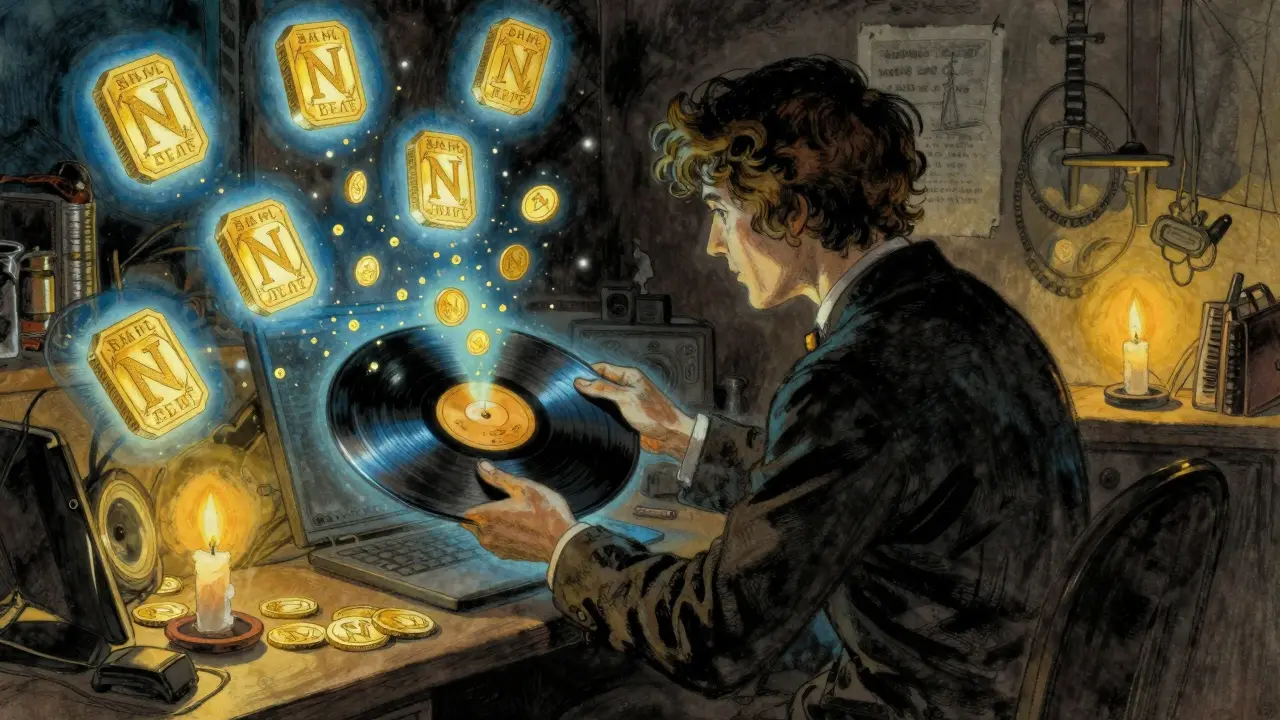
For decades, musicians have struggled to make a living from their music. Streaming services pay pennies per play-about $0.0043 per stream on average. Meanwhile, when a fan buys a vinyl record or a digital album, the artist typically sees less than a dollar. But what if an artist could keep earning every time their music changes hands? That’s the promise of NFT royalties for musicians.
What Are NFT Royalties for Musicians?
NFT royalties are automatic payments that go to the original creator every time their NFT is resold. Unlike traditional music sales, where the artist gets paid once and then loses control, NFTs let musicians earn a cut-usually between 5% and 10%-on every future sale. This isn’t a handshake deal or a contract signed on paper. It’s built into the blockchain using a smart contract, which is just code that runs automatically when certain conditions are met.
For example, if a musician mints a song as an NFT and sets a 7% royalty, every time someone resells that NFT, 7% of the sale price goes straight to the artist’s wallet. No label. No middleman. No waiting for a quarterly statement. The money arrives in minutes, often within 15-30 seconds on Ethereum, as long as the marketplace supports it.
How NFT Royalties Work Technically
Here’s how it actually happens:
- The artist uploads their music file-usually a high-quality WAV or FLAC-to a music-specific NFT platform like OneOf or a blockchain-based platform designed for musicians to tokenize songs and albums.
- They set the royalty percentage during minting. Most choose between 5% and 10%. Some go as high as 15%, though that can discourage buyers.
- The smart contract is written into the NFT’s metadata. This contract includes the artist’s wallet address and the agreed-upon royalty rate.
- When the NFT is sold again on a compatible marketplace, the smart contract triggers a payment. The buyer’s payment is split: the majority goes to the seller, and the royalty portion is sent to the original creator.
This system runs on blockchains like Ethereum, Solana, and Polygon. But Ethereum still dominates music NFTs, handling about 80% of all transactions, according to 2023 DappRadar data. That’s because Ethereum has the most mature infrastructure, even if gas fees can spike.
Why This Changes Everything for Musicians
Traditional music revenue is broken. A song with 1 million streams on Spotify might earn the artist $4,300. But if that same song is sold as an NFT for $100 and resold five times at $200 each-with a 7% royalty-that’s $70 in royalties from just those five sales. Multiply that by hundreds of resales, and you’re looking at income that outpaces streaming.
Real-world examples prove this isn’t theoretical. Kings of Leon’s 2021 NFT album release, When You See Yourself, brought in $2 million in primary sales. But the real win? Ongoing royalties from secondary sales that pushed total earnings far beyond what traditional album sales could deliver-where artists typically earn only $0.70 per physical or digital album sold.
Another standout case: musician RAC sold one NFT for $1,000. Over the next year, it changed hands 17 times. With a 10% royalty, RAC earned $17,000 in secondary income-17 times the original sale. That’s not luck. That’s structure.
The Big Problem: Royalties Aren’t Always Paid
Here’s the catch: NFT royalties only work if the marketplace enforces them. And not all do.
Platforms like Foundation and a curated NFT marketplace that requires creators to set royalties and enforces them automatically stick to the rules. But others-like LooksRare and OpenSea-let sellers bypass royalties by listing NFTs off-platform or using private sales. This is called “royalty enforcement evasion.”
One electronic musician from Wellington, who goes by BeatsByJen, minted 50 NFTs with an 8% royalty. She later found out that 60% of the secondary sales happened on marketplaces that ignored her smart contract. She lost over $3,000 in expected income.
Worse, some platforms have started offering creators alternative compensation. LooksRare, for instance, now shares 25% of its protocol fees with artists-basically saying, “We won’t enforce royalties, but here’s a slice of our revenue instead.” It’s a band-aid, not a fix.
That’s why artists like Tyler Hobbs have started blacklisting marketplaces that don’t pay royalties. It’s becoming a movement: creators are voting with their wallets, refusing to list on platforms that don’t honor their terms.
How Musicians Can Get Started
If you’re a musician wondering how to tap into this, here’s what actually works:
- Choose the right platform. Stick to music-specific NFT platforms like Royal or a blockchain platform that allows fans to buy fractional ownership in songs, with built-in royalty enforcement, OneOf or a music-focused NFT marketplace with strong artist support and royalty enforcement, or Catalog and a platform built for musicians to mint one-of-a-kind tracks with automatic royalties. These platforms are designed for artists and enforce royalties.
- Set your royalty rate wisely. 5%-7% is the sweet spot. Too high (like 15%) and buyers will walk away. Too low (like 2%) and you’re leaving money on the table.
- Use a wallet that supports Ethereum or Solana. MetaMask is the most common. Make sure you understand gas fees-on Ethereum, they can range from $1.50 to $15 depending on network congestion.
- Bundle your NFT with perks. The most successful music NFTs include things like exclusive access to live streams, unreleased demos, or even physical merchandise. Fans aren’t just buying a file-they’re buying a connection.
It’s not easy. Most musicians spend 20-30 hours learning the basics of wallets, blockchains, and smart contracts before they even mint their first NFT. But the payoff is real. A 2023 survey by MusicTech magazine found that artists using NFT royalties earned 3.5x more than their Spotify income from the same catalog.
The Future: What’s Next for Music NFTs?
The industry is evolving fast. In 2023, the Music NFT Alliance proposed a 5% minimum royalty standard. While it’s not mandatory, major platforms are starting to adopt it. By the end of 2024, 78% of music NFT platforms surveyed by Billboard said they’ll enforce royalties consistently.
New models are emerging too. Blocktones and a platform integrating NFT royalties with traditional music publishing systems, creating hybrid revenue streams are linking NFT royalties to publishing rights, so artists get paid even when their music is used in ads or films.
And then there’s DAOs. Artists like 3LAU are letting fans vote on how royalty income is used-funding tours, supporting other musicians, or even buying studio time. It’s not just money. It’s community.
Long-term, Bernstein analysts predict music NFT royalties will become a stable 10%-15% of artist income within five years. Not instead of streaming. Alongside it.
Final Thoughts: Is It Worth It?
NFT royalties aren’t magic. They won’t make every artist rich overnight. They require effort, technical understanding, and patience. But they’re the first real alternative to the broken streaming model that’s been squeezing musicians for over a decade.
If you’re an independent artist, this is your chance to take back control. You own your music. You set the terms. And if you pick the right platform and build real fan engagement, you can turn your catalog into a living, breathing income stream-one that grows every time someone resells your work.
The old system told you to wait for a label. The new system says: mint it yourself.
Do musicians really earn more from NFT royalties than from streaming?
Yes, in many cases. A single NFT with a 7% royalty can generate more income in a year than a song with 1 million streams. For example, if a song sells as an NFT for $100 and resells 10 times at $150 each, the artist earns $105 in royalties. On Spotify, 1 million streams at $0.0043 per stream equals $4,300-but that’s spread across hundreds of listeners. With NFTs, income is concentrated around a smaller group of dedicated fans who are willing to pay more than a cent per play.
Can I still release music on Spotify if I mint NFTs?
Absolutely. NFTs and streaming aren’t mutually exclusive. Many artists use NFTs to offer exclusive content, early access, or collectible versions of songs, while still releasing standard versions on Spotify, Apple Music, and YouTube. In fact, the most successful musicians treat NFTs as a premium fan experience, not a replacement for streaming.
What happens if I sell my NFT royalty rights?
You can sell the NFT itself, but the royalty rights are tied to the smart contract and stay with the original creator unless the contract is explicitly changed. Most platforms don’t allow royalty rights to be transferred. Even if you sell the NFT, you still earn royalties on future sales. That’s one of the key advantages-it’s built into the code, not the ownership.
Are NFT royalties legal?
The smart contract itself is legally enforceable as a digital agreement, but copyright law still applies. The U.S. Copyright Office clarified in May 2023 that owning an NFT doesn’t give you copyright to the music-it just gives you ownership of the token. So if you want to use the song in a film or ad, you still need a separate license. NFT royalties are about resale revenue, not usage rights.
Which blockchain is best for music NFTs?
Ethereum is still the most popular, with 80% of music NFTs built on it. But Solana is growing fast because it has lower fees and faster transactions. Polygon is another option for artists who want to avoid high gas costs. If you’re just starting out, choose a platform like OneOf or Royal-they handle the blockchain complexity for you.
Do I need to pay taxes on NFT royalties?
Yes. In most countries, NFT royalties are treated as income. If you earn $5,000 in royalties from resales, that’s taxable income. Keep detailed records of every sale, including the date, amount, and wallet address. Some artists use tools like Koinly or TokenTax to track crypto income automatically.
Jeff French
February 22, 2026 AT 14:05Michael Rozputniy
February 22, 2026 AT 21:02Shannon Black
February 24, 2026 AT 13:58Richard Cooper
February 26, 2026 AT 01:39Dee Resin
February 26, 2026 AT 17:50Tanvi Atal
February 27, 2026 AT 22:04Sony Sebastian
March 1, 2026 AT 12:46Brian Lemke
March 2, 2026 AT 14:03Megan Lavery
March 2, 2026 AT 17:02Mae Young
March 4, 2026 AT 14:56Trenton White
March 4, 2026 AT 16:24Cheryl Fenner Brown
March 6, 2026 AT 02:26Michael Teague
March 7, 2026 AT 09:16kati simpson
March 8, 2026 AT 03:03