
Imagine you hand over a brand-new laptop to a customer. They smile, walk out the door, and minutes later, your payment processor tells you the transaction was invalid. The money never arrived. In the physical world, this is impossible-you can’t hand over the same object twice. But in the digital world of Bitcoin is a decentralized cryptocurrency that relies on proof-of-work consensus to secure transactions without a central authority., it’s not just possible; it’s a known vulnerability called double-spending is the act of spending the same digital currency unit more than once by creating conflicting transactions..
If you run a business accepting crypto, or if you’re just curious about how blockchain security actually works under the hood, you’ve probably heard terms like "Race Attack" and "Finney Attack" thrown around. These aren’t sci-fi hacking plots from a movie. They are real, documented methods attackers use to trick merchants into giving up goods for worthless coins. Understanding them isn’t just academic-it’s the difference between getting paid and losing inventory.
What Is a Race Attack?
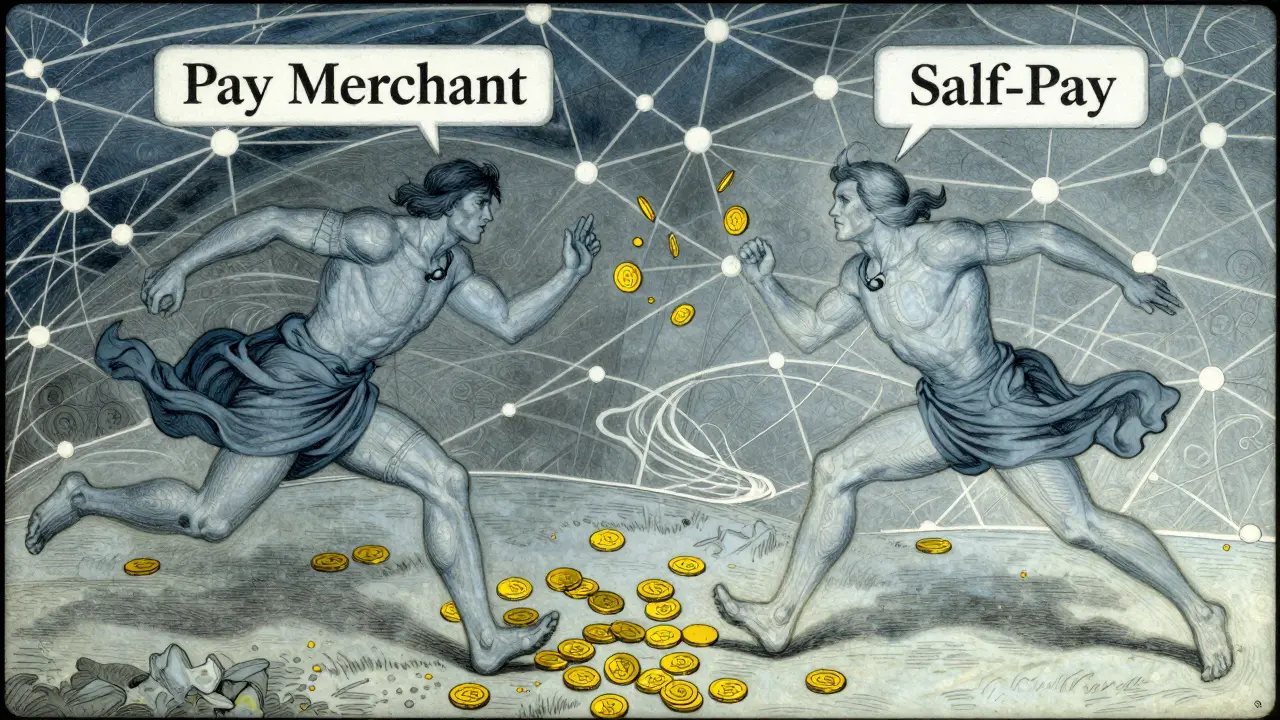
A Race Attack is a double-spending method where an attacker broadcasts two conflicting transactions simultaneously to exploit network propagation delays. sounds technical, but the concept is simple. It’s a game of speed against the network.
Here is how it plays out in real life. An attacker wants to buy something from you. They create two transactions using the exact same unspent transaction output (UTXO)-essentially the same digital cash:
- Transaction A: Sent directly to your node (your computer or point-of-sale system). This says, "I am paying you."
- Transaction B: Broadcast to the rest of the global Bitcoin network. This says, "I am sending this money back to myself."
The attacker sends Transaction A to you first because they have a direct connection. You see the transaction appear in your wallet software as "unconfirmed." Many merchants, especially those selling low-cost items like coffee or digital downloads, accept payments with zero confirmations to keep things fast. If you do, you might hand over the goods immediately.
Meanwhile, Transaction B spreads across the wider network. Miners pick up Transaction B, include it in the next block, and validate it. Because the network sees Transaction B as valid (and often prioritizes the one with higher fees), it gets confirmed. Transaction A-the one paying you-gets rejected as a duplicate. You now have no payment, and the attacker has their goods.
This attack doesn’t require supercomputers. According to research from Cornell University published in 2012, titled "Two Bitcoins at the Price of One," an attacker with control over the merchant’s node connection could succeed in over 85% of attempts. Even without that control, standard race attacks have historically succeeded in about 30% of cases against naive nodes. The key weakness? Your trust in an unconfirmed transaction.
What Is a Finney Attack?
The Finney Attack is a double-spending strategy named after Hal Finney, requiring the attacker to be a miner who pre-mines a block containing a self-payment before broadcasting a conflicting purchase. is different. While a Race Attack relies on luck and network timing, a Finney Attack requires power. Specifically, it requires the attacker to own mining hardware.
This attack is named after Hal Finney, one of Bitcoin’s earliest adopters and contributors, who theorized this specific vulnerability. Here is the step-by-step sequence:
- Pre-Mining: The attacker uses their mining rig to solve a block header. Inside this block, they include a transaction sending coins from their Wallet A to their Wallet B. Crucially, they do not broadcast this block to the network yet. They keep it secret.
- The Purchase: Once the block is solved, the attacker knows they have a "head start." They immediately go to a merchant and initiate a purchase using the same coins from Wallet A. They send this new transaction to the merchant.
- The Trap: The merchant accepts the payment based on zero confirmations and delivers the product.
- The Reveal: The attacker broadcasts their pre-mined block to the network. Since this block already contains the transaction from Wallet A to Wallet B, the network rejects the merchant’s transaction as a double-spend.
Why does this work? Because miners prioritize transactions in blocks they mine. By including their own transaction in a block before anyone else sees the merchant’s transaction, the attacker guarantees their version wins. The window for this attack is incredibly narrow-often just seconds. As noted in security guides updated in 2025, the attacker needs enough hash power to find blocks occasionally. Estimates suggest controlling at least 1% of the network’s total hash rate gives a reasonable chance of success. On Bitcoin, which had a hash rate of approximately 450 PH/s in early 2026, that’s a significant amount of energy and hardware investment.
Race Attack vs. Finney Attack: Key Differences
Both attacks result in the same outcome: you lose your goods, and the attacker keeps their coins. But the resources required and the likelihood of success differ wildly. Let’s break down the comparison so you can understand the threat level for your specific context.
| Feature | Race Attack | Finney Attack |
|---|---|---|
| Attacker Role | Any user with a wallet | Must be a miner with hashing power |
| Resource Cost | Low (internet connection) | High (mining hardware/electricity) |
| Success Rate | ~30% (standard) to 85% (controlled node) | Near 100% (if pre-mined block exists) |
| Time Window | Seconds to minutes | Seconds (extremely tight) |
| Primary Target | Merchants accepting 0-conf payments | Merchants accepting 0-conf payments |
| Detection Difficulty | Hard (looks like normal network lag) | Medium (requires monitoring mempool vs. blocks) |
The most critical distinction is accessibility. Anyone can attempt a Race Attack. Only a subset of users can attempt a Finney Attack. However, a Finney Attack is far more reliable if executed correctly. For high-value transactions, the Finney Attack is the greater theoretical threat because the miner controls the outcome. For low-value, high-volume transactions, the Race Attack is more common because it’s cheaper to execute repeatedly.
Why Zero Confirmations Are Dangerous
You might wonder why merchants ever accept zero-confirmation transactions in the first place. The answer is convenience. Bitcoin’s average block time is 10 minutes. Waiting for even one confirmation means waiting ~10 minutes. For a $5 coffee, that’s an eternity. For a digital download, it kills conversion rates.
However, the data shows this convenience comes with a price. According to Ledger Academy analysis from late 2025, the expected loss from Race Attacks for transactions under $100 is about $0.87 per $1,000 processed. That sounds small, but for thin-margin businesses, it adds up. For transactions over $10,000, the risk skyrockets to $84.30 per $1,000 processed. Why? Because attackers are motivated. No one spends thousands of dollars in electricity trying to steal a $5 latte. But they will try to steal a $50,000 car.
Real-world examples prove this isn’t hypothetical. In March 2025, a verified merchant on Reddit reported losing $450 worth of espresso machines due to a Race Attack during a period of network congestion. Their point-of-sale system accepted the initial transaction, but the conflicting transaction won the race. Conversely, discussions among professional miners reveal that successful Finney Attacks are rare-not because they don’t work, but because the ethical cost and technical precision required deter most honest participants. Still, the risk remains.

How to Protect Yourself From These Attacks
So, how do you stay safe? The golden rule of Bitcoin security is simple: never accept high-value transactions with zero confirmations. But what does that look like in practice?
- Set Confirmation Thresholds: Most modern payment processors allow you to set rules. Require 1 confirmation for transactions under $500. Require 3+ confirmations for anything over $5,000. This aligns with industry standards adopted by 92% of large crypto merchants as of 2026.
- Use Secure Node Configurations: If you run your own node, disable incoming peer connections from unknown sources. Manually specify 8-12 well-connected outbound nodes. This reduces the chance of an attacker feeding you a fake view of the network. Enterprise merchants using services like Coinbase Commerce have adopted this practice at a 76% rate.
- Leverage Risk Scoring Tools: Platforms like BTCPay Server offer "0-conf risk scoring." These tools analyze transaction patterns, fee levels, and input history to estimate fraud probability. In 2025, these systems reduced false positives by 63% while maintaining strong security.
- Consider Layer-2 Solutions: For instant, low-risk payments, the Lightning Network is a game-changer. It processes off-chain transactions that settle instantly and securely. By 2026, the Lightning Network handled 18% of all Bitcoin merchant transactions, bypassing the main chain’s confirmation delays entirely.
Regulatory bodies are also stepping in. The EU’s MiCA regulations, effective in 2024, require merchants to implement at least one blockchain confirmation for transactions exceeding EUR 100. The US Treasury’s 2025 guidance mandates risk-based confirmation requirements. Ignoring these isn’t just risky; it may soon be non-compliant.
The Future of Double-Spending Defenses
Is this problem going away? Not entirely, but it’s evolving. Bitcoin Core developers have implemented improvements like BIP 125 (Replace-By-Fee) and BIP 321 (Transaction Pinning), which make Race Attacks significantly harder by standardizing how transactions are propagated and replaced. As of late 2025, these protocols have made traditional Race Attacks "virtually impossible" on mature networks.
However, newer cryptocurrencies with smaller networks remain vulnerable. A 2026 analysis showed that 73% of altcoins with market caps under $100 million still face significant risks from both Race and Finney Attacks. If you’re dealing with lesser-known tokens, assume zero confirmations are unsafe regardless of the platform.
Looking ahead, protocols like Client-Driven Transaction Ordering (CDTO) aim to eliminate these vulnerabilities by allowing users to verify transaction order before settlement. But until universal adoption occurs, the advice remains unchanged: patience pays. Wait for the confirmations. The blockchain is designed to be slow to ensure it’s correct. Don’t let speed tempt you into insecurity.
Can I still get scammed if I wait for 1 confirmation?
For most practical purposes, 1 confirmation is very safe for small amounts. A Finney Attack specifically targets zero-confirmation transactions because the attacker broadcasts a pre-mined block immediately. Once your transaction is in a block (1 confirmation), reversing it would require a 51% attack, which is prohibitively expensive for Bitcoin. However, for very high-value transactions, waiting for 3-6 confirmations is recommended to protect against deeper chain reorganizations.
What is the difference between a Race Attack and a 51% Attack?
A Race Attack exploits network propagation delays and requires minimal resources, targeting only unconfirmed transactions. A 51% Attack requires controlling more than half of the network's total hashing power (approx. 22,500 PH/s for Bitcoin in 2026) to rewrite blockchain history, including confirmed transactions. Race Attacks are common fraud tactics; 51% Attacks are existential threats to network integrity that have never successfully occurred on Bitcoin.
Do Finney Attacks happen often in real life?
Successful Finney Attacks are extremely rare. They require the attacker to be a miner, solve a block privately, and then quickly interact with a merchant within a narrow time window. Most miners are ethical and have no incentive to damage the network's reputation. However, the theoretical possibility remains, which is why merchants should never rely on zero confirmations for valuable goods.
Is the Lightning Network immune to these attacks?
Yes, effectively. The Lightning Network uses bilateral channels secured by smart contracts and cryptographic signatures rather than immediate on-chain confirmations. Payments are settled instantly between parties, and only the final balance is recorded on the main blockchain. This architecture bypasses the zero-confirmation vulnerability entirely, making it ideal for microtransactions.
How many confirmations should I wait for?
It depends on the value. For transactions under $100, 1 confirmation is generally sufficient. For amounts between $100 and $1,000, wait for 2-3 confirmations. For high-value transactions over $10,000, the industry standard is 6 confirmations, as originally recommended by Satoshi Nakamoto. This balances security with user experience.