
Imagine holding Bitcoin in your portfolio and paying zero tax on the millions you made from it. Sounds too good to be true? In Switzerland, this is reality for private investors. While most countries hunt down every profit with aggressive capital gains taxes, Switzerland takes a different path. They don’t tax your profits; they tax your holdings. This distinction changes everything about how you manage your digital assets in the Alpine nation.
If you live in Switzerland or are considering moving there, understanding the wealth tax treatment of crypto is non-negotiable. It’s not just about compliance; it’s about optimizing your net worth. The system is transparent but strict. You declare what you have on December 31st, and that number determines your tax bill for the year. Whether you hold Bitcoin, Ethereum, or obscure altcoins, the rules are clear. Let’s break down exactly how this works, why it matters, and how to navigate the nuances without losing sleep.
The Core Principle: Wealth Tax vs. Capital Gains
Here is the biggest shock for many newcomers: Switzerland generally does not charge Capital Gains Tax (CGT) on cryptocurrency held as private wealth. If you bought Bitcoin at $20,000 and sold it for $60,000, that $40,000 profit is usually tax-free. Yes, really. This applies to stocks, bonds, and crypto alike. The government doesn’t care about your trading frequency or holding period if you are classified as a private investor.
Instead, the focus shifts to the Wealth Tax. Every year, on December 31st, you must declare the total value of all your assets. This includes cash, real estate, stocks, and yes, your entire crypto portfolio. The tax authorities assess your net worth and apply a percentage rate to it. This means even if your crypto value didn’t change, you still pay tax on its presence in your account. It’s a tax on possession, not performance.
This structure creates a unique incentive. Long-term holders benefit immensely because their tax burden remains low relative to potential gains. However, it penalizes those who sit on massive piles of idle crypto without generating income elsewhere. The key takeaway? Your strategy should focus on asset allocation rather than timing exits for tax reasons.
How Authorities Value Your Crypto Holdings
You might wonder, "Which price do I use?" With crypto prices fluctuating wildly by the minute, picking a valuation date seems tricky. Switzerland solves this with official guidance. The Federal Tax Administration (FTA) publishes specific year-end exchange rates for major cryptocurrencies like Bitcoin, Ethereum, Ripple, Bitcoin Cash, and Litecoin.
For these top-tier assets, you simply look up the FTA’s published rate for December 31st. No guessing, no arguing. But what about the thousands of other tokens? If the FTA hasn’t listed a rate for your specific altcoin, you must use the closing price from the trading platform where you primarily buy and sell that asset. This requirement forces you to keep meticulous records of which exchanges you use for which coins.
In rare cases where no reliable market price exists-perhaps for a dead project or an illiquid token-you declare the original purchase cost in Swiss Francs. This fallback ensures nothing goes undeclared, but it can sometimes undervalue or overvalue your actual position depending on when you bought in. Always prioritize the FTA list first, then your primary exchange data, and only fall back to cost basis as a last resort.
Cantonal Variations: Location Matters
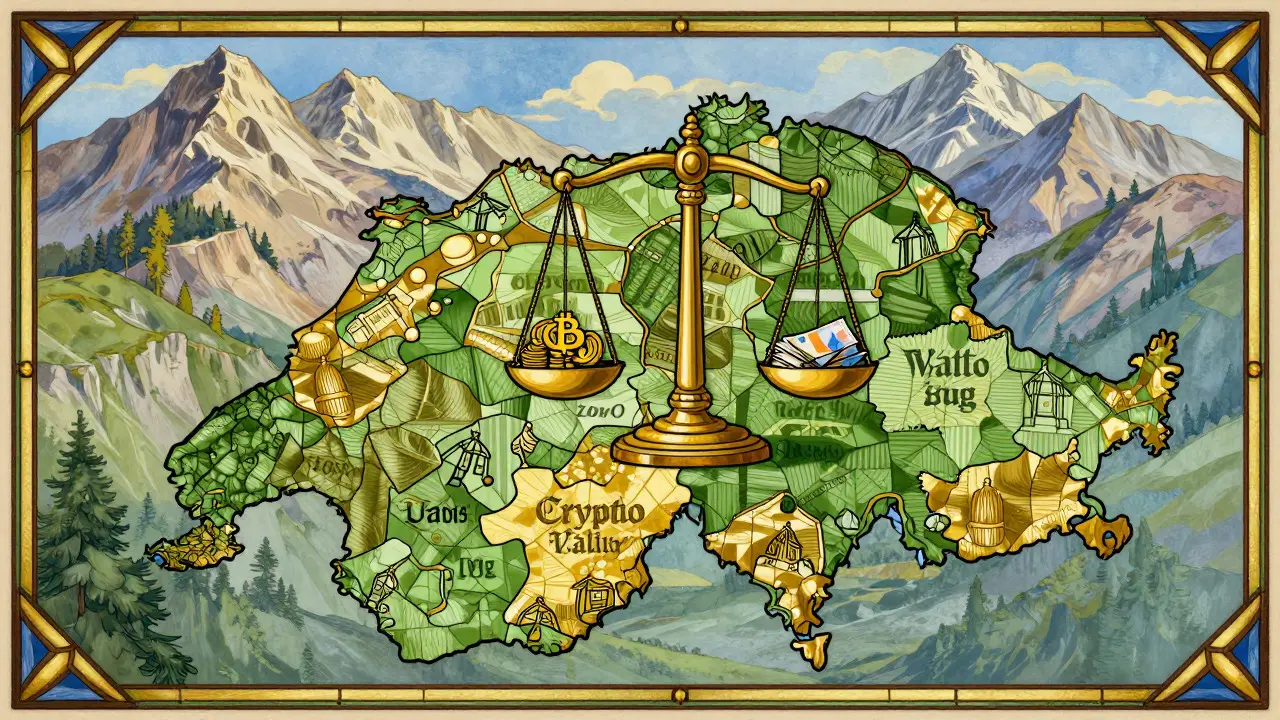
Switzerland isn’t a single tax zone. It’s a federation of 26 cantons, each with significant autonomy over tax rates. This is where strategic planning comes into play. Wealth tax rates vary dramatically between cantons. Some areas impose rates as low as 0.3%, while others might charge up to 1% or more on total wealth.
| Canton Type | Approximate Annual Rate | Impact on Crypto Holders |
|---|---|---|
| Low-Tax Cantons (e.g., Zug, Schwyz) | 0.3% - 0.5% | Highly attractive for large portfolios |
| Medium-Tax Cantons (e.g., Zurich, Geneva) | 0.5% - 0.8% | Balanced services and costs |
| High-Tax Cantons | 0.8% - 1.0%+ | Higher cost for holding large assets |
Living in Zug, often called "Crypto Valley," offers distinct advantages beyond community support. The canton has tailored its tax policies to attract digital asset businesses and wealthy individuals. Moving across a canton border can save you thousands annually if you hold significant crypto reserves. Before settling anywhere, check the current cantonal multiplier and base rates. These figures adjust slightly each year, so always verify with local municipal offices.
Private Investor vs. Professional Trader
The golden rule of "no capital gains tax" comes with a massive asterisk. It only applies if you are classified as a private investor. The Swiss authorities closely monitor trading behavior to identify professional traders. If you cross certain thresholds, you lose the exemption and face regular income tax rates on your profits.
What triggers the "professional" label? The Federal Tax Administration uses circular no. 36 guidelines. Key indicators include:
- High Trading Volume: Frequent buying and selling throughout the year.
- Leverage: Using borrowed funds to amplify positions.
- Derivatives: Heavy reliance on futures or options rather than spot holdings.
- Income Dependency: If crypto trading constitutes your primary source of livelihood.
If the tax office decides you’re a professional trader, your gains become taxable income. This combines federal, cantonal, and municipal income taxes, potentially pushing your effective rate above 30%. For active day traders, this risk is real. Many successful long-term holders stay under the radar by keeping turnover low and avoiding complex derivatives. If you trade actively, consider consulting a tax advisor to structure your activities carefully.
Token Classification and Regulatory Nuances
Not all crypto is treated equally. The Financial Market Supervisory Authority (FINMA) categorizes tokens into three main groups, and this classification influences tax treatment indirectly through regulatory status.
- Payment Tokens: Function like currency (e.g., Bitcoin). Treated as foreign currency for wealth tax purposes.
- Utility Tokens: Provide access to a service. Treatment depends on whether they function more like prepaid vouchers or securities.
- Asset-Backed Tokens: Represent claims against the issuer, similar to stocks or bonds. These align closely with traditional securities.
While the wealth tax calculation method remains consistent across types, the underlying legal framework differs. Asset-backed tokens might trigger additional reporting requirements if they resemble traditional securities. Utility tokens used purely for app access rarely cause issues unless they appreciate significantly and are traded frequently. Understanding your token type helps anticipate any extra scrutiny during audits.

Staking, Mining, and DeFi Income
Holding crypto generates wealth tax liabilities, but earning crypto generates income tax liabilities. This is a critical distinction many overlook. When you receive rewards from staking, mining, or lending platforms, these are considered taxable income at the moment of receipt.
Mining activities are generally viewed as business income if conducted regularly. You deduct costs (electricity, hardware) and pay income tax on the net profit. Staking rewards are typically treated as investment income. You report the fair market value of the received tokens on the day they hit your wallet. Later, when you sell those staked rewards, the sale itself is usually tax-free for private investors, provided you haven’t crossed the professional trader threshold.
DeFi interactions add complexity. Providing liquidity or farming yields requires careful tracking. Each reward distribution is an income event. Failure to report these small amounts adds up quickly during audits. Keep detailed logs of every transaction date, amount, and USD/CHF conversion rate at the time of receipt.
Practical Steps for Compliance
Compliance in Switzerland is straightforward if you prepare ahead. Here is a checklist to ensure you don’t miss anything during tax season:
- Snapshot Your Portfolio: On December 31st, take screenshots or export CSV files from every exchange and wallet. Include cold storage balances.
- Convert to CHF: Use the official FTA rates for major coins. For others, use your primary exchange’s closing price.
- Calculate Total Wealth: Sum up all crypto values along with other assets. Subtract any debts (like loans taken against crypto).
- Report Income: List all staking, mining, or lending rewards received during the year.
- Submit Declaration: File your annual tax return by the cantonal deadline, usually March or April.
Many investors use specialized software to automate this process. Tools that integrate with major exchanges can generate the necessary reports in Swiss formats. Manual entry is error-prone, especially with hundreds of transactions. Investing in a good tracker saves time and reduces audit risk.
Why Switzerland Remains Attractive
Despite the annual wealth tax, Switzerland remains a global hub for crypto enthusiasts. The predictability is unmatched. There are no sudden policy shifts, no ambiguous definitions, and no punitive exit taxes. The DLT Act, enforced since 2021, provides legal clarity for tokenized assets, fostering innovation.
Businesses benefit too. Companies holding crypto as inventory or treasury assets face corporate tax rates, but the environment supports growth. The combination of low wealth taxes for individuals and clear corporate structures makes Switzerland a magnet for both retail and institutional players. As digital assets mature globally, Switzerland’s stable approach likely keeps it competitive against jurisdictions with volatile tax regimes.
Do I pay tax on crypto profits in Switzerland?
Generally, no. Private individual investors are exempt from capital gains tax on cryptocurrency. However, you must pay wealth tax on the total value of your holdings as of December 31st each year.
How is the value of my crypto determined for wealth tax?
You use the official year-end exchange rates published by the Swiss Federal Tax Administration (FTA) for major coins. For lesser-known tokens, you use the closing price from your primary trading platform. If no market price exists, you declare the original purchase cost.
When am I considered a professional crypto trader?
The FTA looks at factors like high trading volume, use of leverage, derivative usage, and whether trading is your primary income source. If classified as a professional, your gains are taxed as regular income.
Are staking rewards taxable?
Yes. Staking rewards are considered investment income. You must report the fair market value of the rewards in Swiss Francs on the day they were received. Selling them later is typically tax-free for private investors.
Does the wealth tax rate vary by location?
Yes, wealth tax rates differ significantly across Switzerland's 26 cantons. Rates typically range from 0.3% to 1% annually. Choosing a residence in a lower-tax canton can reduce your overall burden.
Trista Dennis
August 29, 2026 AT 22:13Oh, how delightful to see another article pretending that 'zero tax' is the whole story while conveniently glossing over the wealth tax that eats you alive every single year regardless of whether your bags are green or red. It’s almost poetic how they frame paying for the privilege of holding assets as a benefit compared to actually earning income, which, let’s be honest, most people in this subreddit haven’t done since the last bear market.
Steve Sulley
August 30, 2026 AT 12:17but really tho who cares about swiss rules when we could just have no taxes at all like real freedom? the state taking cut of what you own is theft not investment strategy imo. if i hold bitcoin its mine why pay rent on my own money to gov that probably spends it on useless things anyway. seems like they just moved the goalpost from profit to possession to keep milking us sheep.
nic c
August 31, 2026 AT 15:30While the headline screams 'zero capital gains,' the devil, as always, resides in the excruciatingly detailed footnotes and the terrifying ambiguity of the 'professional trader' classification, which acts less like a clear legal boundary and more like a bureaucratic guillotine waiting to drop on anyone who dares to trade with any semblance of frequency or sophistication.
The FTA's circular 36 is a masterpiece of vague language designed to maximize discretionary power for tax auditors who likely wouldn't know a futures contract from a fruit basket, meaning that one bad month of high-volume trading could theoretically reclassify your entire life's work into taxable income retroactively, subjecting you to rates that make the US look like a paradise by comparison.
Furthermore, the valuation method for obscure altcoins relies on 'primary exchange closing prices,' which introduces a layer of absurdity where a token listed on a minor exchange with low liquidity can be valued arbitrarily, creating a discrepancy between your actual sellable value and your declared wealth, potentially forcing you to liquidate assets just to pay the tax on their paper value during a crash.
And don't get me started on the cantonal lottery; moving to Zug might save you pennies on the dollar, but the cost of living and the sheer exclusivity of those communities often outweigh the tax benefits unless you are already ultra-high-net-worth, leaving the middle-class crypto holder stuck in medium-tax purgatory with none of the perks.
Ultimately, this system doesn't eliminate taxation; it merely shifts the burden from realized events to unrealized holdings, penalizing long-term conviction and rewarding short-term speculation only until the auditor decides you're too active, creating a perverse incentive structure that rewards mediocrity and punishes excellence in market timing.
J Shepherd
September 1, 2026 AT 10:57Great breakdown! For those looking to optimize, remember that proper asset allocation and strict record-keeping are your best friends here. Don't let the fear of professional trader status paralyze you, but do keep an eye on your turnover ratios and avoid excessive leverage if you want to stay under the radar. Consistency is key!
Carey Thornton
September 1, 2026 AT 17:37It is truly amusing to witness the plebeians debating tax codes while the true aristocracy has long since established residency in the low-tax enclaves of Schwyz and Zug, treating these fiscal nuances as mere trivialities unworthy of their elevated intellects. The concept of 'wealth tax' is simply the price of admission for the civilized world, a tribute paid to maintain the infrastructure that allows such crude digital speculations to exist in the first place.
Linda Jevne
September 3, 2026 AT 00:58I find the philosophical implications of taxing existence rather than action quite fascinating. It suggests a worldview where potential energy is taxed, whereas kinetic energy (trading) is free. This mirrors certain Eastern philosophies where being is valued over doing. However, I wonder about the cultural friction this creates for American expats who are conditioned to view taxes solely as a penalty for success. How does this shift in mindset impact the community cohesion in places like Crypto Valley?
Jane yuan
September 4, 2026 AT 17:15America leads because we reward effort, not just sitting around hoarding coins like dragons. Switzerland is nice for the lazy rich, but we build empires here. Let them keep their small cantons and their tiny economies; we have the scale and the spirit that matters. Real wealth is created through hard work and innovation, not by hiding in a mountain valley avoiding the IRS.
David Powell
September 4, 2026 AT 19:20Sure, let's pretend that 'no capital gains tax' isn't offset by the fact that you're bleeding out via annual levies on assets that might never realize a profit. It's a clever illusion for those who enjoy watching their net worth shrink slowly due to administrative fees and wealth taxes, all while telling themselves they've 'won' against the system. How refreshing to be so intellectually bankrupt.
Ellie Brooks
September 6, 2026 AT 04:49This is such a game-changer for anyone seriously considering relocating! I love how transparent the process is, especially with the official FTA rates making it so much easier to calculate exactly what you owe without getting bogged down in complex formulas or guessing games. It really empowers investors to take control of their financial planning and focus on long-term growth strategies rather than worrying about short-term tax hits every time they make a move. Plus, the clarity around staking and mining rewards helps so much in understanding how different activities affect your overall tax liability, making it feel less like a mystery and more like a manageable part of investing. I'm definitely going to share this with my group chat because everyone needs to know about the canton differences before they make any big moves!
Alan Hawkins
September 7, 2026 AT 16:35Agreed on the importance of using software tools. Manual entry is a nightmare. Also, checking the municipal office for current multipliers is crucial because they change yearly.