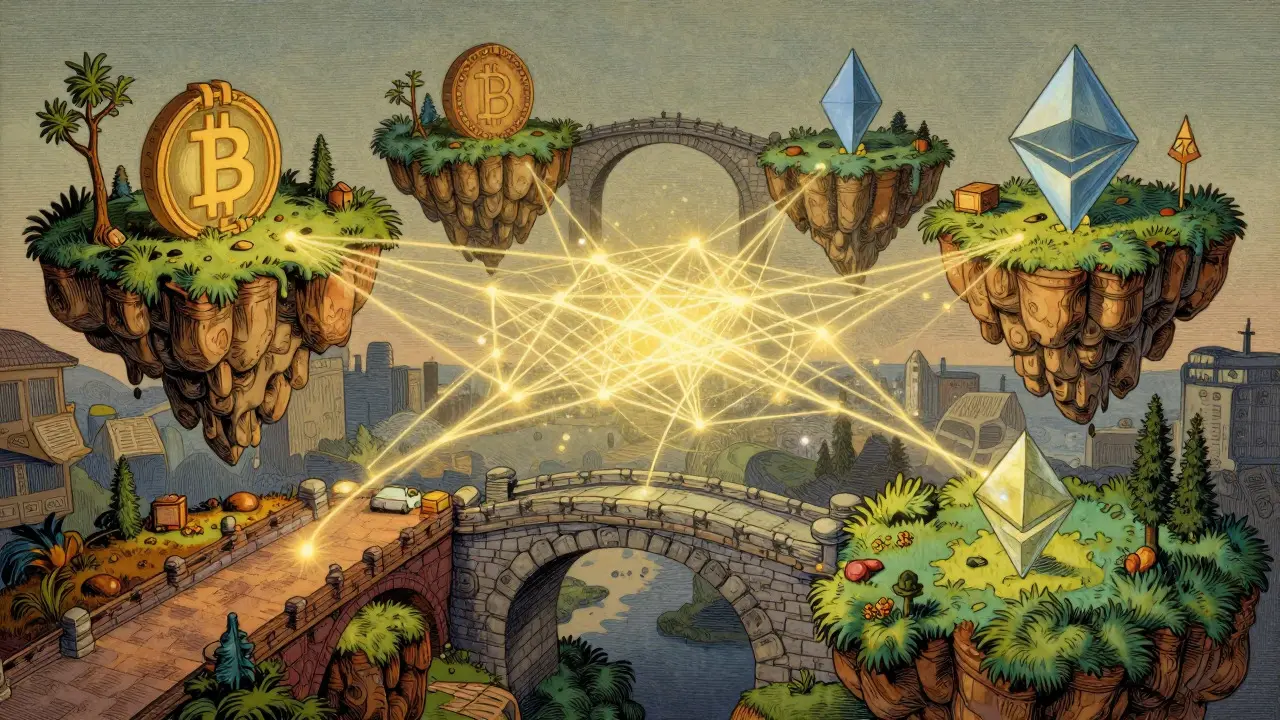
Imagine a world where your Bitcoin wallet talks directly to your Ethereum wallet without needing a middleman, a bridge, or a wrapped token. That is the core promise of Blocknet, a decentralized network designed to solve one of the biggest headaches in crypto: interoperability. If you have ever tried to swap assets between different blockchains and felt frustrated by high fees, slow confirmations, or the risk of trusting a centralized bridge, Blocknet offers a different path. It functions as an "Internet of Blockchains," allowing trustless communication and data exchange across disparate networks. This guide breaks down what Blocknet actually does, how the BLOCK token works, and why its technical approach sets it apart from other bridging solutions.
The Core Concept: Connecting Chains Without Middlemen
Most blockchain bridges work by locking tokens on Chain A and minting equivalent "wrapped" tokens on Chain B. This creates a dependency on the security of the bridge itself. If the bridge gets hacked, both sides suffer. Blocknet eliminates this single point of failure by enabling direct, permissionless communication between chains. It was created in October 2014, making it one of the earliest initiatives focused specifically on cross-chain functionality. The project launched via an Initial Token Offering (ITO) with no premine, ensuring a fair start for early adopters. Today, the protocol supports the construction of proofs of arbitrary strength about the state on any chain. This means users don't have to trust that a specific chain is secure; they can verify the data themselves through cryptographic proofs. This non-partisan design ensures that Blocknet doesn't privilege its own chain over others, decentralizing the interchain process itself.
How the BLOCK Token Powers the Network
The utility of the ecosystem is driven by the BLOCK token. It isn't just a speculative asset; it has clear functional uses. First, all fees for using the Blocknet Protocol are paid in BLOCK. These fees are distributed entirely to Service Nodes, which are the infrastructure providers keeping the network running. Second, standard transaction fees on the Blocknet blockchain are also paid in BLOCK and awarded to stakers. To operate a Service Node, you must lock up a minimum collateral of 5,000 BLOCK. Staking itself has no minimum requirement, but the network's structure naturally locks up a significant portion of the supply. On average, about 45% of tokens are locked as Service Node collateral, rising to roughly 60% when you include general staking funds. This high lock-up ratio reduces circulating supply volatility and aligns incentives for long-term holders.
Technical Specifications and Consensus Mechanism
Under the hood, Blocknet operates with a block time of 60 seconds, which is relatively fast compared to Bitcoin's 10-minute blocks. The network originally used Proof of Work (PoW) but transitioned to Proof of Stake (PoS), a consensus mechanism where validators stake tokens to secure the network instead of solving complex mathematical puzzles. This switch happened at block 2001, ending PoW operations permanently. The mining algorithm used during the PoW phase was Quark. Currently, the block reward is fixed at 1.0 BLOCK per block. While there is no hard maximum supply cap, there is a maximum inflation limit that controls how many new coins enter circulation. As of mid-2026, the circulating supply stands at approximately 12 million BLOCK tokens. The fixed reward structure provides predictability for stakers and Service Node operators, who can calculate their returns based on known variables rather than fluctuating emission rates.

Key Components: xbridge, xrouter, and BlockDX
Blocknet isn't just a single blockchain; it's a suite of tools. The most critical component is xbridge, which handles the actual cross-chain communication. Working alongside it is xrouter, which manages protocol routing to ensure messages reach the correct destination efficiently. For users who want cloud-based services, xcloud provides the infrastructure. However, the most user-facing application is BlockDX. Think of BlockDX as a desktop wallet that connects multiple compatible blockchains. You can link your Bitcoin, Ethereum, or other supported wallets within one interface. From there, you can execute trustless swaps without ever touching a wrapped token or relying on a third-party bridge contract. This simplifies the user experience significantly, turning complex cross-chain interactions into simple click-and-swap actions.
Market Position and Trading Reality
Let's talk numbers, because the market reality is quite different from the technical hype. BLOCK has experienced significant price volatility. Its all-time high was around 0.006998 BTC, while its low was 0.000075004 BTC. As of August 2026, the token is trading approximately 100% below its peak. The current market capitalization is roughly 2.3831 BTC, ranking it around #5629 on major trackers like CoinGecko. This low ranking indicates that Blocknet is a micro-cap asset, meaning it carries higher risk but also potentially higher upside if adoption grows. Liquidity is limited; the token trades on only 10 active markets, including platforms like LBank. Notably, it is not available on major exchanges like Coinbase or Crypto.com. Recent data shows a -1.00% decline in the last 24 hours but a 10.60% increase over the past week. The conversion rate against Bitcoin is currently 1 BLOCK = 0.00000019 BTC. Traders should be aware that due to low volume, slippage can be an issue, and platform gas fees will impact net returns.
| Attribute | Value |
|---|---|
| Consensus Mechanism | Proof of Stake (since block 2001) |
| Block Time | 60 seconds |
| Circulating Supply | ~12 Million BLOCK |
| Service Node Collateral | 5,000 BLOCK minimum |
| Primary Use Case | Trustless Cross-Chain Swaps (BlockDX) |
| Market Rank | #5629 (Micro-cap) |

Why Choose Blocknet Over Other Bridges?
The main competitor to Blocknet's model is the traditional "lock-and-mint" bridge. Those bridges require you to trust the smart contract code and the custodians holding the locked assets. Blocknet removes the custodian. By using cryptographic proofs, you verify the state of the other chain yourself. This is a fundamental shift from trust-based to trustless systems. For developers, this means building applications that can interact with multiple chains without worrying about bridge security audits. For regular users, it means safer swaps. If you are looking for a solution that prioritizes decentralization and security over speed or convenience, Blocknet fits the bill. It may not be the fastest or the most liquid option, but it offers a unique level of financial sovereignty in the cross-chain space.
Frequently Asked Questions
Is Blocknet a layer 1 or layer 2 solution?
Blocknet is primarily a layer 1 blockchain that acts as an interoperability protocol. It runs its own chain but connects to other layer 1 and layer 2 networks. It is not a scaling solution for a specific chain like Ethereum, but rather a connector between them.
Can I mine Blocknet today?
No. Mining (Proof of Work) ended at block 2000. The network now uses Proof of Stake. To earn rewards, you need to stake BLOCK tokens or run a Service Node with a 5,000 BLOCK collateral.
Where can I buy BLOCK tokens?
BLOCK is not listed on major US exchanges like Coinbase. You can find it on smaller exchanges such as LBank. Due to low liquidity, you might need to use a decentralized exchange or a peer-to-peer platform for larger trades.
What is the role of xbridge in Blocknet?
xbridge is the core technology that enables cross-chain communication. It allows data and value to move between different blockchains without wrapping tokens, using cryptographic proofs to ensure accuracy and security.
Is there a maximum supply for BLOCK?
There is no hard maximum supply cap. However, there is a maximum inflation limit that controls the rate of new token issuance. The current circulating supply is around 12 million tokens.
Sean Dalton
August 25, 2026 AT 15:10Oh, how delightful. Another 'interoperability' protocol that sounds like it was invented by a committee of confused accountants in a basement. The idea that we need a *new* chain to talk to other chains is the height of architectural incompetence. We have bridges, we have atomic swaps, and now we have Blocknet. It’s not innovation; it’s clutter. And don’t get me started on the 'trustless' label. If you have to lock up 5,000 tokens just to keep the lights on, you’re trusting the node operators not to run away with the goods. It’s a castle built on sand, dressed up in a tuxedo. I suppose the Irish are too polite to tell them it’s all a sham.
Rachel Etheridge
August 26, 2026 AT 16:34Omg wait this actually looks kinda cool?? i mean i always get so confused when i try to move my eth over to btc without paying like 50 bucks in fees. the fact that you can just do it without wrapped tokens makes my head spin a little but in a good way? also the part about the service nodes locking up 45% of the supply is wild. does that mean there is less inflation? i am trying to learn more about staking because everyone keeps telling me to hold but never explains why the locked supply matters. anyone else here actually use blockdx or is it just hype for now?
Emmanuel Ogbomo
August 27, 2026 AT 13:44It is interesting to observe how the market reacts to such niche solutions. While the technology promises a seamless flow of data between disparate networks, the reality of adoption remains a philosophical puzzle. Most users prefer the familiarity of centralized exchanges, even if it means surrendering some sovereignty. The transition from Proof of Work to Proof of Stake at block 2001 was a significant moment, marking a shift in energy consumption and validator incentives. However, without widespread developer adoption, these cryptographic proofs remain abstract concepts for the average investor. We must look beyond the token price and examine the actual utility being generated by xbridge and xrouter. The silence from major exchanges like Coinbase speaks volumes about institutional hesitation.
Ashwini Chaskar
August 27, 2026 AT 17:04You really think this is going anywhere. i mean seriously. the whole concept of 'trustless' is just marketing speak for 'we haven't been hacked yet'. every single bridge out there has a central point of failure whether you admit it or not. blocknet is no different. they just hide it behind fancy math. and let's not forget the liquidity crisis. trading on lbank? really. that is where the real investors go. not some obscure dex with zero volume. it is sad to see people falling for the same old narrative again. we have seen this movie before and it ends with the rug pull.
Sam Ariafar
August 28, 2026 AT 12:44The moral hazard here is quite evident. By creating a complex layer of intermediaries, we are essentially rewarding inefficiency. Why should we trust a system that requires such high collateral just to function? It feels like a barrier to entry designed to keep the common user out while the insiders profit from the fixed rewards. The lack of transparency in the governance structure is worrying. Who decides what gets connected next? Is it truly decentralized or is it a clique of developers making arbitrary decisions? We need to be vigilant about who benefits from this 'sovereignty' narrative.
Jane yuan
August 30, 2026 AT 12:03American ingenuity is often overlooked in favor of these foreign experiments. This project feels like it lacks the robust infrastructure we expect from US-based protocols. The low market cap is a red flag, suggesting that smart money has already moved on. We need standards, not experimental toys. Until this is listed on a major American exchange, it is just noise. Let us focus on building things that work within our regulatory framework rather than chasing phantom interoperability dreams.
Ian Munro
September 1, 2026 AT 03:56The technical specs are solid. PoS since block 2001. 60-second blocks. The mechanics are clear. The issue is execution. Low liquidity is the primary killer here. Without deep order books, slippage eats into any gains. The 5,000 BLOCK collateral requirement for service nodes creates a stable base but limits decentralization. It is a trade-off. Security vs. openness. For now, it remains a micro-cap curiosity. Watch the developer activity, not the price charts.
Kevin Payette
September 2, 2026 AT 00:59Let’s cut through the fluff. This is a classic 'solution looking for a problem.' Interoperability is a buzzword that sells whitepapers, not products. Look at the TVL (Total Value Locked) compared to competitors. It’s negligible. The team is busy building features nobody asked for while the core product struggles to find users. The 'trustless' claim is ironic given the reliance on service nodes. If a node goes down, your swap fails. That’s trust. Pure and simple. The market will correct this mispricing soon enough. Don’t say I didn’t warn you. 📉
Rebecca Springer
September 2, 2026 AT 22:19It is worth noting that while the technology is intriguing, the cultural aspect of cross-chain interaction is often ignored. Different blockchain communities have different norms and expectations. Blocknet attempts to bridge not just chains, but cultures. The challenge lies in aligning these diverse groups under a single protocol without imposing one community’s values on another. The success of such an initiative depends on respectful collaboration and clear communication. If the developers can foster an inclusive environment, the potential for growth is significant. Otherwise, fragmentation will continue to dominate the landscape.
J Shepherd
September 4, 2026 AT 10:36From a dev perspective, the xbridge architecture is actually pretty clean. Using cryptographic proofs instead of custodial locks is a smart move for security. The main hurdle is the UX. BlockDX needs to be as easy as MetaMask. Right now, setting up the service nodes and managing the collateral is a pain. If they can abstract that away, we might see real adoption. The fee model distributing to stakers is standard, but the 45% lock-up ratio is high. It reduces sell pressure, which is good for long-term holders. Keep an eye on their GitHub commits. That’s where the real signal is.
Steve Sulley
September 5, 2026 AT 22:16everyone says its a scam but i think its just misunderstood. the tech is there. the problem is people dont read docs. they just want quick flips. if you want to make money fast go buy memecoins. if you want something that actually works look at blocknet. the proof of stake switch was the right call. poW is dead anyway. stop complaining about the liquidity. its a microcap for a reason. it takes time. give it a few years and we will see. typical short term thinking.
Dave Worth
September 7, 2026 AT 01:04They are hiding something. Think about it. Why isn't this on Coinbase? Because the SEC is watching. Or maybe the big players don't want to lose control. The 'trustless' thing is a lie. It's all about who controls the nodes. You know who controls the nodes? The whales. They lock up the coins, manipulate the price, and dump on the retail. It's a game. A rigged game. But if you look at the code, you'll see the backdoors. They're planning to mint more coins later. No max supply means infinite dilution. Wake up people. 🕵️♂️🔍
Kelechi Precious Nwachukwu
September 7, 2026 AT 04:37This is a very important discussion. We must consider the global impact of such technology. In many developing nations, access to stable digital assets is crucial. Blocknet could provide a pathway for financial inclusion if the barriers to entry are lowered. The current collateral requirements are high for the average person. However, if the ecosystem grows, these costs may decrease. It is a journey. We must support innovation while remaining cautious. The potential for positive change is immense. Let us hope for the best outcome.
Valentine Okpala
September 8, 2026 AT 01:08Sarcastic aside, the tech is genuinely impressive for what it is. 🤔 The idea of verifying state across chains without wrapping is elegant. But let's be real, the UI/UX is still clunky. I've tried BlockDX and it took me twenty minutes just to figure out how to connect my wallets. If it were as smooth as Uniswap, we'd be talking about it differently. The lack of major exchange listings is a bottleneck, sure, but it also protects the early adopters from FOMO-driven volatility. It's a niche play. Not for everyone. But for those who care about true decentralization, it's a gem. 💎
Jillian Pye
September 9, 2026 AT 22:59:thinking: There is a profound question here about the nature of trust in digital systems. We often assume that removing intermediaries removes risk, but Blocknet shows that it merely shifts the risk to the validators. Are we truly better off? The philosophical implications of a 'non-partisan' chain are fascinating. It suggests a world where no single entity holds power, yet the network itself becomes the authority. This is a subtle form of centralization. We must reflect on what we value more: speed, convenience, or absolute sovereignty. The answer is rarely simple.
Jarnail Singh
September 11, 2026 AT 13:50Well, well, look at this little experiment. :smile: It is quite amusing to see the Western world struggling with basic connectivity while we in India are building entire ecosystems on top of existing frameworks. Blocknet tries to reinvent the wheel with its 'trustless' nonsense, but let us be honest, the real innovation is in the application layer, not the plumbing. The fact that it is ranked #5629 says everything. It is a toy for geeks who enjoy tinkering with code more than making money. But hey, if you want to feel smart, go ahead and stake those 5,000 tokens. Just remember, in the end, it is the mass market that dictates success, and they will likely ignore this until it is either too late or too successful to ignore. :shrug:
Trista Dennis
September 13, 2026 AT 02:57So, you're telling me I should trust a random protocol over my bank? Sure, because that's always worked out so well. The 'interoperability' angle is cute, but let's look at the track record. How many of these projects survive five years? Probably none. The team is full of buzzwords and empty promises. If they had a single major partnership, maybe I'd listen. But no, they're stuck in the dark ages of crypto development. Save your money. Buy gold. Or at least a decent index fund. This is a waste of time. 😒
Alan Hawkins
September 13, 2026 AT 22:54I think there is a lot of merit to what is being said here. The technical approach is sound, and the focus on security is appreciated. It would be great to see more educational resources for new users. The complexity can be daunting, but the potential is there. I am happy to help anyone who wants to understand the basics of how the service nodes work. Collaboration is key in this space. Let's build something together.
Linda Jevne
September 14, 2026 AT 04:31There is a poetic beauty in the idea of chains dancing together, exchanging secrets without revealing their souls. Blocknet acts as the choreographer, ensuring that every step is precise, every movement synchronized. Yet, like all art forms, it is subject to the whims of the audience. Will the masses appreciate the intricate ballet of cryptographic proofs? Or will they demand a simpler, louder spectacle? The tension between elegance and accessibility is the eternal struggle of innovation. Perhaps the true value lies not in the destination, but in the journey of connecting the disconnected. A vibrant tapestry of digital life, woven thread by thread.