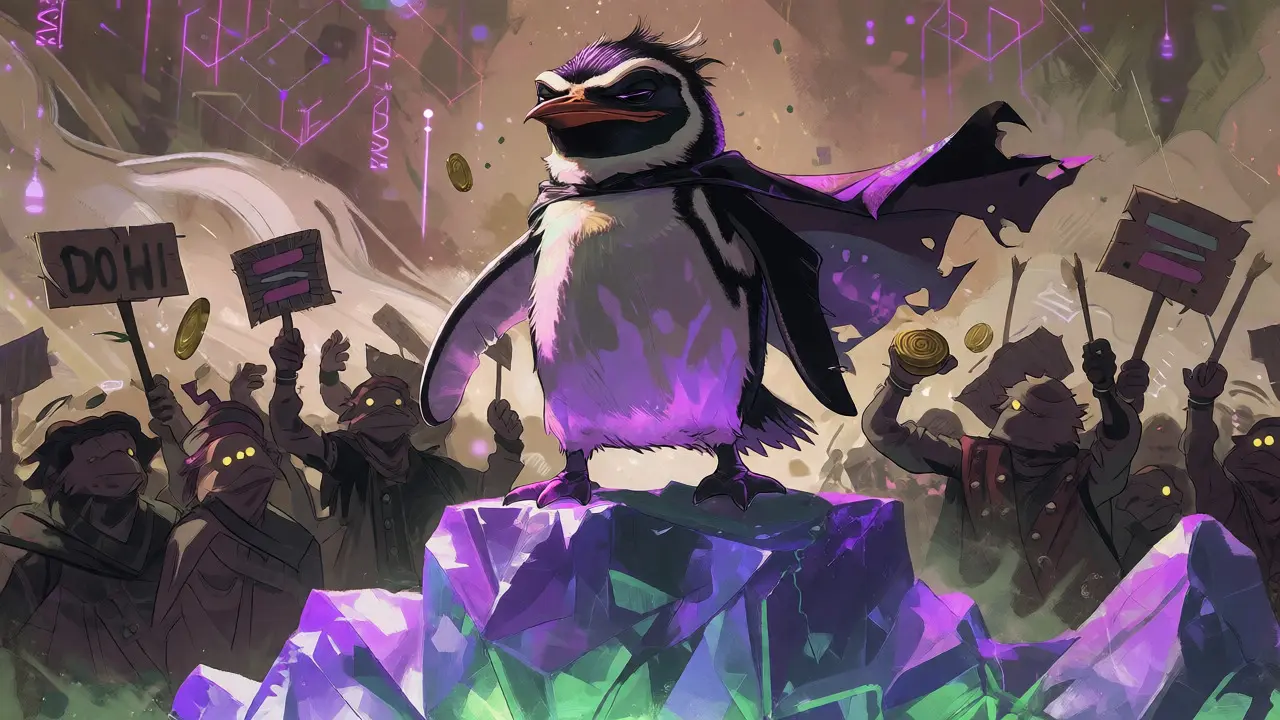
Ever seen a penguin that looks suspiciously like Pepe the Frog and wondered if it’s worth your money? That’s Peng (PENG), a penguin-themed meme cryptocurrency issued on the Solana blockchain. It’s not the famous Pudgy Penguins NFTs, and it’s definitely not a serious financial instrument with cash flow. It’s a speculative asset driven by community hype, internet culture, and the sheer speed of the Solana network.
If you are looking for a utility token that solves real-world problems, you might be barking up the wrong tree. But if you want to understand how tiny, high-risk assets move in the crypto ecosystem, PENG is a perfect case study. As of October 2026, it’s a small player with a market cap hovering around $216,000, but its history shows just how wild these rides can get.
The Quick Breakdown: What You Need to Know
- Identity: PENG is a meme token on Solana, distinct from the PENGU token associated with Pudgy Penguins.
- Supply: Approximately 100 million tokens are in circulation, with no new tokens being minted.
- Liquidity: Trading volume is extremely low, often under $10 daily on major trackers, making large trades difficult without moving the price.
- Risk Level: Extremely High. It lacks verified audits, clear roadmaps, or fundamental utility.
- Best For: Speculators who enjoy meme culture and can afford to lose their entire investment.
Decoding the Identity: PENG vs. The Rest
The first mistake people make is confusing PENG with other "penguin" projects. Let’s clear this up. There is Pudgy Penguins, a popular NFT collection with its own governance token called PENGU. Then there is PENG, which is purely a meme coin. Think of PENG as the chaotic cousin at the family reunion-fun, loud, but not really contributing to the family business.
PENG operates on Solana, a high-performance blockchain known for fast transactions and low fees. Technically, it is an SPL token, which is Solana’s equivalent of Ethereum’s ERC-20 standard. Its specific identity is locked to its mint address: A3eME5CetyZPBoWbRUwY3tSe25S6tb18ba9ZPbWk9eFJ. If you are trading this, always verify this string. Ticker symbols like "PENG" can be reused by different tokens on different chains, leading to costly errors.
The project launched publicly around March 2024. Unlike established cryptocurrencies backed by venture capital or corporate entities, PENG emerged from the decentralized exchange (DEX) environment. It was listed on Poloniex shortly after launch, giving it a brief moment of centralized exchange visibility, but it has largely retreated to decentralized venues like Raydium.
Market Reality: Price, Volume, and Volatility
Let’s look at the numbers. As of October 8, 2026, data from CoinGecko shows PENG trading at roughly $0.002164. This sounds cheap, but remember, there are nearly 100 million of them. The total market capitalization sits at approximately $216,361. To put that in perspective, that’s less than the cost of a decent luxury car. It’s a micro-cap asset, meaning it moves on very little money.
| Metric | Value | Context |
|---|---|---|
| Price | $0.002164 | Down ~99.9% from All-Time High |
| Market Cap | $216,361 | Rank #4801 on CoinGecko |
| Circulating Supply | ~100 Million | Fully circulating, no vesting cliffs |
| 24h Volume | $9.55 | Extremely illiquid; hard to exit positions |
| All-Time High | $2.14 | Reached in March 2024 |
The volatility here is brutal. PENG hit an all-time high of $2.14 in March 2024, right after its launch. Today, it’s down over 99%. If you had bought at the peak, you’d have lost almost everything. This pattern is classic for meme coins: a massive pump driven by social media hype, followed by a long, slow bleed as early buyers take profits and new buyers dry up.
One red flag is the trading volume. With only about $9.55 traded in the last 24 hours according to some trackers, liquidity is dangerously thin. This means if you try to sell $100 worth of PENG, you might crash the price significantly because there aren’t enough buyers on the other side. Slippage-the difference between the expected price and the executed price-can be huge.

Utility or Just Vibes?
Does PENG do anything? Honestly, no. There is no documented product, no software application, and no service that requires you to hold PENG. It doesn’t pay dividends, it doesn’t grant voting rights in a DAO (Decentralized Autonomous Organization), and it isn’t used for staking rewards in a meaningful way.
Its value proposition is entirely cultural. It leverages the popularity of two things: penguins and the meme aesthetic similar to Pepe, a iconic internet meme character often adapted into cryptocurrency tokens. The community behind it engages on X (formerly Twitter) through the handle @pengonsolana, sharing memes and jokes. In the world of meme coins, attention is the only utility. If the community stops talking about it, the price usually follows.
It’s important to note that unlike some projects that promise future utilities, PENG hasn’t released a detailed whitepaper outlining a roadmap for development. Searches for its official website, pengsol.xyz, sometimes lead to generic crypto analysis pages rather than a dedicated project hub, suggesting the team’s focus remains on marketing rather than building infrastructure.
How to Buy and Store PENG
Since PENG is primarily traded on decentralized exchanges, buying it requires a bit more setup than clicking "Buy" on Coinbase. Here is the typical workflow:
- Get a Solana Wallet: Install a wallet extension like Phantom, a popular browser-based wallet for the Solana ecosystem.
- Fund Your Wallet: Purchase SOL, the native currency of the Solana blockchain used for transaction fees, on a major exchange and send it to your Phantom address.
- Connect to a DEX: Go to a decentralized exchange aggregator like Jupiter or directly to Raydium, where the PENG/WSOL pool exists.
- Swap SOL for PENG: Paste the correct mint address (
A3eME5CetyZPBoWbRUwY3tSe25S6tb18ba9ZPbWk9eFJ) to ensure you are swapping for the right token. Adjust slippage tolerance higher (e.g., 5-10%) due to low liquidity. - Confirm Transaction: Approve the swap in your wallet. Remember, you need SOL for gas fees.
Be cautious. Because liquidity is so low, you should never invest money you can’t afford to lock up for a while. Exiting a position quickly might not be possible if the order book is empty.

Risks: Why PENG Is Not for Everyone
If you are new to crypto, PENG is a risky entry point. Here is why experts warn against treating it like Bitcoin or Ethereum:
- No Audit: There is no public record of a smart contract audit by a reputable security firm. This means the code hasn’t been independently checked for bugs or malicious functions like hidden minting abilities.
- Concentration Risk: While tracker data suggests ~23,950 holders, meme coins often suffer from whale dominance. If a few wallets hold a large percentage of the supply, they can dump their holdings and wipe out retail investors.
- Stale Data: Different sites report different volumes and prices. Always check multiple sources. A volume of "$9.55" could mean one trade happened recently, or it could be a glitch. Verify on-chain if possible.
- Reputation Risk: The project’s online presence is fragmented. Confusing websites and lack of transparent leadership make it hard to trust the team’s intentions.
Gate.io’s analysis from late 2025 explicitly labeled PENG as "ultra-speculative," noting a 94% annual decline. This isn’t a bug; it’s a feature of the meme coin lifecycle. Most die quietly. Only a handful survive to become cultural staples.
Final Verdict: Should You Watch PENG?
PENG is a ghost in the machine of the Solana ecosystem. It exists, it has a ticker, and it has a community, but it lacks the substance to sustain long-term growth without significant external catalysts. It’s a lottery ticket, not an investment.
If you love the meme and believe the community will reignite interest, it’s a fun play. But keep expectations grounded. Don’t expect it to reclaim its $2.14 high anytime soon. Treat any gains as a bonus, and assume the principal is at risk. For most beginners, sticking to established layers like Solana itself or major DeFi protocols offers a better balance of risk and reward.
Is PENG the same as Pudgy Penguins (PENGU)?
No. PENG is a standalone meme coin on Solana. PENGU is the token associated with the Pudgy Penguins NFT brand. They are completely different assets with different teams and goals.
Where can I buy PENG crypto?
PENG is primarily traded on decentralized exchanges (DEXs) on Solana, such as Raydium. It may occasionally appear on smaller centralized exchanges, but liquidity is highest on DEXs.
What is the maximum supply of PENG?
The total supply is capped at approximately 100 million tokens. According to current data, all of these tokens are already in circulation, meaning no new tokens will be created to dilute the supply.
Is PENG a good investment?
It is highly speculative. It has no fundamental utility, low liquidity, and high volatility. It is suitable only for experienced traders who understand meme coin risks and can afford to lose their entire stake.
Does PENG have a whitepaper?
There is no widely recognized, detailed technical whitepaper available for PENG. Most information comes from social media channels and exchange listings, which is common for simple meme tokens.