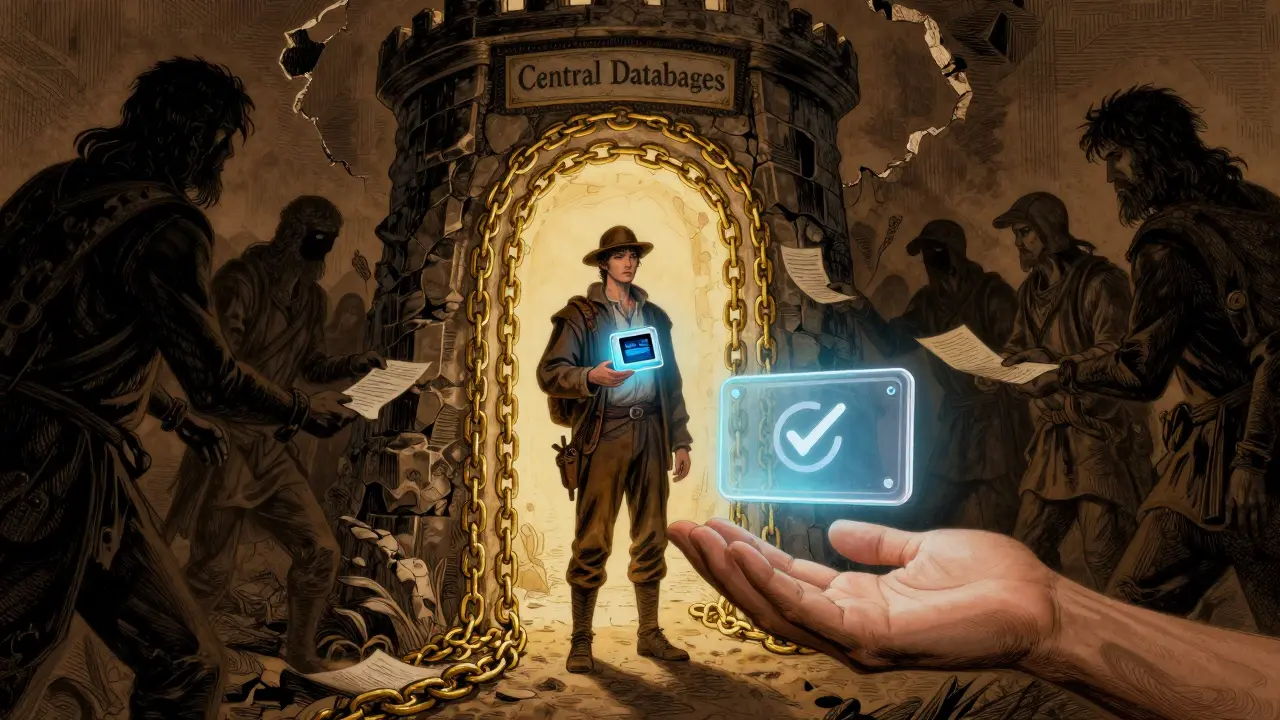
Think about how many passwords you’ve had to reset this year. How many times did you have to upload a photo of your ID just to open a bank account or sign up for a new service? Now imagine doing all of that without ever sending your passport, driver’s license, or social security number to anyone. That’s what blockchain identity authentication is starting to make possible.
What Is Blockchain Identity Authentication?
Traditional identity systems rely on companies or governments holding your personal data in centralized databases. Your passport details, birth certificate, or even your face scan might be stored on a server somewhere - and if that server gets hacked, your identity is at risk. The 2017 Equifax breach exposed 147 million people’s data because of exactly this flaw.
Blockchain identity flips that model. Instead of storing your personal data on a central server, it gives you control. You hold your identity in a digital wallet - like a crypto wallet, but for your personal credentials. These credentials are issued by trusted sources (like a government agency or university) and cryptographically signed so they can’t be faked. When you need to prove something - say, you’re over 18 - you don’t send your whole ID. You send a mathematical proof that you meet the requirement, without revealing any extra details. This is called a zero-knowledge proofa cryptographic method that allows one party to prove to another that a statement is true without revealing any information beyond the truth of that statement.
The backbone of this system is Decentralized Identifiers (DIDs)unique, resolvable identifiers that are not tied to a central registry, enabling users to control their own digital identities, standardized by the World Wide Web Consortium in 2022. These DIDs work across platforms, meaning your identity can be used for logging into a bank, buying age-restricted goods, or accessing government services - all without creating a new account each time.
Key Benefits of Blockchain-Based Identity
1. You Own Your Data
Right now, companies collect your data because they have to. You give them your address, phone number, and even your face - and they store it, sometimes sell it, and often get breached. With blockchain identity, you decide what to share and when. Your wallet holds your credentials. You choose to share a verified proof that you’re a citizen of New Zealand, not your entire passport scan. No more giving out your full birthdate just to sign up for a newsletter.
2. No More Passwords
Passwords are broken. They’re easy to guess, reuse, or steal. Blockchain authentication replaces them with cryptographic keys. Your private key - stored securely on your phone or hardware device - signs your actions. If you lose your phone, you don’t need to reset a password. You use a backup recovery phrase (like a crypto wallet) or a multi-factor recovery system built into solutions like 1Kosmos BlockIDan enterprise blockchain identity platform that uses biometrics and decentralized storage to secure digital identities. It’s not perfect, but it’s far more secure than typing ‘Password123’ for the tenth time this week.
3. Faster, Cheaper Verification
Traditional Know Your Customer (KYC) checks can take days. Banks, insurers, and government agencies often need to manually verify documents, cross-reference databases, and wait for third-party confirmations. Blockchain cuts that down. According to Consensysa blockchain software company that develops decentralized identity and financial applications (2023), optimized blockchain identity systems verify 98% of requests in under 2 seconds. Compare that to the 24-72 hours traditional KYC takes. Dock Labs (2025) found organizations using blockchain identity cut verification costs by 65% and cut processing time by 70%.
4. One Identity, Everywhere
How many accounts do you have? One for your bank, another for your email, a third for your gym, a fourth for your government portal. Each one asks for the same info: name, address, ID. Blockchain identity solves this. Once you have a verified credential - say, proof of your university degree - you can use it to apply for jobs, access student discounts, or even get a loan. No re-uploading documents. No re-verification. It’s like having a digital passport that works everywhere.
5. Built-In Security and Immutability
Blockchain doesn’t store your personal data on the chain itself. Instead, it stores cryptographic hashes - digital fingerprints - of your credentials. Any attempt to alter a credential breaks the chain. This makes fraud nearly impossible. If someone tries to fake a university transcript, the system instantly detects it. And because the system is distributed across hundreds of nodes, there’s no single point of failure. No more “server down” or “database hacked” scenarios.
Real-World Use Cases
Blockchain identity isn’t theoretical. It’s already in use.
- In Switzerland, the SwissCovida digital identity system developed to enable secure access to health services without centralized data collection platform lets citizens prove vaccination status without revealing their medical history. 92% of 50,000 users rated it positively.
- Financial institutions like J.P. Morgana global financial services firm that has piloted blockchain identity for mortgage applicant verification are using it to verify mortgage applicants. What used to take days now takes hours.
- Universities in Canada and Australia now issue blockchain-based diplomas. Employers can instantly verify a graduate’s credentials without calling the school.
- A New Zealand-based startup is testing blockchain identity for age verification at liquor stores. Instead of showing ID, customers use their phone to prove they’re over 18 - in under 15 seconds.
Challenges and Limitations
It’s not all smooth sailing.
First, key management is still hard for non-tech users. Losing your private key means losing access to your identity. On Reddit, users report being locked out after losing phones - and recovery isn’t always simple. Solutions are improving: multi-factor recovery, biometric backups, and social recovery (letting trusted contacts help restore access) are now common in enterprise systems.
Second, integration with old systems is tricky. Banks and governments still run on 20-year-old software. Connecting blockchain identity to legacy systems requires API gateways and custom middleware. Microsoft and IBM have built tools to help, but adoption is slow.
Third, regulation is catching up. The European Union’s eIDAS 2.0 regulation (effective 2026) legally recognizes blockchain identities. But in the U.S., only 22 states have passed laws supporting them. Without legal standing, businesses hesitate to adopt.
And then there’s the user experience. A European bank tried rolling out blockchain identity in 2023. Forty percent of users abandoned the process because the onboarding was too complex. The tech works - but if it’s not intuitive, people won’t use it.
Market Growth and Future Outlook
The numbers speak for themselves. The blockchain identity market was worth $1.23 billion in 2023. By 2028, it’s projected to hit $8.64 billion - a 46.7% annual growth rate, according to MarketsandMarkets (2024).
Adoption is strongest in:
- Financial services (42% of current deployments)
- Healthcare (28%) - for secure patient records and consent management
- Government (20%) - for citizen services, voting, and tax filing
Microsoft leads the enterprise space with 35% market share, thanks to its Entra Verified IDa Microsoft platform for issuing and verifying blockchain-based digital credentials. Open-source projects like Sovrin Networka decentralized identity network built on blockchain to enable self-sovereign identity for individuals and organizations and Hyperledger Indyan open-source framework for building decentralized identity systems are gaining traction in public sector projects.
Looking ahead, the next big step is integration with AI. The Decentralized Identity Foundation announced in April 2024 that adaptive assurance levels - where systems automatically adjust how strictly they verify you based on risk - will be standard by 2025. Quantum-resistant cryptography is also being built into new systems, preparing for future threats.
Gartner predicts that by 2027, 30% of consumer digital identities will be blockchain-based - up from just 5% in 2023. That’s not hype. That’s a shift in how we live online.
Getting Started
If you’re curious, you don’t need to be a developer to try blockchain identity.
- Download a digital wallet that supports DIDs - like Sovrin Walleta mobile application for managing decentralized identities and verifiable credentials or Microsoft’s IONa decentralized identity network built on the Bitcoin blockchain.
- Get a verifiable credential from a trusted issuer - like a university, government portal, or employer.
- Use it to log into a service that supports it. Some platforms already do: certain job boards, health portals, and even online gaming sites.
For businesses, start small. Pilot blockchain identity for one process - like onboarding new customers or verifying employee credentials. Use existing tools like IBM Verify Credentialsan enterprise blockchain identity solution that enables secure, verifiable credential issuance and validation or Docka blockchain-based platform for issuing and managing verifiable credentials to avoid building from scratch.
Final Thoughts
Blockchain identity isn’t about replacing the internet. It’s about fixing its biggest weakness: trust. Right now, we trust companies to protect our data. But we’ve seen time and again that they can’t. Blockchain doesn’t ask you to trust a company. It asks you to trust math - and that’s a lot more reliable.
The technology is here. The standards are set. The market is growing. The question isn’t if blockchain identity will become mainstream. It’s when - and who will be ready when it does.
Steven Lefebvre
March 7, 2026 AT 07:13And zero-knowledge proofs? Mind blown. You don't need to show your birth certificate to prove you're over 21. You just prove you are. That's not convenience-that's dignity.
nalini jeyapalan
March 8, 2026 AT 10:14Christina Young
March 10, 2026 AT 08:09Drago Fila
March 10, 2026 AT 08:28And yes, losing your phone sucks-but that’s why recovery options exist now. Social recovery, biometrics, backup codes. It’s not perfect, but it’s better than forgetting your password and having to call your bank at 2am.
Bonnie Jenkins-Hodges
March 12, 2026 AT 00:18Melissa Ritz
March 12, 2026 AT 00:38Cerissa Kimball
March 12, 2026 AT 09:31Basil Bacor
March 14, 2026 AT 05:37Nash Tree Service
March 16, 2026 AT 05:10Jane Darrah
March 17, 2026 AT 02:53Denise Folituu
March 17, 2026 AT 11:34