
Why Public Blockchains Are the World’s Least Private Diary
Bitcoin and Ethereum changed how we think about money - but they also made every transaction public. If you send 5 ETH to a friend, anyone can see the amount, the sender, and the receiver. This transparency is built into the system. It’s how trust works without banks. But it’s also why your financial history is permanently out there, searchable, and traceable. The Wilson Center called public blockchains ‘the world’s least private diary’ - and they’re right. Every coin you’ve ever moved, every exchange you’ve used, every DeFi swap - it’s all recorded forever.
That’s fine if you’re just buying coffee with crypto. But what if you’re paying rent in a country with strict capital controls? What if you’re a journalist sending funds to a source in a repressive regime? Or a small business owner who doesn’t want competitors knowing how much inventory you’re buying? Transparency becomes a liability. That’s where privacy protocols come in.
How Privacy Protocols Solve the Transparency Problem
Privacy protocols don’t break blockchain. They enhance it. They let you prove a transaction is valid - without revealing who sent it, who received it, or how much was sent. It’s like signing a check without showing your name or account number. The bank still knows the money moved, but no one else does.
There are two main ways this happens: on the base layer (Layer 1) and on top of existing chains (Layer 2). Layer 1 protocols like Monero and Zcash were built from scratch with privacy as the default. Layer 2 solutions like Aztec Network and Tornado Cash add privacy to blockchains that weren’t designed for it - like Ethereum.
Monero: Privacy by Default
Monero doesn’t give you a choice. Every transaction is private. That’s the point. It uses three tools to hide your activity:
- Ring signatures: Your transaction is mixed with 11 others. No one can tell which one is yours.
- Stealth addresses: Each payment goes to a one-time address only you can access. No public wallet addresses.
- Confidential transactions: The amount is hidden using cryptographic math called Pedersen commitments.
According to a 2021 study by Kwon et al., 98% of Monero transactions couldn’t be linked to a specific user. That’s the highest rate of any public blockchain. It’s not perfect - researchers have found ways to weaken privacy under extreme conditions - but for everyday use, it’s the most reliable option.
There’s a trade-off: Monero transactions are about six times larger than Bitcoin’s. That means slower processing and higher fees during busy times. But most users don’t notice. The system just works.
Zcash: Privacy You Have to Choose
Zcash is different. You can send either transparent transactions (like Bitcoin) or shielded ones (private). The problem? Most people stick with transparent. In 2023, only 2.3% of Zcash transactions used shielded addresses, down from 10.6% in 2018.
Why? Because shielded transactions are slow. Generating a zero-knowledge proof - called a zk-SNARK - takes around 40 seconds. That’s not practical for everyday payments. Also, managing viewing keys and shielded addresses adds complexity. Users on Zcash forums report feeling like they’re doing cryptography homework just to send money.
But Zcash isn’t giving up. Its 2022 Orchard upgrade cut proof generation time by 90%. If this trend continues, shielded transactions could become faster than transparent ones by 2026. That’s a big deal.
Layer 2 Privacy: Tornado Cash and Aztec
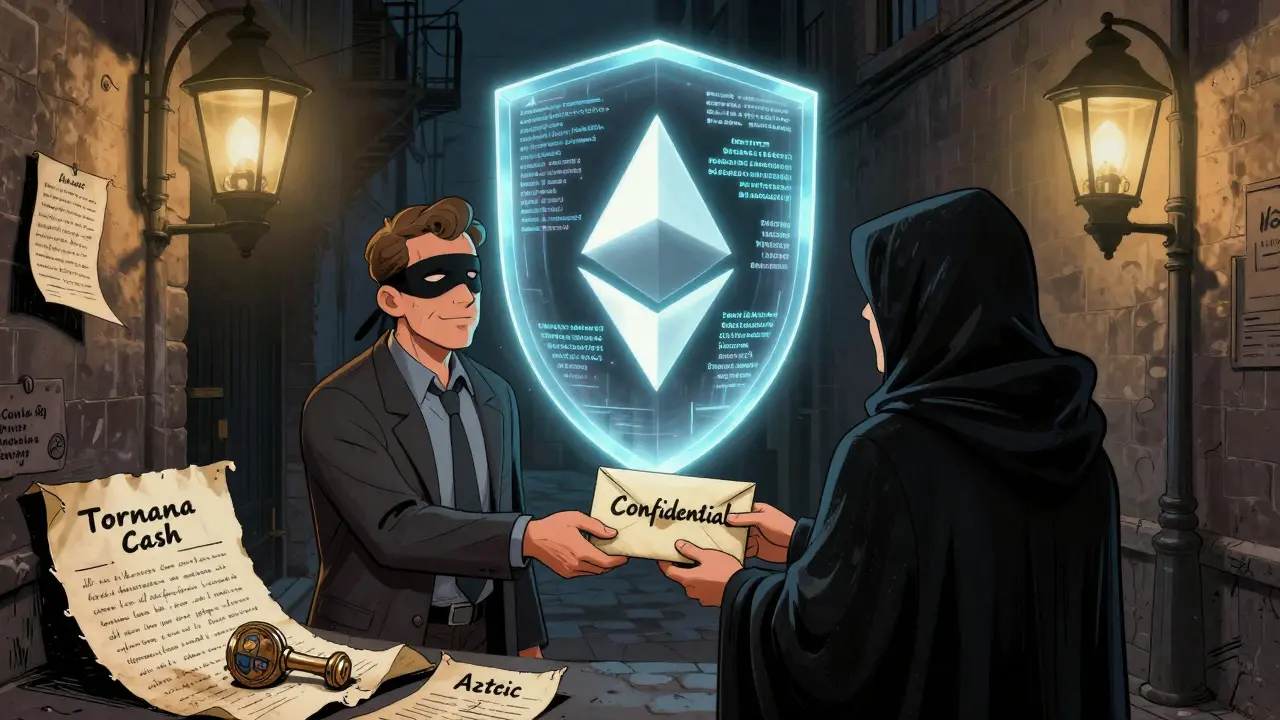
Tornado Cash was the most popular privacy tool on Ethereum. It let users mix their ETH with others, breaking the link between sender and receiver. Over $7 billion passed through it before the U.S. Treasury sanctioned it in August 2022. The government called it a money laundering tool. The developers called it open-source code protected by the First Amendment. The case is still in court.
Today, Aztec Network is one of the few surviving Layer 2 privacy solutions. It runs on Ethereum but processes transactions off-chain. It uses zk-Rollups and private function execution to keep everything hidden. Only a cryptographic proof of validity is posted to the main chain. That means low fees and fast speeds - but you need to understand smart contracts to use it. Developers are working on simpler interfaces, but it’s still early.
The Trilemma: Privacy, Speed, Decentralization
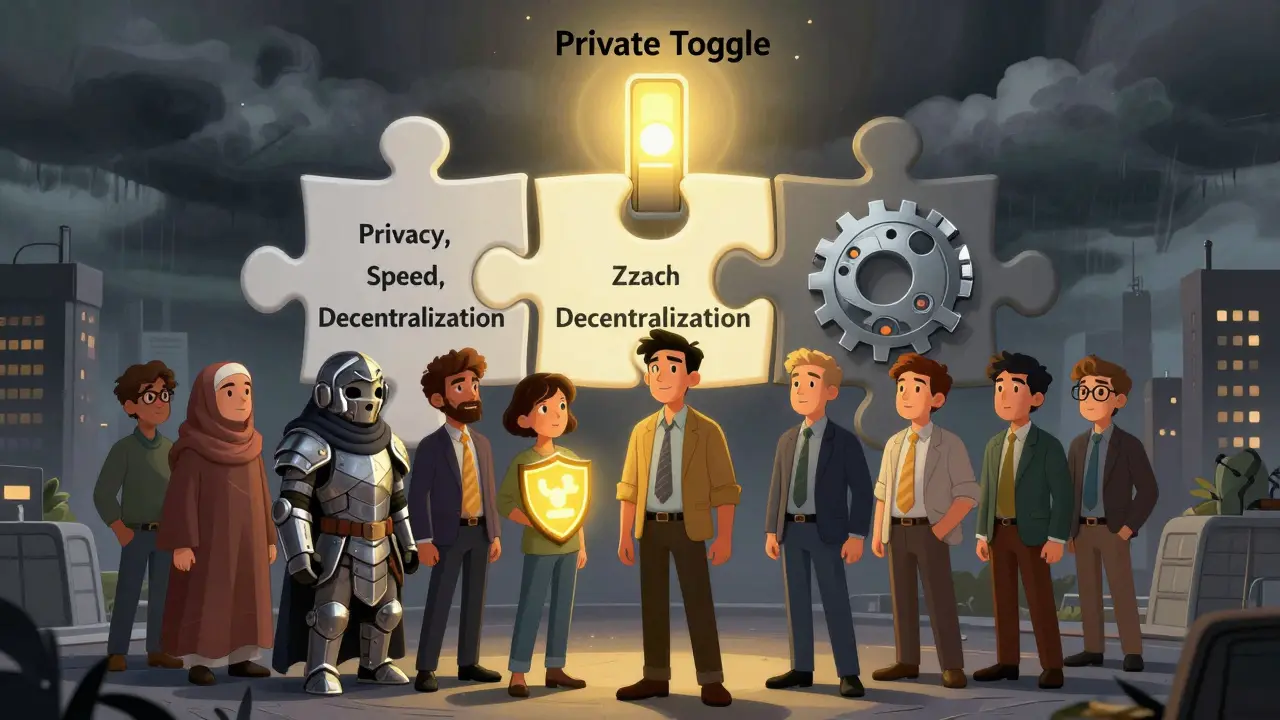
You can’t have all three. That’s the privacy trilemma, as Dr. Ari Juels put it. If you want strong privacy, you usually sacrifice speed or decentralization.
Monero is decentralized and private, but slow. Zcash is private and fast for transparent transactions, but shielded ones are slow. Layer 2s like Aztec are fast and private, but rely on centralized sequencers for now. No solution is perfect. The best you can do is pick the trade-off that fits your needs.
Real-World Use Cases - and Failures
Privacy tools aren’t just for criminals. The Dash Refugee Project used PrivateSend (a coinjoin tool) to send $427,000 to Ukrainian refugees without exposing their identities. That’s a legitimate, life-saving use.
But there are failures too. In 2021, researchers from the National University of Singapore de-anonymized 70% of Tornado Cash users by analyzing transaction timing and amounts. Even strong privacy can leak if you’re not careful.
And then there’s the human error. A 2023 guide from the BSV Skills Center found that 23% of privacy-related mistakes came from users losing or mismanaging viewing keys. One wrong click, and your private transactions become public.
Regulation Is the Biggest Threat
The biggest challenge for privacy protocols isn’t technology - it’s law. The EU’s MiCA regulation, effective in 2024, requires full transaction transparency. That directly conflicts with Monero and Zcash. The U.S. already sanctioned Tornado Cash. If other countries follow, privacy tools could be banned or forced to add backdoors.
Dr. David Chaum, the pioneer of digital cash, warns that most current protocols create a false sense of security. True privacy means complete unlinkability - and few protocols achieve that. The World Economic Forum warns that without clear rules distinguishing privacy tools from illicit ones, many projects could be shut down.
What’s Next? The Future of Private Blockchains
Change is coming fast. Zcash’s next upgrade could make shielded transactions faster than transparent ones. Ethereum’s PSE team is building Midnight, a dedicated privacy sidechain. Noir, a programming language for zero-knowledge proofs, is growing 300% year over year on GitHub.
By 2025, experts predict privacy will become a toggle - not a separate chain. Apps will let you choose: ‘Private’ or ‘Public’ - just like turning on encryption in your email. That’s the goal: make privacy as easy as turning on a light switch.
Dr. Alessandro Chiesa, a Zcash co-inventor, says the next generation of zero-knowledge proofs will be 100x faster. By 2026, private transactions might feel as fast as sending a text message.
Should You Use Privacy Protocols?
If you care about financial privacy - and you’re not trying to hide illegal activity - then yes. But know the risks.
- Use Monero if you want set-and-forget privacy. No choices. Just send.
- Use Zcash if you’re comfortable with complexity and want to mix public and private transactions.
- Avoid Tornado Cash - it’s sanctioned. Even accessing it could get you flagged.
- Try Aztec if you’re on Ethereum and want privacy without switching chains - but only if you understand smart contracts.
And always back up your keys. One mistake, and your privacy vanishes.
Market Growth and Developer Interest
Despite the risks, demand is rising. The global blockchain privacy market was worth $317 million in 2022. By 2027, it’s expected to hit $1.8 billion. Developer activity is growing faster than the rest of blockchain - 27% year-over-year growth in privacy-focused projects, compared to 19% overall.
Enterprise adoption is still low - only 12% of companies use privacy tools, mostly due to GDPR fears. But that’s changing. As regulators start to understand the difference between privacy and crime, tools like Monero and Zcash could become as normal as HTTPS.
Joseph Pietrasik
January 30, 2026 AT 04:22Raju Bhagat
January 31, 2026 AT 06:07laurence watson
February 1, 2026 AT 22:55Rico Romano
February 2, 2026 AT 21:19Crystal Underwood
February 3, 2026 AT 12:07Raymond Pute
February 5, 2026 AT 12:06Jack Petty
February 7, 2026 AT 06:51Meenal Sharma
February 8, 2026 AT 09:06mary irons
February 9, 2026 AT 06:30Wayne mutunga
February 10, 2026 AT 09:24Rob Duber
February 11, 2026 AT 04:57Joshua Clark
February 12, 2026 AT 18:54Brandon Vaidyanathan
February 13, 2026 AT 06:02Dahlia Nurcahya
February 14, 2026 AT 14:25Dylan Morrison
February 16, 2026 AT 02:36Akhil Mathew
February 17, 2026 AT 08:17