Imagine holding a single grain of sand from the Sahara Desert. That’s roughly what a Satoshi Stablecoin (SATS) represents: the smallest possible unit of Bitcoin, brought to life on the Ethereum network. If you’ve ever wondered how to use tiny fractions of Bitcoin in decentralized finance (DeFi) apps without wrestling with complex wrapped tokens, SATS might be the answer you’re looking for. But here’s the catch: despite its clever name and technical design, it’s not a traditional stablecoin pegged to the US dollar. Instead, it’s a digital representation of the satoshi itself.
This article breaks down exactly what SATS is, how it differs from other "Satoshi" branded projects, and whether this niche asset has a real future in the crypto ecosystem. We’ll look at the hard data, the confusing supply numbers, and the practical steps to actually get your hands on some.
The Core Concept: Tokenizing the Smallest Bitcoin Unit
To understand Satoshi Stablecoin (SATS), you first need to grasp what a satoshi is. A satoshi is named after Bitcoin’s creator, Satoshi Nakamoto, and equals 0.00000001 BTC. It’s the smallest divisible unit of Bitcoin, much like a cent is to a dollar. There are 100 million satoshis in one whole Bitcoin. With Bitcoin’s maximum supply capped at 21 million coins, there can theoretically never be more than 2.1 quadrillion satoshis in existence.
SATS takes this concept and wraps it into an ERC-20 token on the Ethereum blockchain. The core promise is simple: 1 SATS always equals 1 satoshi (or 1e-8 BTC). This allows developers and users to interact with Bitcoin’s smallest units directly within Ethereum smart contracts. Why does this matter? Because most DeFi applications on Ethereum speak the language of ERC-20 tokens. By converting satoshis into an ERC-20 format, SATS aims to let you lend, borrow, or swap these micro-Bitcoin units just as easily as you would with USDC or DAI.
Unlike fiat-backed stablecoins that try to hold a $1 value, SATS doesn’t have a fixed USD price. Its value floats entirely with the price of Bitcoin. If Bitcoin goes up, each SATS becomes worth more dollars. If Bitcoin crashes, SATS crashes too. It’s not a hedge against volatility; it’s a vehicle for accessing Bitcoin’s granularity on Ethereum.
Confusing Supply Numbers and Market Data
If you try to research SATS, you’ll hit a wall of contradictory data almost immediately. This isn’t necessarily a scam flag, but it does signal that the project is young, poorly documented, and lacks a centralized authority managing its public image. Let’s look at the discrepancies across major platforms as of late 2025 and early 2026:
| Platform | Circulating Supply | Total Supply | Max Supply | Price Status |
|---|---|---|---|---|
| CoinMarketCap | 100,000,000 | 100,000,000 | 2.1 Quadrillion | $0 (No active volume) |
| Bitget | 0 | 100,000,000 | 2.1 Quadrillion | $0.001174 (Low liquidity) |
| Crypto.com | N/A | N/A | 2.1 Trillion | $0.000737 (Not tradable) |
| CoinTracker | N/A | N/A | N/A | $0.000737 (Zero volume) |
Notice the conflict? CoinMarketCap says 100 million tokens are circulating, while Bitget says zero are. Crypto.com lists a max supply of 2.1 trillion, which is off by a factor of 1,000 compared to the theoretical 2.1 quadrillion limit derived from Bitcoin’s cap. These inconsistencies make it nearly impossible to calculate a reliable market capitalization. When aggregators disagree on basic facts like circulating supply, it usually means the token contract hasn’t been widely audited or adopted enough for data providers to agree on a single source of truth.
Furthermore, trading volume is virtually non-existent. While some platforms show a price feed, actual trades are rare. Bitget notes that SATS ranks around #8118 globally, explicitly stating that its value is "not widely recognized by the market." This low recognition translates to high slippage if you try to buy or sell large amounts, and potential difficulties in exiting positions quickly.
SATS vs. SATUSD: Don’t Mix Them Up
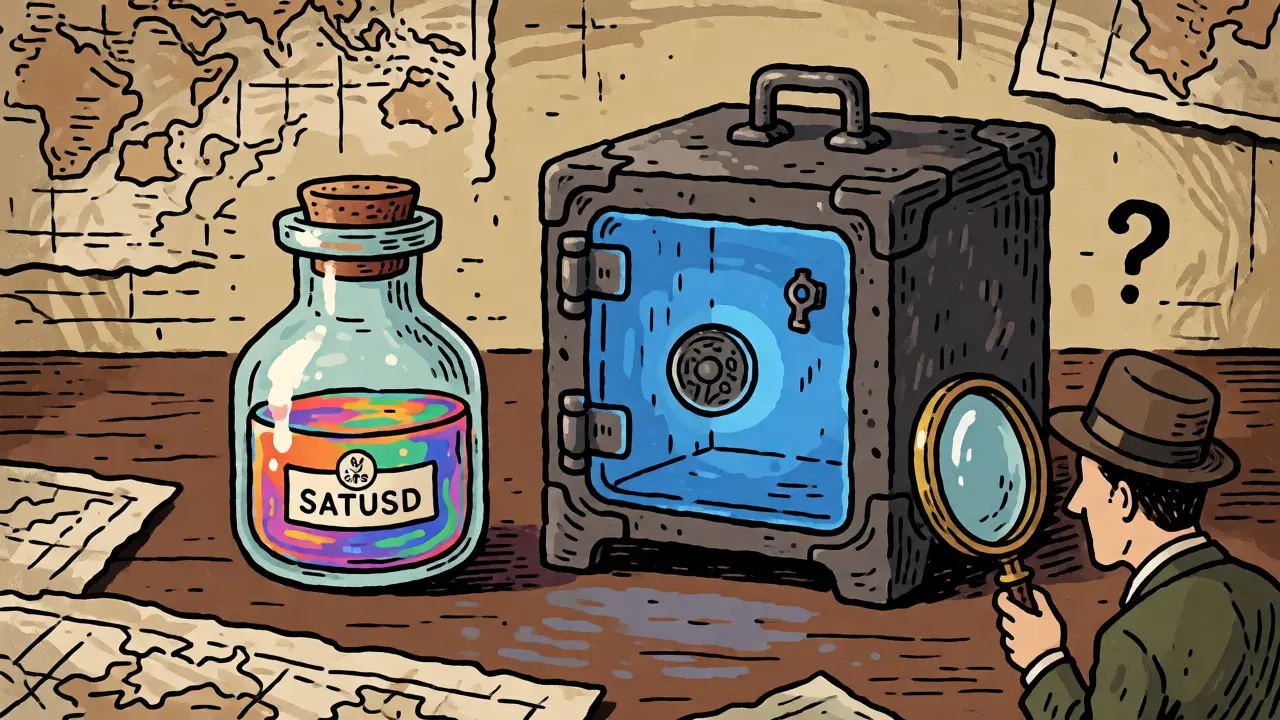
The biggest confusion in the market comes from two different projects using similar names. You must distinguish between SATS (the subject of this article) and Satusd (issued by Satoshi Protocol).
- SATS (Satoshi Stablecoin): An ERC-20 token representing 1 satoshi. It floats with Bitcoin’s price. It has negligible market cap and unclear team details.
- SATUSD (Satoshi Protocol): A Bitcoin-collateralized stablecoin pegged to $1. It uses a CDP (Collateralized Debt Position) model similar to MakerDAO, where you lock up BTC to mint SATUSD. It has a real market cap of ~$158 million and is listed on major exchanges with visible volume.
When people talk about "Bitcoin-backed stablecoins," they usually mean assets like SATUSD, not SATS. SATS is less of a financial instrument for hedging and more of a utility token for micro-transactions and specific DeFi integrations. Confusing the two could lead to bad investment decisions. If you want a stable store of value backed by Bitcoin, you’re likely looking for SATUSD or similar assets. If you want to trade fractional Bitcoin units on Ethereum, you’re looking at SATS.
How to Buy and Use SATS
You won’t find SATS on the main spot trading interface of Binance or Coinbase in the same way you find Bitcoin or Ethereum. Major centralized exchanges often list it only for informational purposes or via their Web3 wallet integrations. Here’s the realistic path to acquiring SATS:
- Set up a Web3 Wallet: Download a wallet like MetaMask, Binance Web3 Wallet, or Bitget Wallet. Ensure it supports the Ethereum mainnet.
- Fund Your Wallet: Deposit ETH or a stablecoin like USDT into your wallet. You’ll need ETH for gas fees regardless of what you swap.
- Connect to a DEX: Go to a decentralized exchange aggregator like Uniswap, SushiSwap, or the integrated swap feature in your wallet app.
- Swap for SATS: Search for the SATS contract address (verify this carefully on multiple sources due to fake tokens). Swap your USDT or ETH for SATS.
Because liquidity is thin, expect higher transaction costs relative to the small amount of tokens you receive. Buying $10 worth of SATS might cost $5-$10 in gas fees depending on Ethereum network congestion. This makes SATS impractical for small retail transactions unless you batch them or wait for Layer 2 solutions to potentially support it in the future.
Risks and Red Flags
Investing in SATS carries significant risks that go beyond standard crypto volatility:
- No Whitepaper or Team: Unlike established projects, SATS lacks a publicly available, detailed whitepaper explaining its governance, roadmap, or audit history. The founding team remains largely anonymous or undocumented in major aggregators.
- Liquidity Risk: With near-zero trading volume on centralized exchanges, selling large holdings could crash the local price temporarily. You might be stuck holding the bag if no buyers are present.
- Contract Risk: Without prominent audits mentioned in top-tier media, there’s always the risk of smart contract vulnerabilities. Always check the contract code on Etherscan before interacting.
- Brand Confusion: As noted, many users mistake SATS for SATUSD or even speculative meme coins like tSAT. This confusion can lead to poor liquidity pools and mispriced assets.
Is it a scam? Not necessarily. Many legitimate niche projects start with little marketing. However, the lack of transparency demands caution. Treat SATS as a high-risk experimental asset rather than a core portfolio holding.
The Future of Sat-Denominated DeFi
Why would anyone want SATS? The thesis rests on the idea that Bitcoin’s future lies in micro-payments and granular control. As Bitcoin Lightning Network adoption grows, users become accustomed to thinking in satoshis. Bringing that mindset to Ethereum DeFi allows for new types of yield strategies where you earn returns in satoshis rather than whole BTC.
For now, SATS remains a curiosity. It serves as a bridge for those who believe in the "sat" denomination but want to participate in Ethereum-based lending protocols. If a broader ecosystem of dApps starts integrating SATS specifically for tipping, gaming, or microlending, demand could rise. Until then, it sits in the shadows of larger, more liquid Bitcoin derivatives.
Is Satoshi Stablecoin (SATS) pegged to the US Dollar?
No. Despite the word "Stablecoin" in its name, SATS is not pegged to the USD. Its value fluctuates directly with the price of Bitcoin because 1 SATS equals 1 satoshi (0.00000001 BTC). If Bitcoin rises, SATS rises; if Bitcoin falls, SATS falls.
What is the difference between SATS and SATUSD?
SATS is an ERC-20 token representing a fraction of Bitcoin, floating with BTC's price. SATUSD is a separate asset issued by Satoshi Protocol, which is a Bitcoin-collateralized stablecoin pegged to $1. They are distinct products with different mechanisms and market caps.
Can I buy SATS on Binance or Coinbase?
Generally, no direct spot trading pairs exist on major centralized exchanges like Binance or Coinbase. You typically need to use a Web3 wallet (like Binance Web3 Wallet or MetaMask) and swap for SATS via a Decentralized Exchange (DEX) such as Uniswap.
Why do supply numbers for SATS vary so much?
Data providers like CoinMarketCap and Bitget report conflicting figures (e.g., 0 vs. 100 million circulating) because the token is illiquid and lacks official, transparent reporting from a central team. Aggregators rely on on-chain data and self-reported info, leading to discrepancies when activity is minimal.
Is SATS safe to invest in?
It carries high risk. There is no verified whitepaper, anonymous team, and very low trading volume. Smart contract audits are not prominently advertised. Only invest money you can afford to lose, and verify the contract address on Etherscan before purchasing.