Imagine trying to send money across borders in 2026, only to find that the digital bridge you relied on has been dismantled by government decree. For users in Russia and those dealing with sanctioned entities, this isn't a hypothetical scenario-it is daily reality. The landscape of cryptocurrency access has shifted dramatically due to aggressive international sanctions, turning what was once a decentralized haven into a heavily monitored checkpoint.
The core issue isn't just about 'crypto being banned.' It is about specific infrastructure-exchanges, wallets, and stablecoins-being targeted by agencies like the U.S. Department of the Treasury's Office of Foreign Assets Control (OFAC). When these entities are sanctioned, your ability to move funds doesn't just slow down; it can freeze entirely. Understanding how these restrictions work, who is behind them, and what alternatives have emerged is critical for anyone navigating this complex financial terrain.
The Fall of Garantex and the Rise of Grinex
To understand the current limitations, we have to look at Garantex, a Russian-operated cryptocurrency exchange that became a primary target for U.S. sanctions enforcement. Founded by Sergey Mendelev, Aleksandr Mira Serda, and Pavel Karavatsky, Garantex was designated by OFAC as early as April 2022 under Executive Order 14024. But the real heat turned up in 2025.
In March 2025, the U.S. Secret Service led an international operation that seized three Garantex domains, confiscated servers, and froze over $26 million in cryptocurrency. Co-founder Aleksej Besciokov was arrested in India. This wasn't just a slap on the wrist; it was a decapitation strike against the platform's operational capacity.
But here is where it gets tricky for users. In response to these disruptions, Garantex employees didn't pack up and leave. They immediately created Grinex, a successor exchange designed to continue operations and circumvent sanctions imposed on Garantex. Grinex explicitly acknowledged in its promotional materials that it was formed in response to the asset freezes affecting Garantex. Its goal? To let customers regain access to their accounts using the A7A5 token.
This cat-and-mouse game highlights a major challenge for sanctions enforcement: resilience. While one door closes, another opens almost instantly. However, the window for anonymity is shrinking fast.
| Feature | Garantex | Grinex |
|---|---|---|
| Status | Sanctioned (April 2022 & Aug 2025) | Sanctioned (August 2025) |
| Key Action | Domains seized, servers confiscated | Created as successor to bypass freezes |
| Primary Token | USDT (Tether) reliance | A7A5 (Ruble-backed stablecoin) |
| Leadership Risk | Co-founders arrested/designated | Linked to same executive team |
The A7 Network and the A7A5 Stablecoin
If Garantex and Grinex are the storefronts, the A7 Network, a group of companies including A7, A71, and InDeFi Bank linked to facilitating billions in crypto transactions for sanctioned entities is the plumbing. Since early 2024, Elliptic, a leading blockchain analytics firm, identified that companies linked to the A7 network had received $8 billion in cryptocurrency transactions. That number is likely a conservative lower bound.
Central to this ecosystem is the A7A5 stablecoin, a ruble-backed digital asset issued by a Kyrgyzstani firm, designed as an alternative to USDT to bypass sanctions. Why did this emerge? Because Tether’s USDT, while popular for its stability, is centralized. Tether can freeze wallets. When Garantex went offline in March 2025, users realized their USDT holdings were vulnerable if the exchange controlling the keys was compromised or sanctioned.
A7A5 offered a solution: a stablecoin pegged to the ruble, operating on TRON and Ethereum blockchains, that was harder for traditional banks to track initially. However, the playing field leveled again in August 2025. Elliptic announced they added support for screening A7A5 transactions. Suddenly, the 'invisible' money became visible again to compliance teams.
The timing is no coincidence. Unusual activity observed with A7A5 wallets around August 14, 2025-the same day OFAC re-designated Garantex and sanctioned Grinex-suggests a security breach or forced migration. It appears cryptographic keys may have been compromised, forcing a rapid infrastructure change. For users, this means that even 'alternative' stablecoins are not immune to surveillance and seizure.
How OFAC and Blockchain Analytics Are Closing the Net
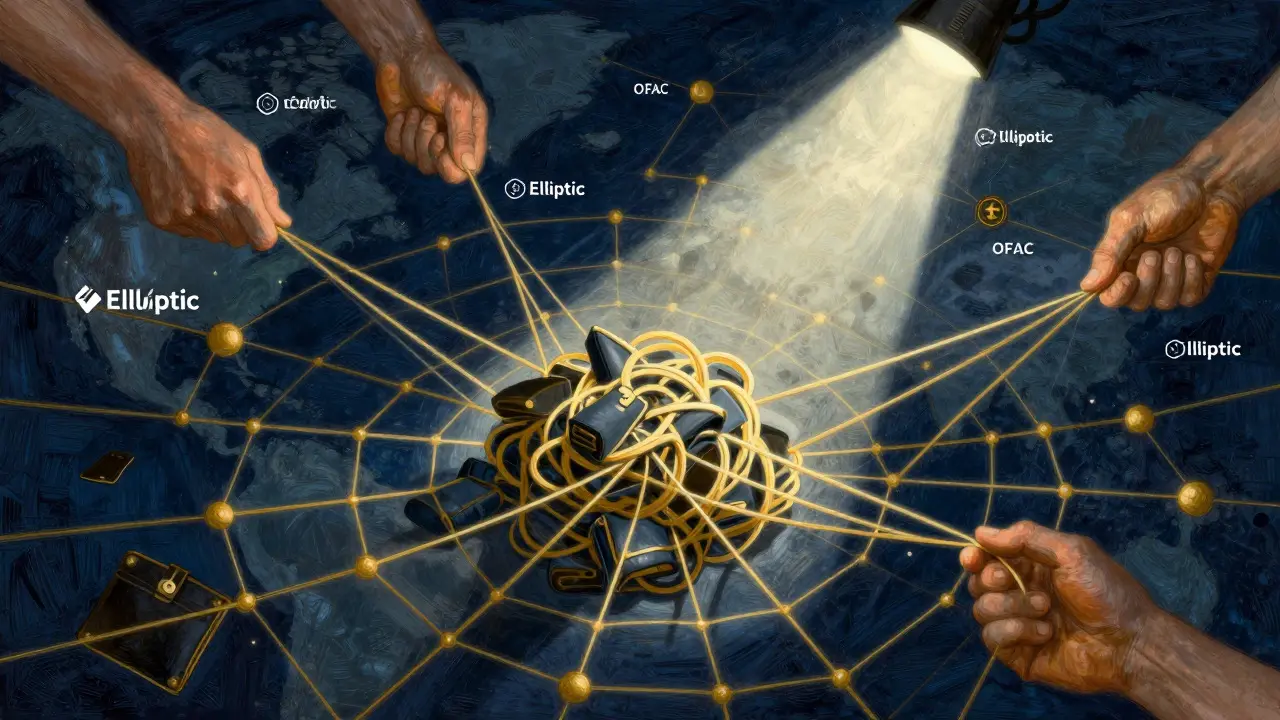
The old myth was that crypto equals anonymity. The data from 2025 and 2026 proves otherwise. The combination of OFAC sanctions, regulatory actions by the U.S. Treasury targeting specific entities and individuals involved in illicit financial flows and private-sector blockchain analytics has created a powerful enforcement net.
Elliptic’s technical analysis played a crucial role. They uncovered sophisticated wallet obfuscation techniques used by Garantex to hide assets. By mapping these patterns, they provided actionable intelligence to the U.S. Secret Service, enabling the freeze of $26 million in USDT. This isn't just theory; it's proven methodology.
Furthermore, the U.S. Department of State announced financial rewards totaling up to $6 million for information leading to the arrest of Garantex leaders, including up to $5 million for Aleksandr Mira Serda. This incentivizes whistleblowers and adds pressure from within.
For businesses and individual users, the implication is clear: if you are transacting through sanctioned exchanges or their successors, you are leaving a trail that can be traced back to you. Compliance software now flags A7A5 transactions, Grinex addresses, and associated wallets. Ignorance is no longer a defense when the tools to detect evasion are so advanced.
Practical Implications for Users and Businesses
So, what does this mean for you in July 2026? If you are holding assets on platforms linked to the A7 network or recently sanctioned exchanges, your risk profile has skyrocketed.
- Asset Freezes: If your exchange is sanctioned, your funds may become inaccessible overnight. We saw this with Garantex in March 2025.
- Secondary Sanctions: Even if you aren't Russian, interacting with sanctioned entities can expose you to secondary sanctions. Banks and non-sanctioned exchanges will de-risk quickly.
- Stablecoin Volatility: Relying on niche stablecoins like A7A5 carries counterparty risk. If the issuer is sanctioned or hacked, the peg can break.
- Compliance Costs: For businesses, integrating deeper KYC (Know Your Customer) and blockchain screening is no longer optional. It is essential for survival.
The strategic shift here is from broad sectoral sanctions to targeted entity dismantling. OFAC isn't just blocking Russia; it is blocking the specific pipes-Garantex, Grinex, A7-that keep the flow going. And they are getting better at plugging those pipes before new ones can be fully established.
Navigating the Future: What Comes Next?
Will new exchanges pop up? Absolutely. The incentive to move money is too high. But the cost of doing so is rising. Each new platform faces immediate scrutiny from firms like Elliptic and regulatory bodies like OFAC. The lag time between launch and sanction is shrinking.
Users need to prioritize transparency and compliance over convenience. Using regulated, non-sanctioned exchanges with clear audit trails is safer than chasing the latest 'uncensored' platform. Remember, the $8 billion flowing through the A7 network wasn't hidden forever. It was mapped, analyzed, and targeted.
The geopolitical context also matters. With statements from global leaders linking economic sanctions to ceasefire agreements, the pressure on Russian financial infrastructure will likely intensify, not ease. Crypto remains a tool, but it is no longer a shield.
Is Grinex safe to use in 2026?
Grinex was designated by OFAC in August 2025 as a successor to Garantex. Using it carries significant risk of asset freezing and potential secondary sanctions for non-Russian users. It is considered high-risk.
What happened to Garantex?
Garantex was first sanctioned in 2022. In March 2025, its domains were seized, servers confiscated, and over $26 million frozen. It effectively ceased normal operations, leading to the creation of Grinex.
Can I still use A7A5 stablecoin?
While technically possible, A7A5 transactions are now screened by major blockchain analytics firms like Elliptic. Holding or transferring large amounts may flag your wallet for compliance reviews.
Who are the key figures behind Garantex?
Key figures include Sergey Mendelev, Aleksandr Mira Serda, and Pavel Karavatsky. All were designated by OFAC in August 2025, with bounties placed on some for information leading to their arrest.
How do blockchain analytics firms help enforce sanctions?
Firms like Elliptic map transaction patterns, identify wallet clusters, and reveal obfuscation techniques. They provide law enforcement with the data needed to trace and freeze illicit funds, making anonymous evasion increasingly difficult.